Why APNT Matters
Modern operations in defense, military, and maritime environments depend on precise positioning, navigation, and timing. GPS and GNSS have been the backbone of these services for decades, but they are increasingly vulnerable.
Jamming overwhelms or blocks GNSS signals, causing position data to become unavailable or unreliable. Spoofing is more deceptive: false signals can make a receiver calculate and display a plausible but incorrect position, potentially without an obvious loss of service. Even without hostile interference, GPS performance suffers in urban canyons, at high latitudes, or during operations in contested areas. For mission critical systems and commercial maritime operators, losing trusted timing and positioning is unacceptable.
Assured PNT (A-PNT) via Iridium PNT addresses this problem by providing an independent, authenticated source of position and timing that can be used when conventional GNSS information is degraded, unavailable or cannot be trusted.
The key difference is independence. Many GNSS resilience technologies are designed to protect, strengthen or validate GNSS reception. A-PNT takes a different approach: it provides a separate source of position and timing that can be compared with GNSS-derived information.
Iridium PNT
Ground Control’s A-PNT solutions are built on Iridium’s Positioning, Navigation and Timing service, Iridium PNT. The constellation of 66 Low Earth Orbit (LEO) satellites provides overlapping global coverage, including the polar regions.
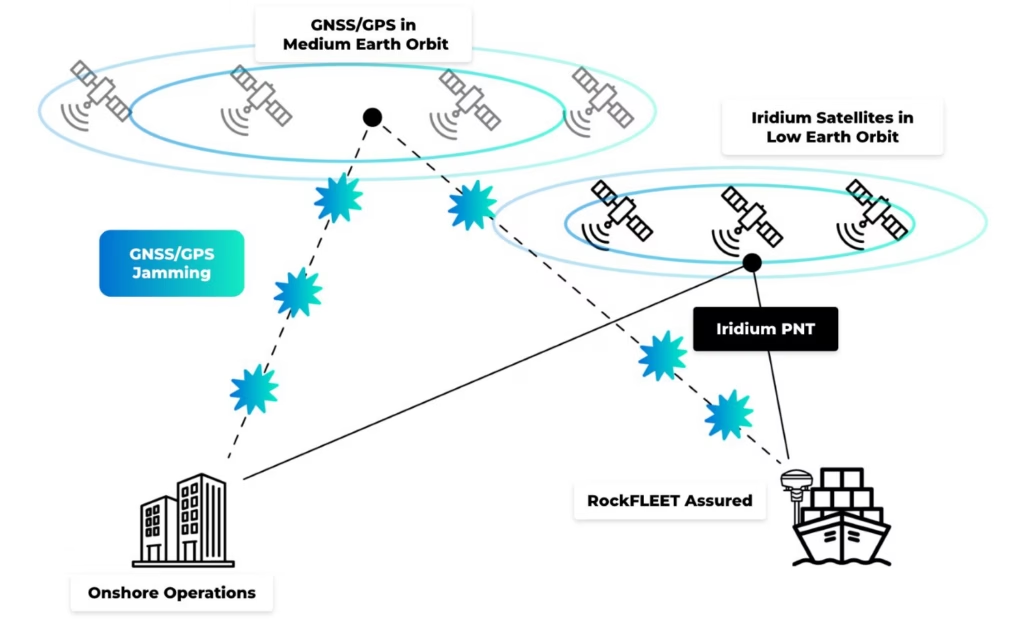
Unlike GNSS satellites in Medium Earth Orbit (MEO), Iridium satellites operate in Low Earth Orbit and provide PNT signals that can be up to approximately 1,000 times stronger than GNSS signals at the Earth’s surface.
This stronger received signal, combined with Iridium’s Low Earth Orbit architecture and operation in different spectrum from GNSS, provides an independent PNT source with different characteristics and vulnerabilities from conventional GNSS.
By delivering A-PNT signals independently, but alongside GPS and GNSS, Iridium creates an independent and resilient timing and navigation layer. For maritime shipping, defense operations, and other critical missions, this means trusted positioning and synchronization anywhere on Earth, even under deliberate electronic attack.
Resilience Against Jamming and Spoofing
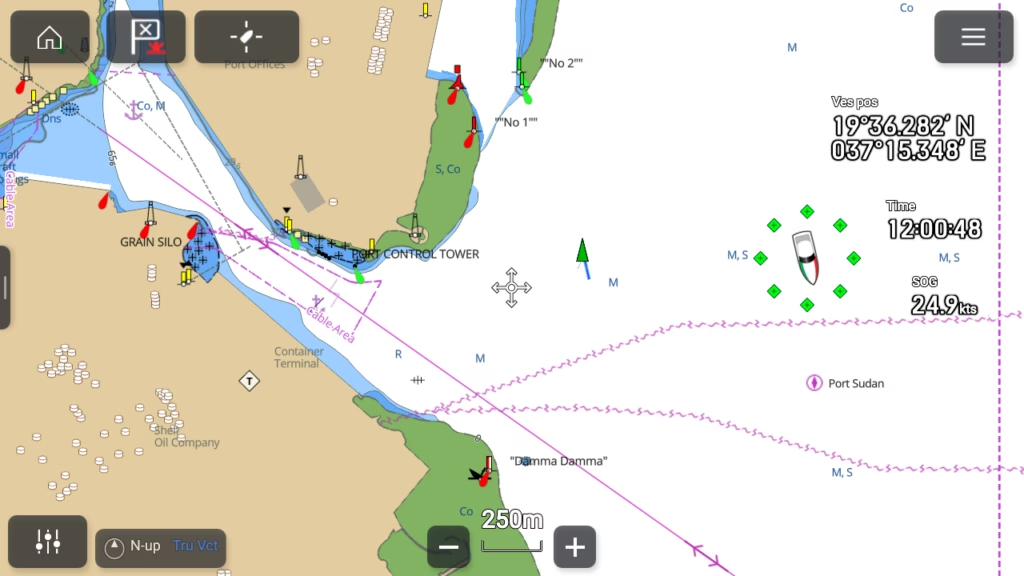
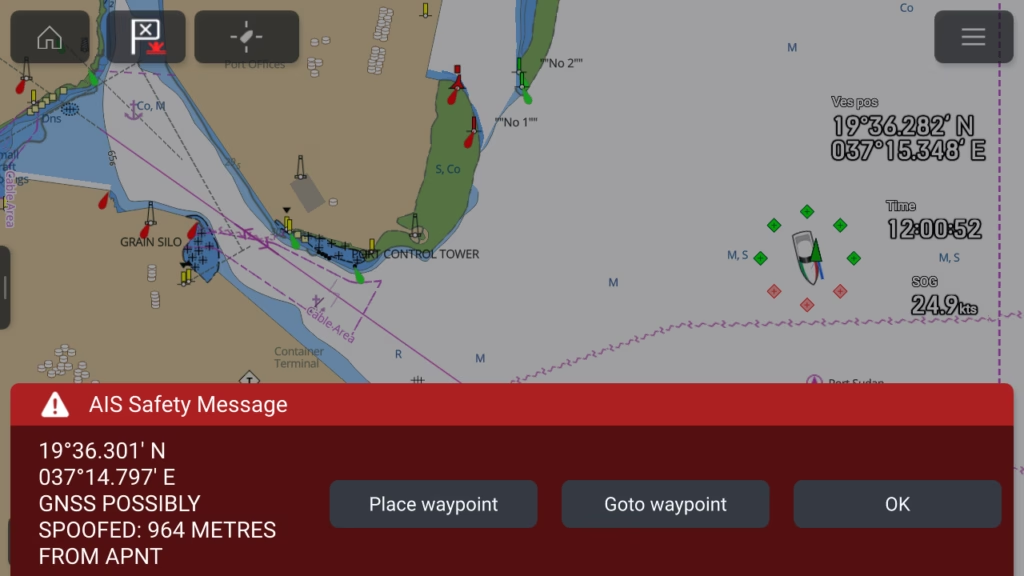
Jamming and spoofing are growing threats to global navigation systems across maritime, military, and defense environments, but they compromise GNSS in fundamentally different ways. Spoofing in particular can leave a receiver appearing to operate normally while reporting an incorrect position. Without an independent reference, this seemingly credible information can be difficult to identify as false. Jamming can remove the position you rely on, and spoofing can make you rely on the wrong one.
Ground Control’s A-PNT approach addresses this vulnerability by using Iridium PNT to provide an independent position reference alongside GNSS. With solutions such as RockFLEET Assured, the GNSS-derived position can be compared against an independently derived Iridium PNT position. When the two remain aligned, operators have greater confidence in the position being reported. If they diverge, or GNSS becomes unavailable, the system can identify a potential position-integrity issue. This is particularly important in a spoofing scenario as receiving a GNSS signal is not, in itself, assurance that the position it provides can be trusted.
Cryptographic Integrity
Satellite proximity to the Earth and signal strength alone are not enough to secure PNT, so Iridium PNT service incorporates cryptographic authentication to protect against spoofing and tampering. Every navigation and timing message is digitally signed, and Ground Control devices verify the integrity of those signatures before using the data. Unauthorized or falsified signals are rejected, ensuring that systems operate only on trusted information.
This security model extends through the entire A-PNT chain. Devices such as the RockFLEET Assured and RockBLOCK APNT are equipped with verification logic that ensures data cannot be manipulated in transit. Authorized users are provisioned with secure keys that allow them to authenticate signals. This design prevents unauthorized or falsified signals from being accepted, further enhancing the security and reliability of positioning, navigation, and timing (PNT) data in environments where traditional GNSS signals may be compromised.
System Architecture
The A-PNT architecture is designed for resilience and seamless integration into existing IT and operational networks. At its foundation is the Iridium satellite constellation, which continuously broadcasts navigation and timing data as part of its communications service. The constellation is supported by a secure ground network that maintains global synchronization with atomic time standards and manages the distribution of cryptographic keys.
On the user side, Ground Control’s A-PNT-enabled devices receive and process this data. RockFLEET Assured is a ruggedized, marine-grade, single above-deck terminal, while the RockBLOCK Pro APNT provides a self-contained platform for testing A-PNT performance and integration in vehicles, drones and autonomous systems. The new RockBLOCK APNT provides the same Iridium PNT capability in a compact developer board designed for integration directly into OEM systems and platforms.
These devices allow an independent Iridium PNT position or timing source to be introduced alongside conventional GNSS rather than relying on GNSS alone.
Depending on the application, this information can be presented to operators, incorporated into tracking and monitoring systems, or integrated into a wider platform. Because Iridium PNT operates independently of GNSS, it can provide redundancy, resilience and an additional source of position integrity without requiring organizations to replace their existing GNSS infrastructure.
What Ground Control’s A-PNT Approach Does and Does Not Do
Because Ground Control’s A-PNT approach compares an independent Iridium PNT position against GNSS, it’s worth being clear about what this specifically can and cannot tell you.
| A-PNT can | A-PNT does not | |
|---|---|---|
| Source Diversity | Provide a PNT source with different characteristics and failure modes from conventional GNSS. | Make GPS or other GNSS signals immune to jamming, spoofing or interference. |
| Independent Verification | Provide an independent reference against which GNSS-derived position or timing can be compared. | Guarantee that an alternative PNT position will always be more accurate than an uncompromised multi-constellation GNSS fix. |
| Continuity | Maintain alternative position and/or timing information when GNSS is unavailable or considered untrustworthy, subject to system configuration and operating conditions. | Mean that every difference between GNSS and A-PNT is evidence of spoofing; normal positioning uncertainty must also be considered. |
| Anomaly Detection | Improve the ability to identify anomalous or unexpected GNSS behavior. | Remove the need for appropriate antenna placement, RF engineering, receiver configuration, integration or operational procedures. |
| Architecture Resilience | Increase the resilience of a wider PNT architecture by adding source diversity and independence. | Replace every other navigation sensor, technique or source of operational evidence. |
Applications in Defense and Maritime
A-PNT has practical applications wherever the availability and integrity of positioning and timing information are critical to operations.
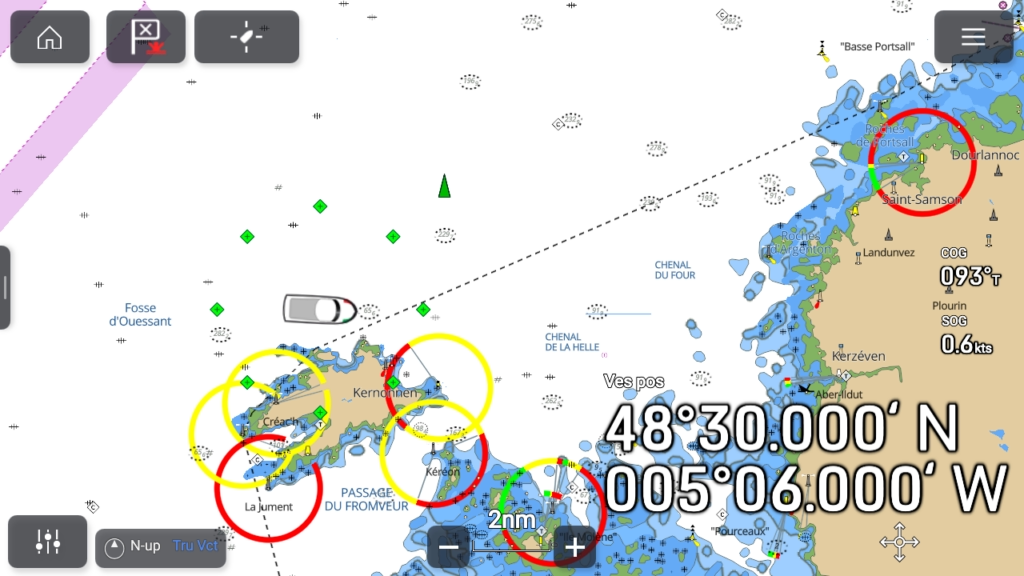
In commercial maritime, RockFLEET Assured brings assured positioning to existing vessel infrastructure. The device outputs standard NMEA position data for integration with compatible onboard navigation systems, while position-integrity information can be made available to bridge and shore-side teams. This gives operators greater visibility of GNSS disruption across individual vessels and wider fleets, particularly when operating in congested or higher-risk waters.
For defense applications, resilient PNT supports operations in contested and electronically challenged environments, where disruption to conventional GNSS can affect vehicles, personnel, autonomous platforms, communications, and other mission-critical systems.
RockBLOCK APNT enables Iridium PNT capability to be integrated directly into platforms such as land vehicles, UAVs, autonomous systems, and specialist equipment. This gives system designers and integrators greater flexibility to build PNT resilience into the platform itself, rather than treating it as an additional standalone system.
Across both sectors, A-PNT can therefore be deployed at different levels from a complete vessel solution to embedded technology within a wider platform according to the operational environment and the level of integration required.
How Assured Positioning Works
For applications such as RockFLEET Assured, A-PNT turns that independent source into practical position-integrity information.
1. Receive – The system receives the vessel’s conventional GNSS-derived position alongside an independent position based on Iridium PNT.
2. Compare – The two sources can be continuously compared to determine whether the conventional GNSS-derived information remains consistent with the independent reference.
3. Identify – If GNSS becomes unavailable or the positions begin to diverge, the system can identify a potential integrity issue.
4. Respond – Operators can be alerted to the event and use the independent position reference to support operational decision-making.
For RockFLEET Assured, position-integrity information can be available both onboard and ashore, helping bridge and fleet teams understand not only where a vessel is reported to be, but whether the position being reported can be trusted.
Why Operators and Leaders Should Care
For commercial maritime operators and military and defense leaders, A-PNT is about more than navigation. Position and timing information underpin the systems organizations use to understand where assets are, coordinate operations, maintain situational awareness, and support critical operational decisions.
When that information becomes unavailable, operations can be disrupted. When it remains available but is wrong, the consequences can be harder to identify and potentially more serious. A-PNT adds resilience by reducing dependence on a single source of Positioning, Navigation and Timing information. For maritime operators in particular, this creates three important capabilities:
Position resilience – access to an independent position reference when conventional GNSS is unavailable, degraded, or cannot be trusted.
Position integrity – the ability to compare independently derived and GNSS-derived positions to help identify when conventional positioning may have been compromised.
Operational visibility – position-integrity information that can be made available to onboard and shore-side teams, helping GNSS disruption to be identified, understood, and managed as an operational event.
By integrating Ground Control’s A-PNT devices, commercial maritime operators, military users, and system integrators can add another layer of PNT resilience, reducing reliance on conventional GNSS alone in contested, degraded, or GNSS-challenged environments.
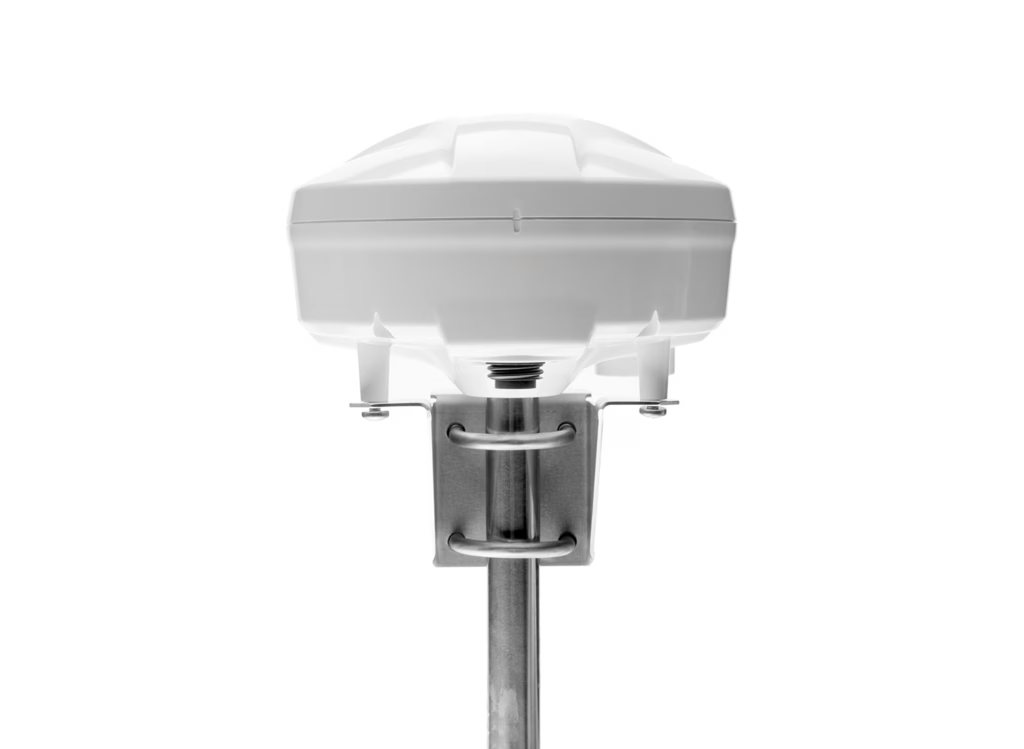
RockFLEET Assured
RockFLEET Assured is designed for commercial vessels requiring an independent position source and a practical way to identify GNSS position-integrity issues onboard and ashore.
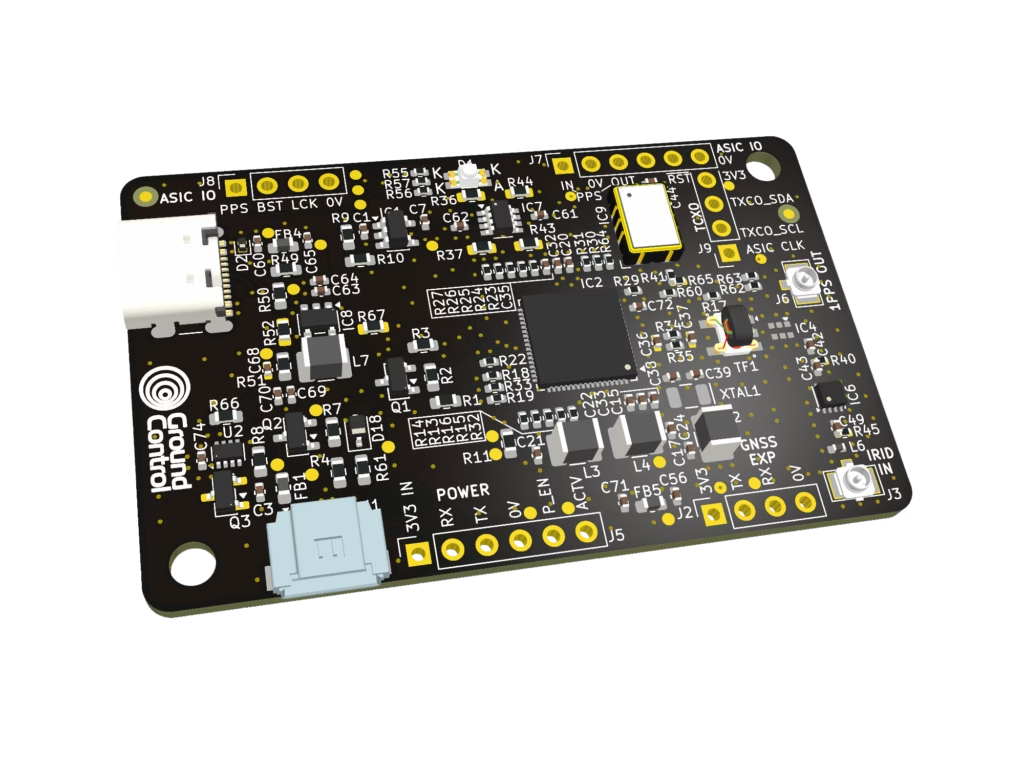
RockBLOCK APNT*
RockBLOCK APNT provides Iridium PNT capability for OEMs and integrators building assured positioning or timing into vehicles, UAVs, autonomous platforms and other systems.
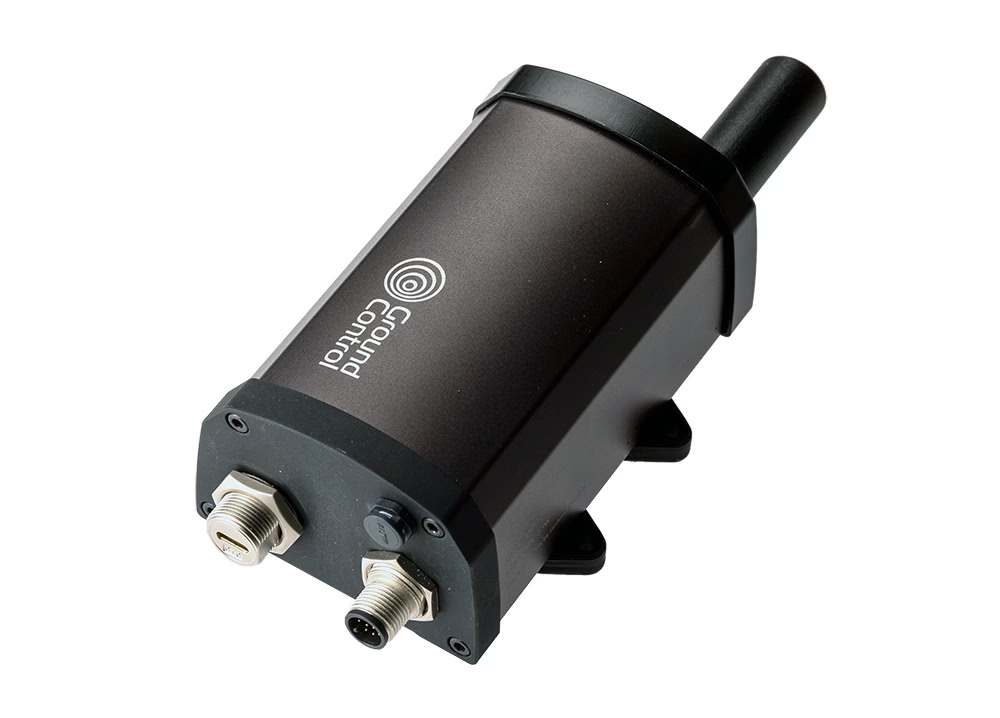
RockBLOCK Pro APNT Evaluation Kit
RockBLOCK Pro APNT provides a self-contained platform for evaluating Iridium PNT performance and A-PNT integration.
*RockBLOCK APNT does not contain a conventional GPS/GNSS receiver. It provides the independent Iridium PNT source so that the host platform or wider system can determine how that information should be combined or compared with other navigation sources.
Next Steps
Building resilience into positioning, navigation and timing starts with understanding where reliance on GNSS creates operational risk, and where an independent source of position or timing can provide greater confidence. A-PNT strengthens GNSS resilience by introducing an independent source of position and timing. This provides an additional reference when GNSS is unavailable or cannot be trusted, helping operators identify position-integrity issues and maintain greater confidence in the information supporting critical decisions.
As GNSS disruption becomes a more significant consideration across maritime, defense and other critical operations, understanding where these dependencies exist – and how greater PNT resilience can be introduced – is an important next step. Ground Control has developed A-PNT solutions for real-world deployment, from RockFLEET Assured for commercial maritime operations to RockBLOCK APNT for integration into vehicles, autonomous systems and other mission-critical platforms.
Explore Ground Control’s A-PNT solutions and resources to learn more about building resilience into your positioning, navigation and timing systems.
Talk To An Expert
We work with organizations across defense, utilities, maritime, and more to design secure, resilient, and future-ready connectivity strategies.
Get in touch to discuss your A-PNT, GNSS resilience, positioning or tracking requirements; either complete the form or email hello@groundcontrol.com and we’ll respond within one working day.