Last updated
RockBLOCK Plus vs Iridium Edge: choosing a rugged Iridium SBD terminal
Some of the most important data in the world is also some of the smallest: a river level, a pressure alarm on a pipeline valve, a buoy checking in to say it’s still where it should be. Each one is only a few dozen bytes, and each one has to get through, wherever it’s coming from.
That’s what Iridium Short Burst Data (SBD) was designed for, and it’s been doing the job quietly and reliably for a long time. We’ve been an Iridium partner since 2008 (back when we were Rock Seven), and our RockBLOCK range has been built around SBD from day one.
In this post we’re looking at RockBLOCK Plus, the rugged, field-ready member of the family. It’s been out in the field since 2015, with an Iridium SBD modem, antenna and power regulation sealed into one weatherproof unit. If you’ve been looking at the Iridium Edge® for your project, it’s worth knowing that RockBLOCK Plus does a very similar job, and often for less. We’ll compare the two, look at where each one fits best, and explain when you might want to skip both and go for RockBLOCK Plus 9704 instead.
Why does Short Burst Data still matter?
Iridium’s newer services carry far more data, and we’re big fans of them (more on that later). SBD is still the right tool for a huge number of projects, though, and here’s why.
- It works everywhere. Iridium’s 66 cross-linked satellites in Low Earth Orbit (LEO) cover the entire planet, oceans and poles included. If your device can see the sky, it can send.
- It’s tried and tested. SBD is already inside tsunami sirens, glacier dataloggers, ocean buoys and pipeline controllers all over the world. Its behavior is well understood, and so are its quirks.
- It’s the right size for telemetry. Each message carries up to 340 bytes from the device and 270 bytes back to it. That’s plenty for a sensor reading, a status update or an alarm. With a clear view of the sky, a session takes around 10 seconds.
- It’s two way. You can send commands, configuration changes or acknowledgments back down to the device, as well as receiving data from it.
- It’s easy to integrate. SBD modems use standard Iridium AT commands over a serial link. All of our RockBLOCK SBD products (9602, 9603, Plus and RTU) use the same command set, so code you write on a bench prototype carries straight over to a field unit.
- It’s economical at low volumes. Airtime is billed by the byte. Our representative Low Usage plan is $15.75 a month for 5,000 bytes, and you can pool data across a fleet of devices.
In short, SBD is one of the quiet success stories of satellite IoT, and for that you can thank Iridium’s network. RockBLOCK Plus and the Iridium Edge are both built on it, which is why they have so much in common.
RockBLOCK Plus and Iridium Edge, side by side
First things first: both devices wrap an Iridium 9602 SBD modem, an integrated antenna and a wide range power supply in a sealed enclosure, and both talk to your equipment over RS-232. The differences are mostly physical, plus one important one around how you buy airtime. We’ve added RockBLOCK Plus 9704 to the table too, which we’ll come back to that later.
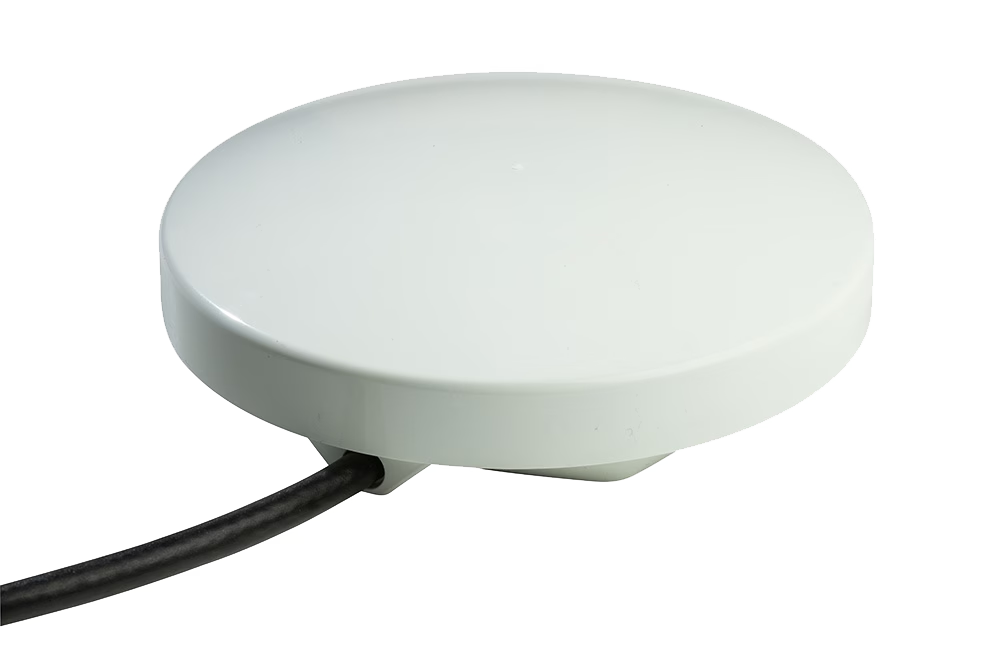 RockBLOCK Plus |
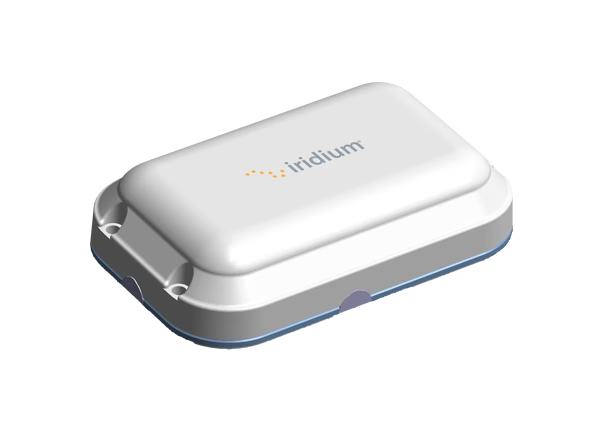 Iridium Edge |
RockBLOCK Plus 9704
|
|
|---|---|---|---|
| Made By | Ground Control | Iridium | Ground Control |
| Service | Iridium SBD, 340 bytes up / 270 bytes down | Iridium SBD, 340 bytes up / 270 bytes down | Iridium Messaging Transport (IMT), 25 bytes to 100 KB per message, both ways |
| Modem | Iridium 9602N | Iridium 9602N | Iridium Certus 9704 |
| Form Factor | Round, 137 mm diameter × 40 mm (5.39 × 1.57 in) | Rectangular, 130 × 80 × 30 mm (5.12 × 3.15 × 1.18 in) | Round, 137 mm diameter × 40 mm (5.39 × 1.57 in) |
| Weight | 450 g (15.9 oz) with 3 m (10 ft) cable | 320 g (11.3 oz) with 20 cm (8 in) pigtail | 460 g (16.2 oz) with 3 m (10 ft) cable |
| Ingress Protection | IP67 | IP67 | IP67 |
| Power Input | 9 to 30 V DC | 9 to 32 V DC | 7 to 30 V DC |
| Interface | RS-232, Iridium AT commands, plus on/off, ring alert and network availability lines | RS-232, Iridium AT commands, on/off control lines | Two RS-232 ports (Iridium and GNSS) and two enable inputs; Ground Control C, Python and Arduino libraries |
| Built-in GNSS | |||
| Cable | Molded marine-grade cable, stripped and tinned, in 3, 5, 10 or 15 m (10, 16, 33 or 49 ft), or a 1.8 m (6 ft) USB (FTDI) lead for development | 20 cm (8 in) pigtail with M12 8-pin connector; mating cable bought separately | Eight-core cable in 3, 5, 10 or 15 m (10, 16, 33 or 49 ft) |
| Mounting | Four M5 inserts; flat steel and rail mounts available | Pole, screw or tape; side or bottom cable exit | Same UV-stable ASA radome as RockBLOCK Plus |
| Operating Temperature | -40 C to +85 C (-40 F to +185 F) | -40 C to +85 C (-40 F to +185 F) | -40 C to +70 C (-40 F to +158 F) |
| Airtime Options | Prepaid data packs, or post-paid monthly plans | Annual plans | Prepaid data packs, or post-paid monthly plans |
| View Product | View Product | View Product |
Where RockBLOCK Plus comes out ahead
- Ready to wire in. The cable comes attached, in lengths up to 15 m (49 ft), so there’s nothing extra to buy and no connectors to weatherproof.
- Prototyping. The USB version plugs straight into a laptop or Raspberry Pi, using the same AT commands as our RockBLOCK 9602 and 9603.
- Flexible airtime. Our pay-as-you-go plans, with no annual contract, are only available on Ground Control hardware.
Where the Iridium Edge is the better fit
- Teltonika trackers in satellite backup mode. Teltonika documents the Edge as its satellite add-on for FMB and FMC vehicle trackers. If that’s your setup, the Edge is the proven pairing.
- Vehicles. The Edge’s load-dump protection and SAE J1455 vibration rating are designed with vehicle power systems in mind.
- Existing M12 harnesses. If your installation already standardizes on M12 connectors, the Edge will drop straight in.
To be clear, we supply and support both devices, on the same airtime plans and through the same Cloudloop platform. We’re not invested in selling you one particular box, so we’re happy to help you pick whichever suits your project.
Where does RockBLOCK Plus come into its own?
RockBLOCK Plus is at its best when it’s bolted to something that stays put outdoors for years: a mast, a buoy, a hut roof or a pipeline cabinet, wired back to a logger or controller that decides what to send. Here are a few of the projects it’s already part of.

Tsunami early warning, Thailand
American Signal Corporation chose RockBLOCK Plus for Thailand’s national warning network. There are more than 1,500 alerting devices in the system, and over half of them have a RockBLOCK Plus on board. Because SBD is two way, the same link that reports status also triggers the sirens.
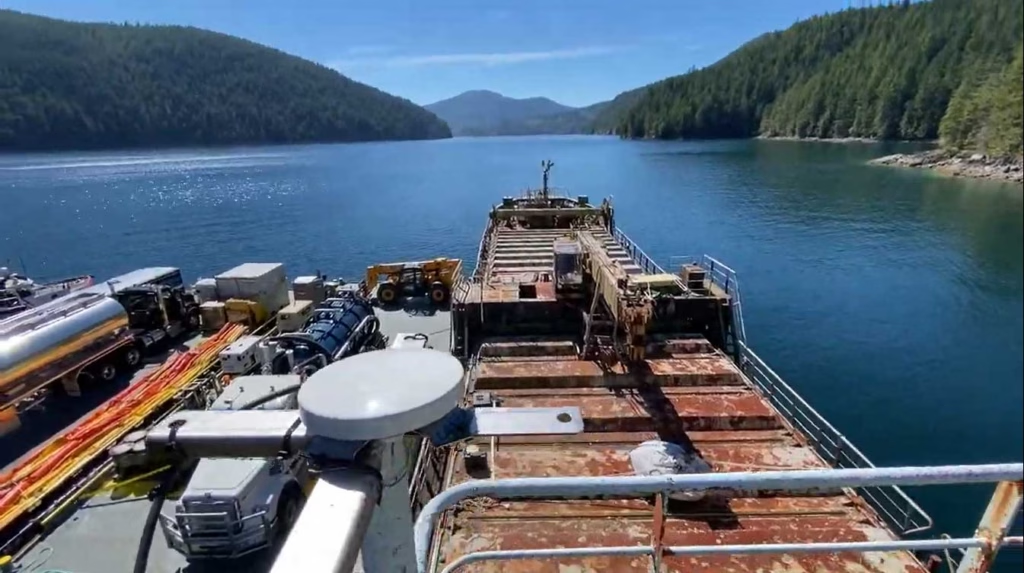
Derelict vessel monitoring, Canada
The Canadian Coast Guard puts BRNKL Rapid Deploy units from Barnacle Systems on hazardous vessels along the coastline, and RockBLOCK Plus provides the satellite link. If a vessel starts to sink or move, the Coast Guard knows about it in near real time.
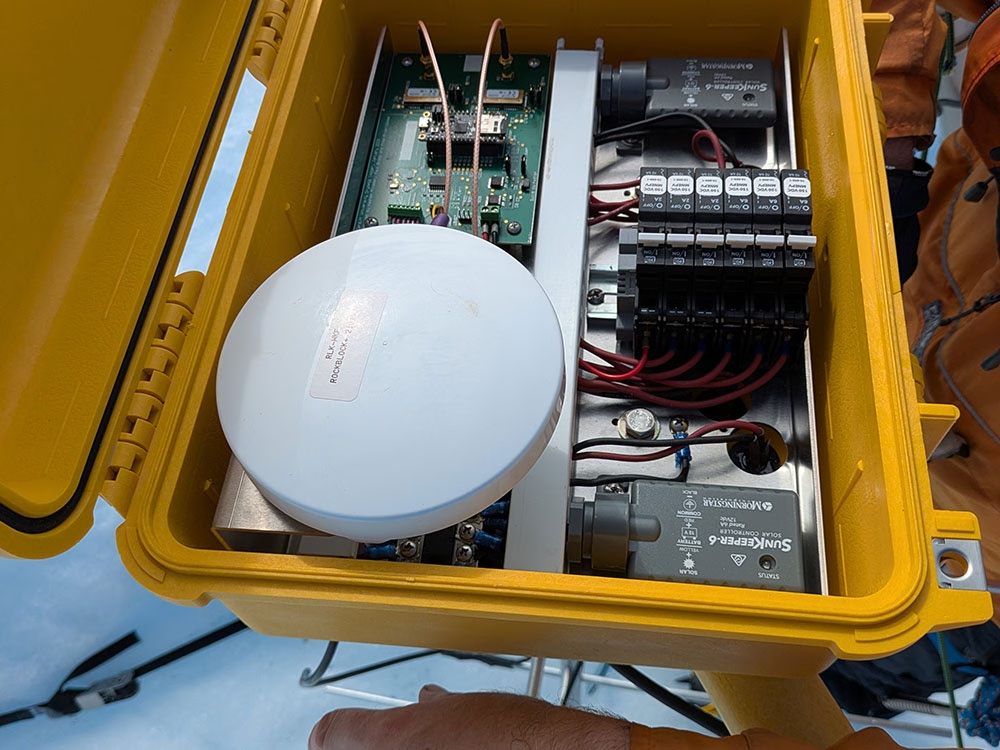
Glacier science, Greenland
Cardiff University’s Cryoegg team uses RockBLOCK Plus in surface dataloggers on Isunnguata Sermia, relaying readings from probes deep under the ice. Not the easiest place to pop out and fix something.
Landslide monitoring, USA
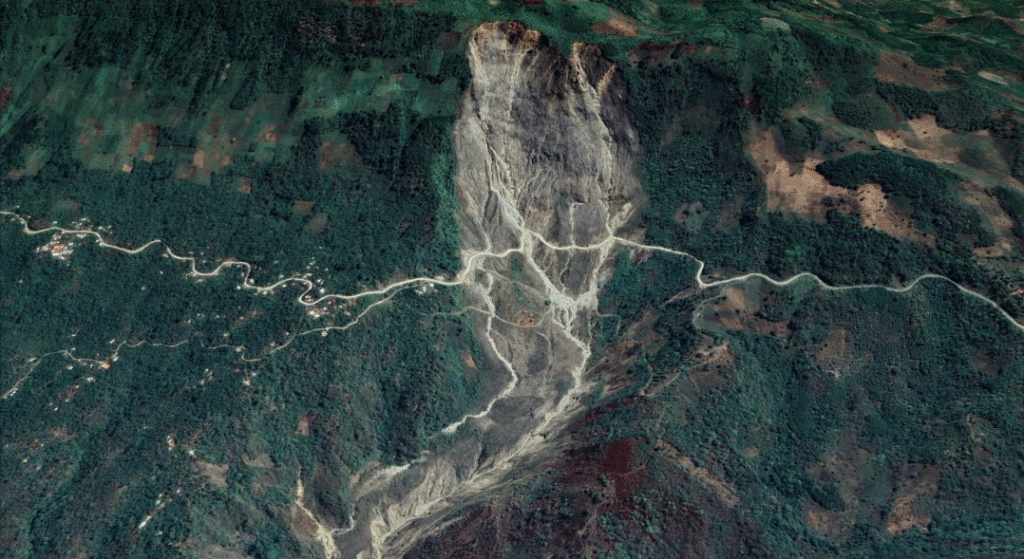
Oregon State University’s Slide Sentinel system uses RockBLOCK Plus to upload rover positions every two to three hours, and to send configuration changes back out to the rovers.

Rainforest protection, Africa and South America
Rainforest Foundation UK’s ForestLink system uses RockBLOCK and RockBLOCK Plus to relay community reports of illegal logging where there’s no mobile signal. Over 30 communities in the DRC, Ghana, Cameroon and Peru have been trained to use it.
Beyond these, we see RockBLOCK Plus in metocean buoys, hydrology and flood stations, seismic networks, pipeline valve telemetry and defense projects. The common thread? A fixed installation, a modest amount of data, and a need to keep working for years without a site visit.
Sending more than 10 KB a month? Look at RockBLOCK Plus 9704
SBD’s sweet spot is small amounts of data, though. If your device sends more than about 10 KB a month, RockBLOCK Plus 9704 will usually cost less to run than either RockBLOCK Plus or the Iridium Edge. It looks almost identical on the outside, but inside it uses the Iridium Certus 9704 module and Iridium Messaging Transport (IMT), Iridium’s messaging service for larger payloads.
- Much bigger messages. IMT messages can be anything from 25 bytes to 100 KB, so you can send a full day of readings, a log file or a compressed image in one go
- Lower cost per kilobyte. Our representative IMT plans include 50 KB a month for $25, compared with $36.75 for 25 KB on SBD
- Built-in positioning. There’s a u-blox MAX-M10S GNSS receiver on board, tracking GPS, Galileo, BeiDou and GLONASS, with its own RS-232 port. Neither RockBLOCK Plus nor the Edge has one.
- Same rugged package. IP67, the same 137 mm (5.39 in) radome, 7 to 30 V DC input, and cables from 3 to 15 m (10 to 49 ft).
So how do the numbers stack up? The chart shows what you’d pay each month for each service, depending on how much data a device sends and receives (USD, excluding tax, from our standard price book).
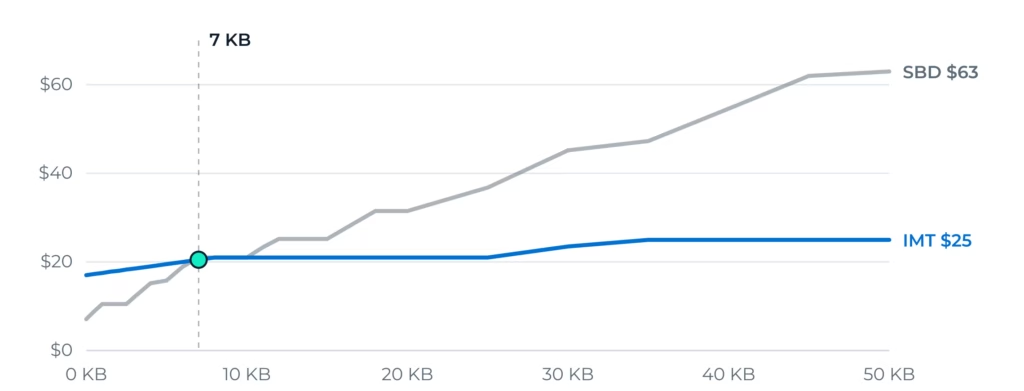
At very low volumes SBD is still the cheaper option, which is why RockBLOCK Plus remains such a good fit for alarms and status reports. From around 7 KB a month IMT matches or beats SBD, and above 10 KB it’s cheaper every time. Beyond that, the gap widens quickly.
One thing to bear in mind: RockBLOCK Plus 9704 doesn’t use AT commands. IMT devices use Iridium’s JSON-based JSPR protocol, which our open-source C, Python and Arduino libraries handle for you. If you need to keep your existing AT command code, RockBLOCK Pro offers IMT with a backwards-compatible AT interface.
Which one should you choose?
| If your project… | Choose |
|---|---|
| Sends small alarms or status reports, under about 10 KB a month, from a fixed outdoor site wired to a logger or controller | RockBLOCK Plus |
| Needs a long cable run, a USB development version, or pay-as-you-go airtime with no annual contract | RockBLOCK Plus |
| Pairs with a Teltonika vehicle tracker in satellite backup mode, or must plug into an M12 harness | Iridium Edge |
| Sends more than about 10 KB a month, needs messages bigger than 340 bytes, or needs built-in GNSS | RockBLOCK Plus 9704 |
Still not sure? That’s what we’re here for. We sell and support all three, along with the airtime and the Cloudloop platform that delivers your data, so our advice is about getting the fit right. Tell us what you’re sending, how often and from where, and we’ll recommend the most cost effective option.
Can we help?
Complete the form, email hello@groundcontrol.com or call +44 (0) 1452 751940 (Europe, Asia, Africa and Oceania) or 800 773 7168 (the Americas), and we’ll get back to you within one working day.