Last updated
Beyond Cellular: Smart LoRaWAN Backhaul for Remote Water Sites
Across water utilities, flood management, and environmental research, monitoring remote assets has become an operational necessity. From regulatory monitoring on combined sewer overflows (CSOs) to watershed-wide flood early warning systems and network pressure management, sensors are being deployed in increasingly isolated locations.
LoRaWAN has emerged as a leading technology for these deployments. Its long range, low power radio communication makes it ideal for gathering data from dozens of distributed battery powered sensors across difficult terrain.
However, system design often runs into a fundamental architectural reality: LoRaWAN uses a star of stars topology. Gateways do not communicate with each other over LoRa to pass data along a chain; every LoRaWAN gateway requires an independent backhaul connection to forward packets to a network server. Cellular blackspots are common in rural terrain, and the retirement of 2G and 3G networks is creating more of them. When a gateway sits in one, getting its data back to headquarters becomes the primary engineering hurdle.
So, how do you backhaul a remote LoRaWAN gateway without cellular coverage? What are the practical trade offs of existing methods? And when does satellite messaging offer a more sensible, low power solution?
The pros and cons of backhaul options for remote LoRaWAN sites
When cellular networks fail or are entirely absent, engineers have devised several ways to bridge the gap. While each approach can work, each often introduces significant operational or power constraints.
Satellite Broadband (Starlink, OneWeb, Viasat Go-anywhere Pro)
Using high bandwidth satellite terminals to give each gateway a full Internet Protocol (IP) connection is an increasingly common tactic.
- Upside: It provides standard IP backhaul, supporting uncompressed gateway traffic, remote administration, and high frequency data polling
- Downside: The power requirements are substantial. Operating a broadband satellite terminal off grid typically requires a large solar array, heavy battery enclosures, rigid mounting structures, and routine physical maintenance.
For a site whose only job is to report periodic tank levels or flow rates, the energy required to power the communications system can dwarf the energy consumed by the sensors themselves.
Point-to-Point Radio Links and Chaining
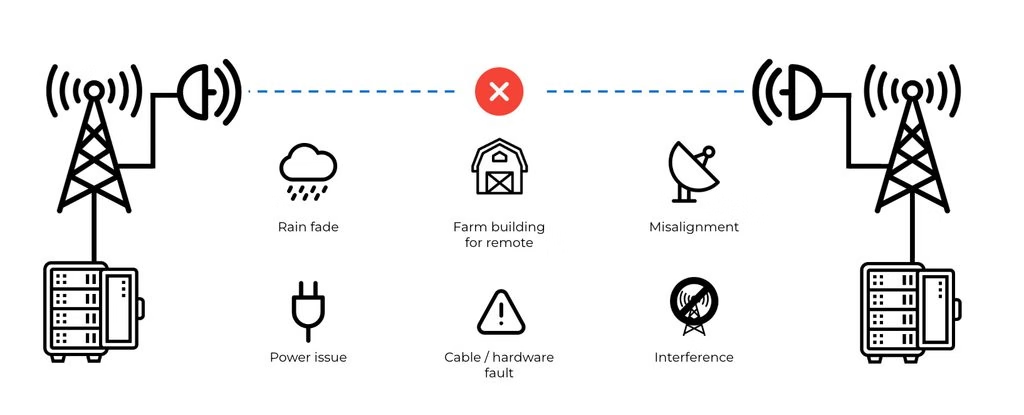
To avoid putting a satellite link at every gateway, deployments sometimes link multiple outlying gateways via unlicensed 5 GHz or licensed microwave bridges back to a single central hub with a satellite or fiber link.
- Upside: Amortizes the cost and power footprint of a single satellite terminal across multiple gateways.
- Downside: Point-to-point radio demands strict line-of-sight. In hilly catchments, valleys, or heavily forested terrain precisely where water monitoring occurs, achieving line-of-sight often requires constructing intermediate relay towers. Unlike LoRa, which can slightly diffract or bend around obstacles, microwave links need a clear radio path between dishes. A single growing tree or obstruction can degrade or break the link. Changes in temperature and humidity can also affect the bridge signal, causing the air to refract the microwave beam away from the receiving dish.
The supporting radio infrastructure quickly becomes a complex engineering project in its own right.
Store and Forward and Local Processing
In this setup, an edge gateway runs a local network server (such as ChirpStack or embedded gateway software) to process and store readings locally on site.
- Upside: This eliminates the need for continuous external connectivity, preserving historical data logs during long outages.
- Downside: Data loss is prevented, but data visibility is delayed. If a reservoir reaches a critical flood threshold or a pressure reducing valve fails, operators remain blind to the event until someone retrieves the logs or a scheduled connection opens.
Manual Collection (“Data Mules”)
In some remote locations, stored data is collected physically by dispatching an engineer in a vehicle or using a passing drone to download local logs.
- Upside: No permanent external communication hardware or recurring airtime subscriptions are required on site.
- Downside: Replacing digital backhaul with physical site visits converts network costs into heavy ongoing operational expenditure. A four hour round trip every two weeks to retrieve data from a remote site accumulates over 100 hours of travel annually per station, before accounting for vehicle wear, fuel, and staff costs. Crucially, it deprives utilities of timely operational alerts.
Rethinking Backhaul: Transmit Telemetry, Not Overhead
To choose a more practical architecture, start with a simple question:
Does a remote water monitoring gateway really need a continuous, high-bandwidth IP pipe back to the cloud?
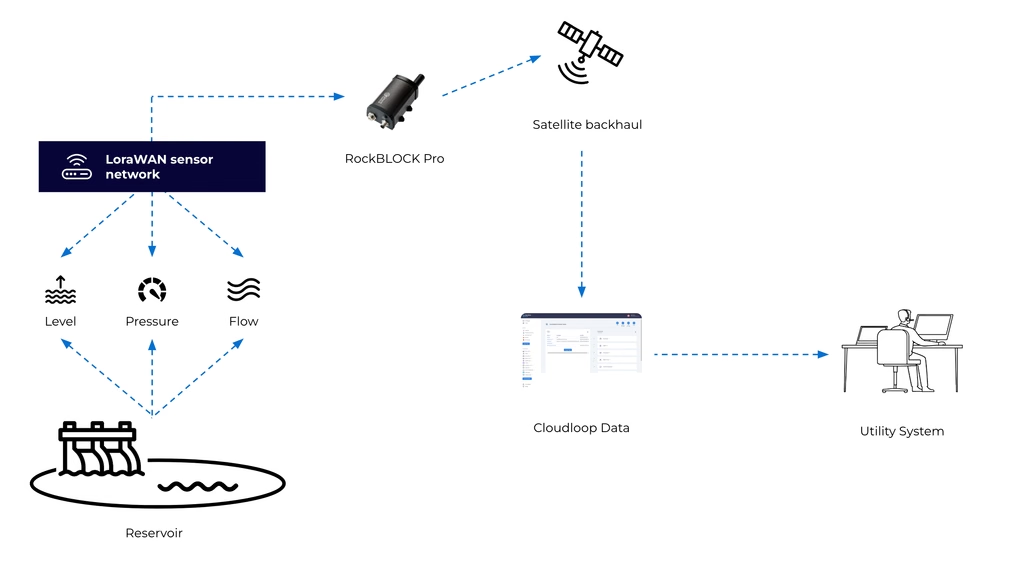
In most environmental and utility monitoring applications, raw packet data contains significant overhead. What the central monitoring application actually requires are key readings: periodic water levels, aggregated flow totals, state changes, or immediate threshold alarms. By moving to an edge-processed architecture, a local processor or edge gateway handles the local LoRaWAN traffic, extracts the critical data, and condenses it into compact summary payloads. This shifts the requirement from continuous, power hungry satellite broadband to efficient, low power satellite messaging.
Ground Control provides compact, low power satellite connectivity options designed to eliminate excessive site infrastructure while delivering reliable data from off-grid water assets.
Aggregated Gateway Backhaul via RockBLOCK Pro
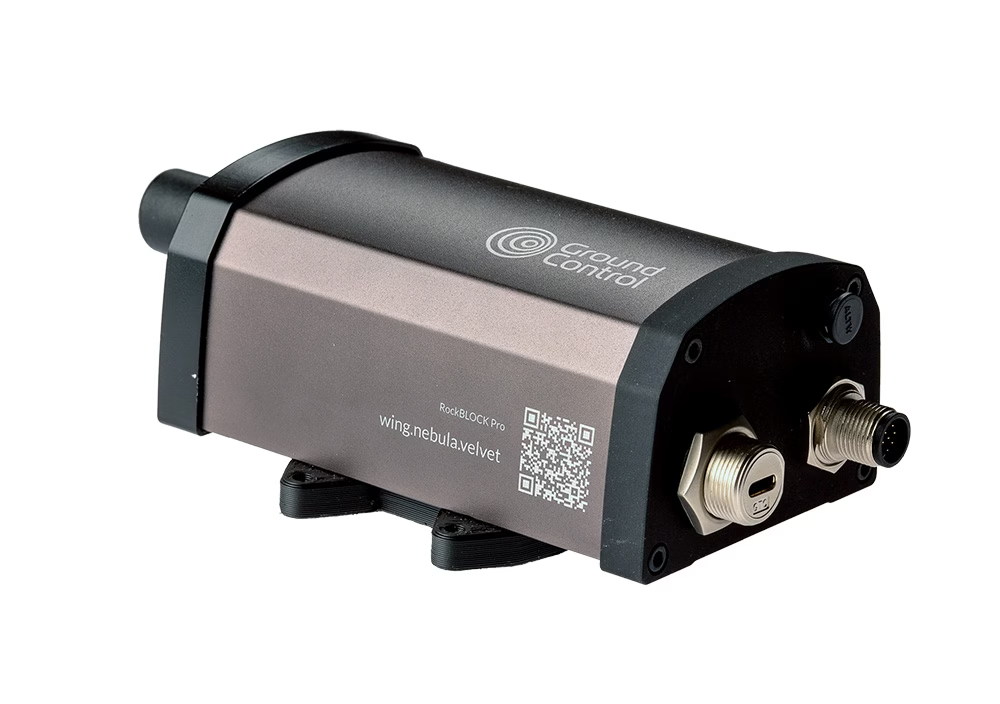
For sites using LoRaWAN to aggregate multiple sensors, the RockBLOCK Pro offers a low-power satellite backhaul link using Iridium Messaging Transport (IMT). Unlike traditional short burst messaging services, Iridium IMT supports payloads of up to 100 kB. This allows edge gateways to package aggregated sensor trends and logs into concise, highly efficient satellite transmissions.
Enclosed in an IP66 rated housing with flexible serial and USB interfaces, the Pro is engineered for harsh outdoor environments and draws under 200 mW at idle and under 75 mW in sleep, giving it a minimal power footprint. Easily powered by small solar panels and lightweight lithium battery packs, it avoids the heavy power systems required by satellite broadband terminals.
Direct Sensor Connectivity via RockBLOCK RTU
For isolated monitoring points such as a single river gauge, a remote tank transducer, or a standalone valve chamber, deploying a complete LoRaWAN gateway and local edge server can often be unnecessary overengineering. In these scenarios, the RockBLOCK RTU bypasses the LoRaWAN layer entirely by connecting field instruments directly to the Iridium satellite network.
Engineered specifically to bridge the gap between modern satellite telemetry and established water industry hardware, the unit features a multi-channel I/O framework that integrates seamlessly with existing site instrumentation. Its hardware configurable serial interface (offering RS232, RS485/RS422, or CAN ordering options) connects directly to SDI-12 sensors, Modbus flow meters, PLCs, and legacy dataloggers.
Beyond serial communications, the unit incorporates fixed digital inputs for real time pulse counting or threshold triggers such as high level flood switches or security door contacts alongside flexible options for analog inputs (4–20 mA or 0–10 V pressure and level sensors) and digital outputs.
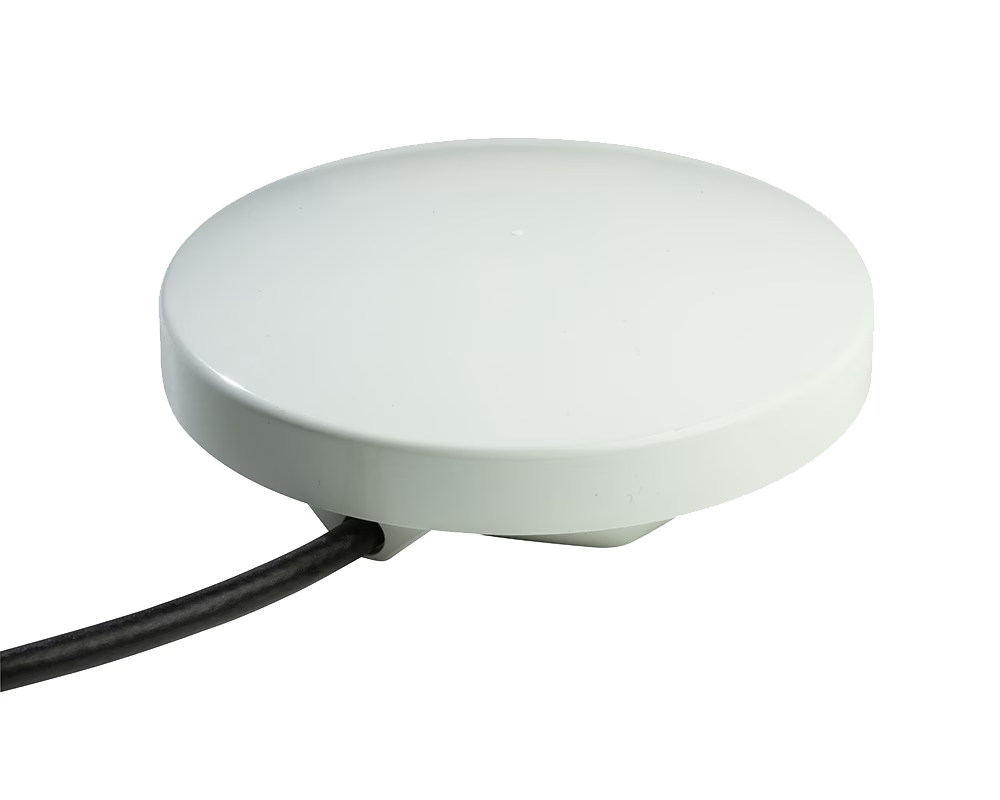
Crucially, its onboard firmware can extract and bundle up to 16 distinct software data channels directly from serial streams into a single compact satellite payload. Housed in a rugged IP67 weatherproof enclosure with internal battery backup and an integrated satellite antenna, the RockBLOCK RTU functions as an all in one micro-logger.
From Sensor Readings to Cloudloop Insights
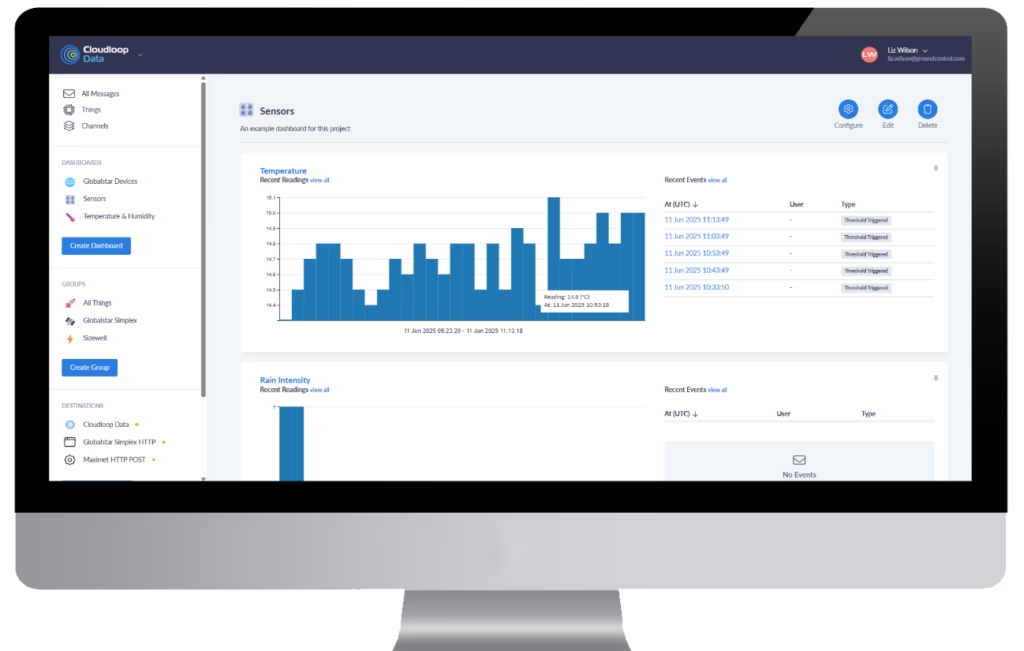
Collecting and transmitting sensor readings is only part of the monitoring process; once they reach the application, they must be translated quickly into meaningful insights to manage assets and make operational decisions. Data transmitted via RockBLOCK hardware passes securely through the Iridium satellite constellation into Ground Control’s Cloudloop platform ecosystem.
Cloudloop Data decodes and routes sensor information into customer systems, managing message routing, payload decoding, and secure delivery into utility software, SCADA systems, or third party platforms.
Cloudloop Insights provides visualization of live and historical measurements, configurable thresholds, alerts, and condition based actions. All of Cloudloop’s functionality is available via programmatic API, allowing monitoring data to be integrated with existing utility applications and operational platforms.
Together, RockBLOCK Pro and RTU with Cloudloop provide a route from remote sensor to usable monitoring information, whether you’re backhauling an existing LoRaWAN gateway or connecting an isolated asset directly.
Comparing Backhaul Architectures
Evaluating backhaul strategies requires looking beyond hardware purchasing costs to consider the Total Cost of Ownership (TCO), including power installation, site access, and maintenance overhead.
| Satellite Broadband | Radio Point to Point | Manual Site Visits | RockBLOCK Pro / RTU | |
|---|---|---|---|---|
| Primary Advantage | Full IP Connectivity | Shares one uplink across sites | Low initial hardware cost | Low power, flexible placement, automated delivery |
| Power Requirement | High (requires large solar/battery systems) | Moderate to high | None on site | Low (suitable for small solar/battery) |
| Terrain Sensitivity | Low – LEO (requires clear sky view), GEO (requires antenna pointing and line of sight) | High (requires line of sight between nodes) | High (requires physical road access) | Low – LEO (requires clear sky view) |
| Reporting Timeliness | Real time | Real time | Delayed (weeks/months) | Scheduled reports, plus real time threshold alarms |
| Maintenance Burden | High (heavy mounting & power infrastructure) | High (multiple radio sites) | High (ongoing vehicle and labor costs) | Low (compact, sealed, unattended operation) |
Right Sizing Your Remote Connectivity
Connecting remote water monitoring sites beyond cellular coverage should never require over-engineering site infrastructure just to transmit periodic telemetry. While LoRaWAN excels at gathering distributed sensor readings, every gateway still requires an independent route home. Shifting to satellite IoT messaging provides a pragmatic, cost efficient, low power solution, eliminating complex network chains and delivering essential data without unnecessary IP overhead.
Planning a Remote Water Deployment?
Whether you are designing a flood warning network, retrofitting asset monitoring stations, or solving a cellular blackspot challenge, Ground Control’s technical team can help you select the right balance of power, hardware, and satellite connectivity.
Complete the form or email hello@groundcontrol.com and we’ll get back to you within one working day.