Last updated
Satellite IoT in Transition: Key Shifts to Watch in 2027
More change, more choice: what satellite IoT users expect in 2027 and beyond
A year ago, satellite IoT users told us which forces would reshape their industry. We asked again, and this time they’re expecting more change, from more directions, at once.
In September 2025, we asked 207 satellite IoT users a simple question: which emerging trends will shape your industry most over the next two to three years? Their answers became our report, Satellite IoT in Transition: Key Shifts to Watch in 2026.
This year, we put the same question and the same five options to a new group of senior decision makers. They work across more than 15 industries, led by environmental monitoring, maritime, technology and engineering, and defense, with most based in Europe and North America.
The clearest finding is that users expect several technologies to reshape their industry at the same time. Every one of the five trends gained ground. The average respondent picked more trends than last year, and almost nobody said none of them would matter.
For anyone designing connected devices and systems, that makes the network decision matter even more. The services on offer differ widely, and each application still needs a deliberate choice of the one that fits it best.
Here’s what changed, trend by trend:
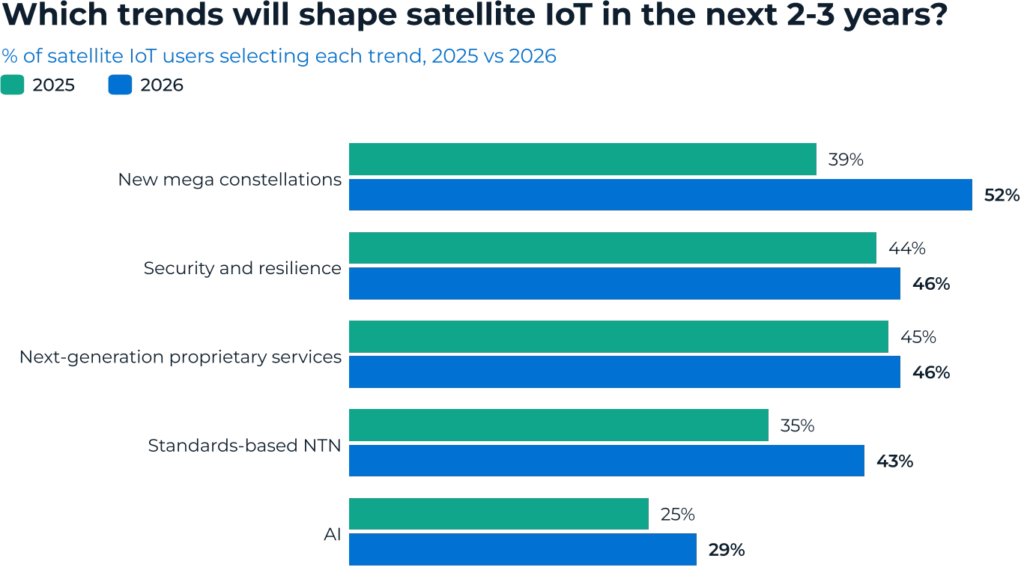
- New mega constellations rose from 39% to 52%, moving from third to first
- Security and resilience rose from 44% to 46%, and leads in Europe
- Next-generation proprietary services edged up from 45% to 46%, with big swings by sector underneath
- Standards-based NTN rose from 35% to 43%, in line with our prediction of a year of pilots
- AI rose from 25% to 29%. It’s still last, but climbing.
The big picture: more change, from more directions
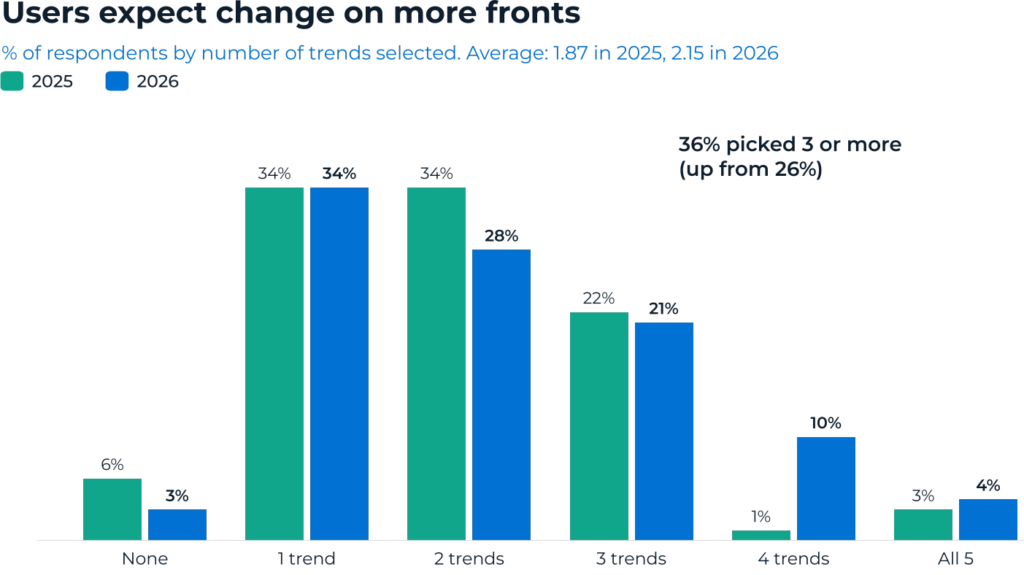
Users now expect more forces to reshape their industry at once than they did a year ago.
- The average respondent picked 2.15 trends, up from 1.87
- More than a third (36%) picked three or more, up from 26%
- The share who said none of the trends would shape their industry fell from 5.3% to under 1%.
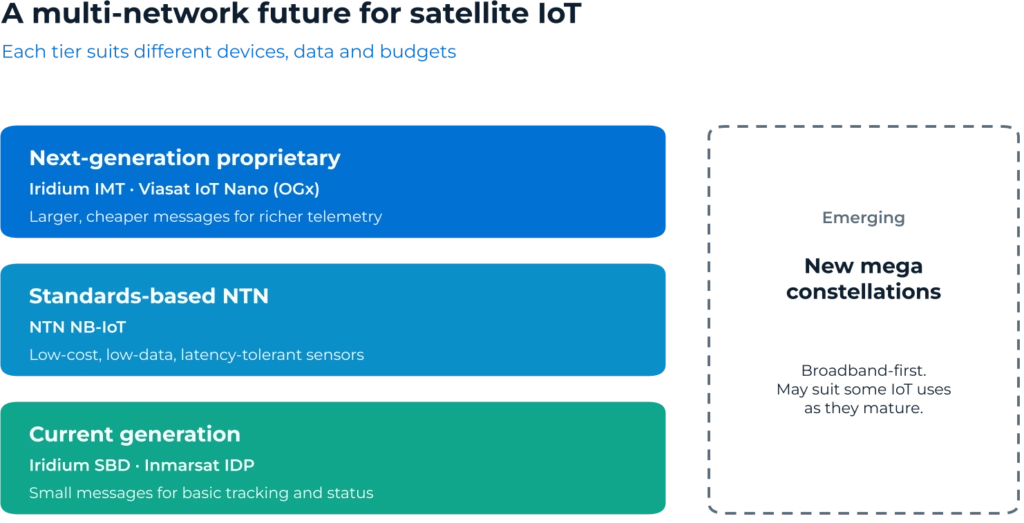
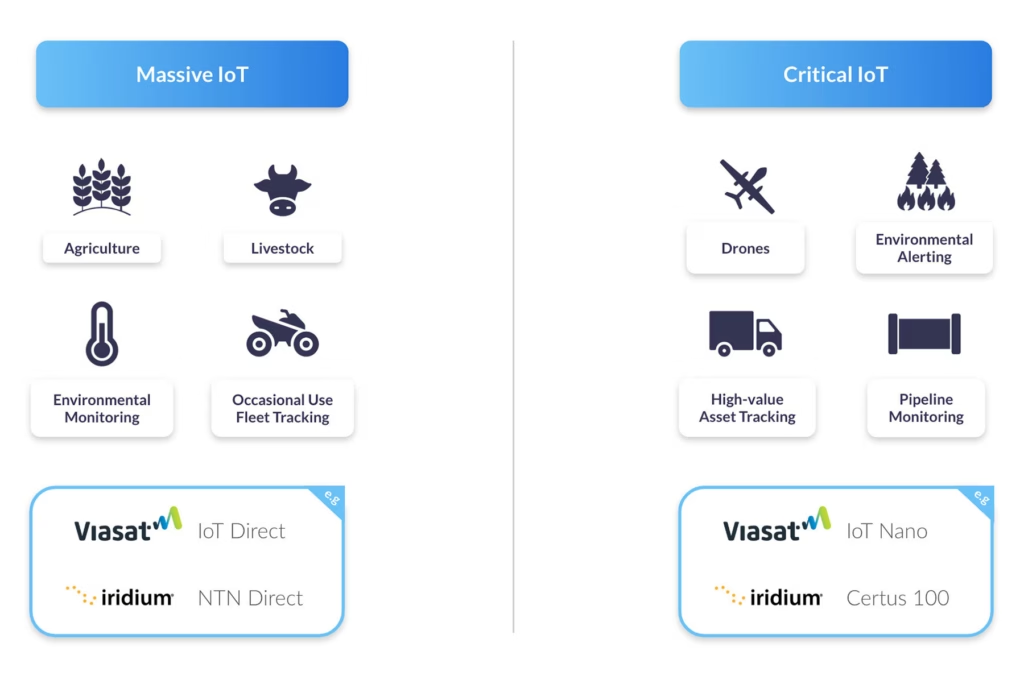
In 2025 we described a three-tier ecosystem emerging: current generation services such as Iridium SBD for small, lightweight messages; standards-based NTN NB-IoT for low cost, low data devices; and next-generation proprietary services such as Iridium Messaging Transport (IMT) and Viasat IoT Nano (OGx) for richer telemetry. This year’s results suggest users are preparing for that ecosystem to get busier still.
More options bring more opportunity, and more ways to get it wrong. No single network offers the best mix of coverage, data capacity, latency, power use and cost for every application.
A container tracker sending a small position report once an hour needs years of battery life and coverage on every ocean. A vessel streaming engine diagnostics needs far more bandwidth, and can power a larger terminal. Put either on the other’s network and you pay in battery life, airtime or missing data.
The services themselves differ too, in coverage, latency, pricing and where they’re licensed to operate. Some are proven at scale while others are still building out, and moving a certified device to a different network later takes fresh engineering work. That’s why the choice of network belongs at the very start of the design process.
“Our customers can see several technologies coming at once, and that makes the choice of network matter even more. These services differ hugely in coverage, latency, landing rights and commercial maturity. You can’t move a deployed device between proprietary networks, and while standards-based NTN promises that kind of flexibility, it will be several years before it works in practice. Devices going into the field this year will still be there in 2030, so match each one carefully to a service that fits it today and is built to keep supporting IoT for the long term.”
Oliver Potter, CEO, Ground Control
1. Security and resilience: a design issue for every sector
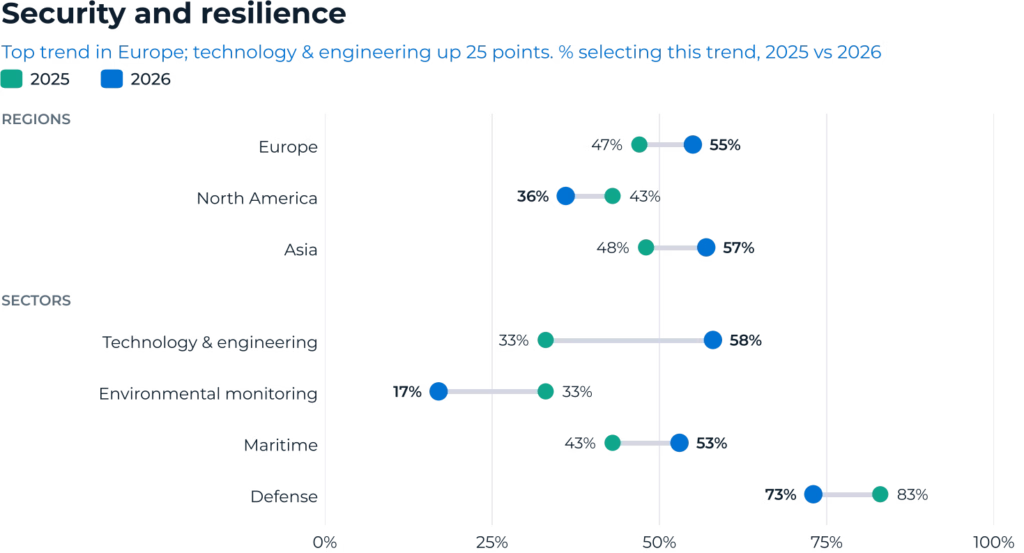
Security and resilience rose from 44% to 46% overall. It’s the top trend in Europe, and the sectors that care about it are changing.
- Europe rose from 47% to 55%, making it the region’s number one trend
- Technology and engineering nearly doubled, from 33% to 58%. Last year we flagged this sector’s low score as a possible blind spot
- Maritime rose from 43% to 53%
- Defense remains the most concerned sector at 73%, down slightly from 83%
- North America moved the other way, from 43% to 36%.
The technology and engineering result matters most. These are the companies designing the devices and systems that other industries depend on. When they start treating resilience as a priority, it moves out of the security team and into the product spec.
Europe’s rise comes as GNSS jamming and spoofing spread beyond conflict zones, affecting shipping lanes, airports and border regions. When positioning data can’t be trusted, everything built on it is at risk.
Resilience now has to be designed in from day one:
- Assured positioning, navigation and timing (A-PNT): an independent position source that can detect when GNSS is being jammed or spoofed
- Planned backup paths: where the application justifies it, a second communications route chosen and tested at the design stage, such as a dedicated satellite IoT service alongside cellular
- Store-and-forward messaging: data that is held and sent later, so nothing is lost when a link drops.
“Last year I said there would be no single winning design, and that diversity would matter at every level, including connectivity. That’s now showing up well beyond defense. If a single outage, a jammed GNSS signal or a change in one provider’s roadmap can take your operation down, that’s a design flaw. Build in an independent position check and a planned backup path for your critical data now, because retrofitting it later costs far more.”
Oliver Potter, CEO, Ground Control
2. Next-generation proprietary services: steady overall, surging where data matters most
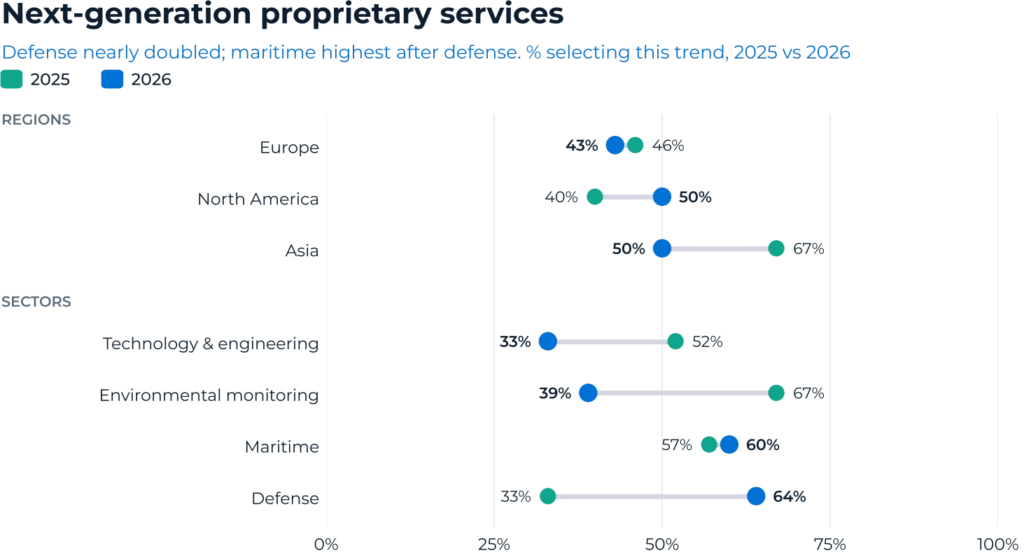
Interest in next-generation proprietary services edged up from 45% to 46%. The sector detail shows demand moving toward users who need richer data from the field.
- Defense nearly doubled, from 33% to 64%, now its second highest trend after security and resilience
- North America rose from 40% to 50%
- Maritime rose from 57% to 60%, behind only defense
- Environmental monitoring fell from 67% to 39%, and technology and engineering from 52% to 33%.
Services such as Iridium Messaging Transport (IMT) and Viasat IoT Nano (OGx) carry much larger messages than Iridium SBD and Inmarsat IDP, at a lower cost per byte once a device is sending over 10 KB data per month. That makes it practical to send engine diagnostics, sensor histories and detailed status reports alongside the basic position and heartbeat.
The sectors pulling ahead are the ones where that extra detail changes outcomes. Defense users need to know the readiness of vehicles and equipment as well as their location. Maritime operators want condition data from engines, cargo and safety systems. Many environmental sensors, by contrast, send a few bytes every hour, and for them the low data options covered in the next section may be the better fit. That’s the market working as it should, with each application finding the service that suits it.
“We predicted 2026 would be the year IMT and OGx moved from pilots into production, and that’s what we’re seeing with the customers we work with. The users who need richer data are the ones adopting fastest. Once a device is sending more than a trickle of data, the cost per byte falls sharply and the business case for richer telemetry writes itself.”
Oliver Potter, CEO, Ground Control
3. Standards-based NTN: the year of the pilot
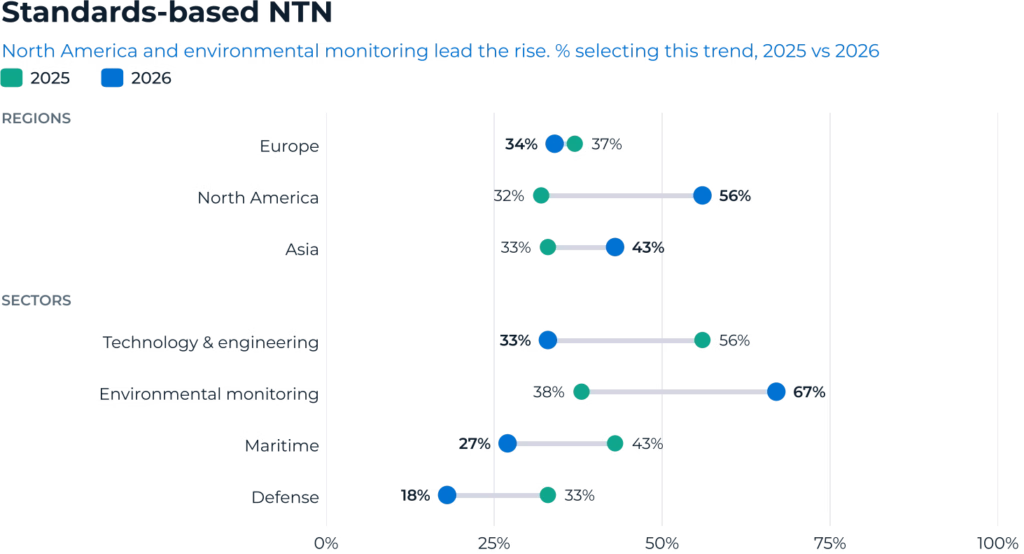
Standards-based non-terrestrial network (NTN) satellite IoT rose from 35% to 43%. A year ago, we predicted 2026 would bring a wave of NTN NB-IoT trials, and interest has grown in step.
- North America rose from 32% to 56%, the biggest regional jump for any trend in the survey
- Environmental monitoring rose from 38% to 67%, now the sector’s top trend
- Interest fell in technology and engineering (56% to 33%) and defense (33% to 18%).
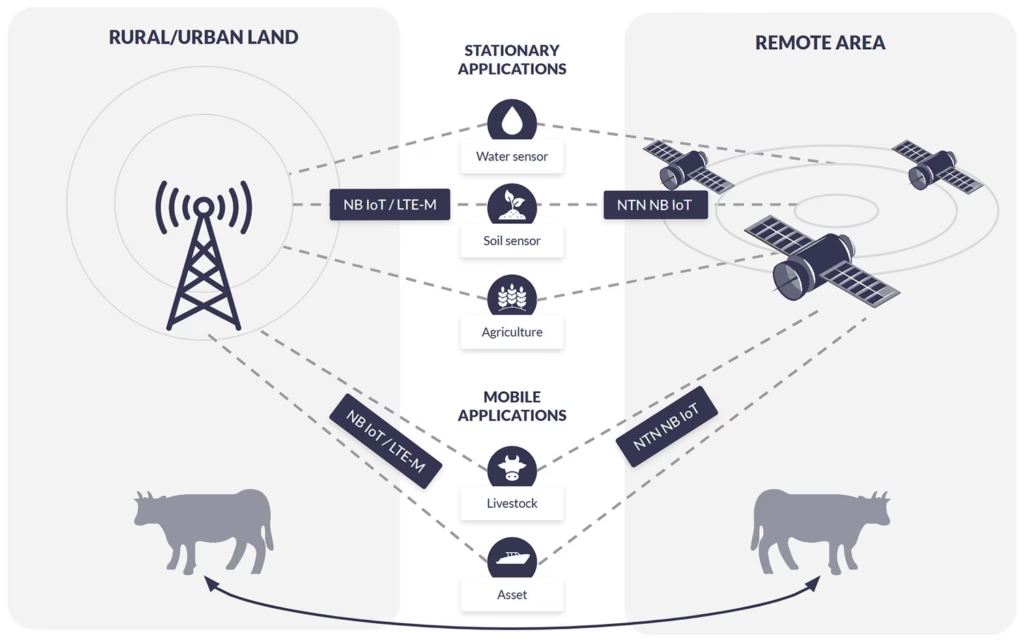
The split makes sense. NTN NB-IoT lets a device connect to satellites using familiar cellular technology and a single SIM. It suits low-data, latency-tolerant devices such as water-level sensors or weather stations that report every hour. It’s a weaker fit for defense users, who need prioritized, highly reliable traffic, or for applications that send larger, more frequent messages.
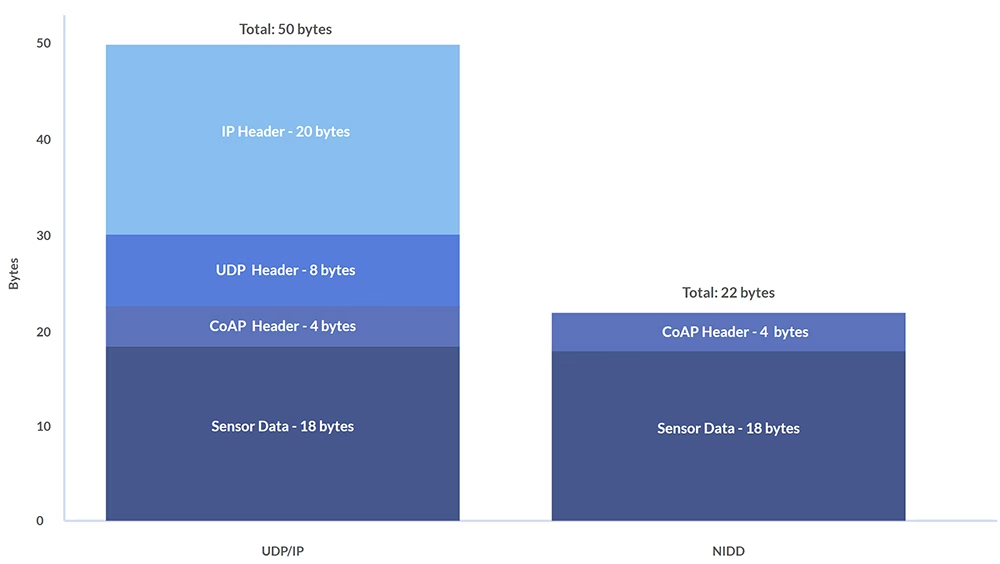
The economics come down to bytes. Standard IP messaging adds headers to every transmission, and on a satellite link you pay for each one. Non-IP Data Delivery (NIDD) strips that overhead out, which can make or break the cost per message at scale. Pilots prove a device can connect. Scaling needs predictable coverage, pricing, device certification and support across every region you operate in.
It’s also worth being cautious about the idea that NTN will be available everywhere, or work the same everywhere. Each provider has to secure spectrum and landing rights country by country, and coverage, latency and commercial terms vary widely between them.
Two services that are both described as NTN NB-IoT can perform very differently in practice, and a device proven on one may need further testing and certification for another. Moving freely between NTN networks is one of the technology’s key promises, but it’s likely to be several years before that works reliably in practice. Choosing a provider is still a real decision, and it should rest on proven coverage where your devices will operate.
“A year ago I said the early excitement about NTN would give way to real engineering work, and that’s where we are now. The interest is real, especially for simple sensors, but commercial services across the market are arriving later than projected. When they do launch, we expect operators to be careful about who gets access, to protect their network capacity. So plan NTN pilots around realistic timelines, and keep proven services in the plan for anything that needs to go live soon.”
Oliver Potter, CEO, Ground Control
4. Mega constellations: users expect the competition to bite
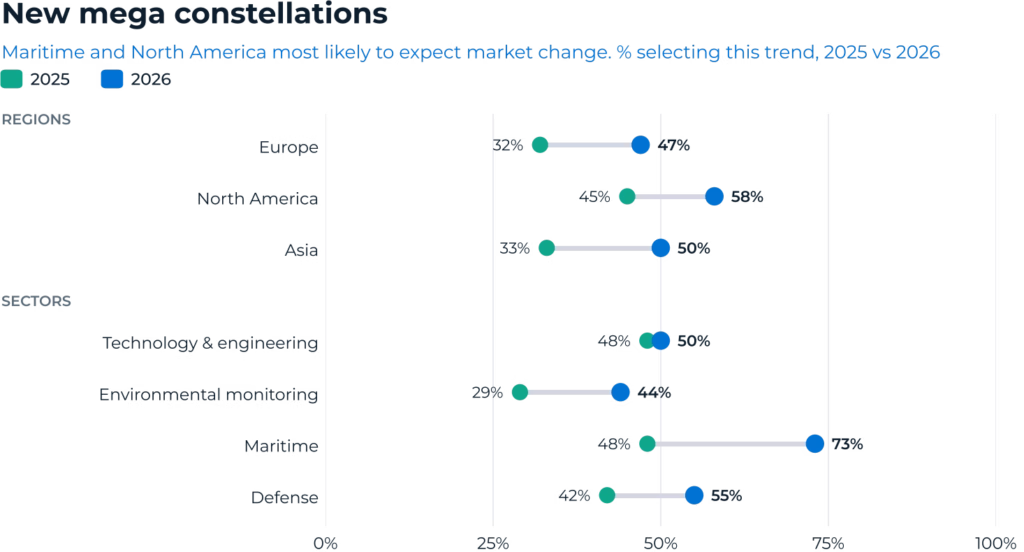
New mega constellations were the most-selected trend this year, rising from 39% to 52%. It’s worth being precise about what respondents agreed with. The option read: “Competition from players like Amazon Kuiper, AST SpaceMobile and Starlink increases, driving down costs and challenging traditional GEO satellite models.”
In other words, users expect these networks to change the market through more competition and lower prices. That’s the same picture we painted last year, when we warned that new constellations were creating over-capacity in satellite broadband and putting financial pressure on the whole sector.
- Maritime rose from 48% to 73%, the highest of any sector
- North America rose from 45% to 58%
- Environmental monitoring rose from 29% to 44%.
The maritime jump is easy to understand. Low Earth Orbit broadband has changed what ships can expect from a connection for crew internet, video and remote support. Broadband to a vessel and IoT from a sensor are very different jobs, though. A broadband terminal needs power, space and a monthly plan sized for gigabytes. A tracker on a container or a sensor on an unmanned buoy may need to run for years on a battery, sending a few bytes at a time. Many vessels will end up using both, each for what it does best.
The survey measures expectation, so it can’t tell us how many users are running IoT over these networks. The hurdles we listed last year (spectrum and landing rights, ground infrastructure, partnerships and sustainable pricing) will decide when, and whether, these networks become a good fit for industrial IoT.
There are also indicationsthat the largest constellations are focusing their direct-to-device plans on phones, vehicles and other commercial applications. Amazon Leo’s July 2026 FCC filing for a direct-to-device constellation is built around smartphones and other mobile devices, with deployment due to start in 2028. Starlink’s direct-to-cell service is sold through mobile operators such as T-Mobile. Commercially that makes sense, as phones and vehicles are enormous markets.
For IoT devices, it means a network designed and supported for IoT is still likely to pay dividends: predictable coverage, low power hardware, pricing built for small messages, and a long term commitment to the devices that depend on it.
“More competition is good news for users, and it will bring broadband prices down. But a cheaper broadband terminal doesn’t change the physics of a battery powered sensor in the middle of the ocean. The question to ask of any new network is the same as ever: does it meet this device’s needs for power, coverage, message size and long-term cost? For a lot of IoT, the answer today is still a purpose-built service.”
Oliver Potter, CEO, Ground Control
5. AI: still last, still climbing
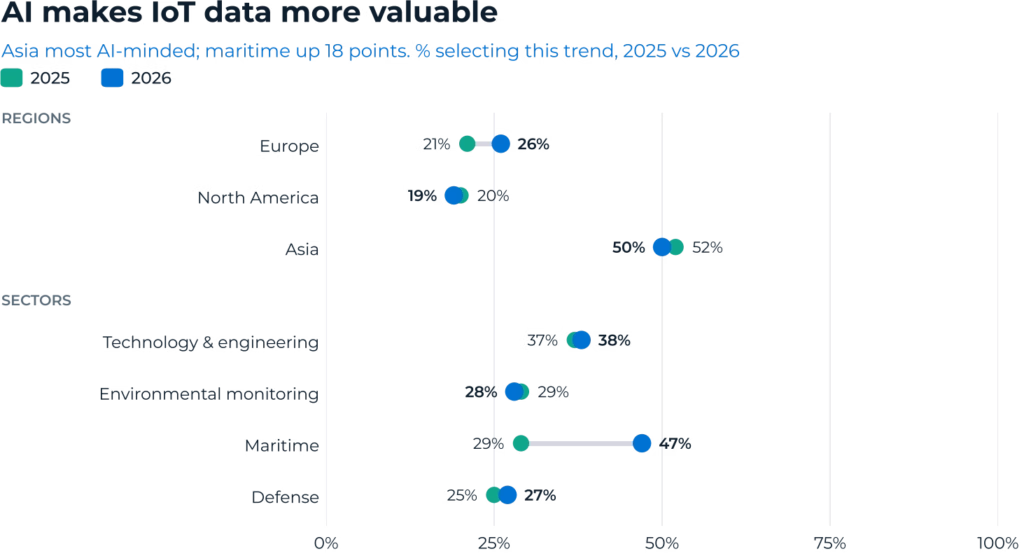
AI remains the least-selected trend, but it edged up from 25% to 29%
- Asia is still the most AI-minded region, at 50%, against 26% in Europe and 19% in North America
- Maritime rose from 29% to 47%
- Technology and engineering held steady at 38%, up from 37%.
For the most talked-about technology of the decade, a four point rise may look modest. We read it as engineering realism. Every byte sent over satellite costs airtime and battery life, and AI is only as good as the data it learns from. A device that sends “position OK, all well” once an hour won’t reveal a bearing about to fail.
That’s why AI and next-generation services are linked. Richer telemetry, such as vibration, temperature and pressure readings, gives a model something to work with. Larger messages over IMT and OGx, at a lower cost per byte for data-heavy applications, make that telemetry affordable to collect. And processing on the device itself can flag what matters, so the satellite link carries only the alerts that matter.
“AI turns satellite data from a record of what happened into an early warning of what’s about to happen. But you can’t analyze data you never collected. The organizations that will win with AI are getting their sensors, message design and data pipelines right now, so there’s something worth learning from when they’re ready.”
Oliver Potter, CEO, Ground Control
What this means if you’re building with satellite IoT
Two years of data point the same way: more choice, more change, and more reasons not to rely on a single network.
- Match the service to the job. Map each device’s message size, frequency, latency, power budget and coverage needs before you choose a network. For most deployments, the answer will be a mix.
- Design for resilience from day one. Plan for GNSS interference, network outages and supplier changes. An independent position check and a planned backup path for critical data cost far less to build in than to add later.
- Put richer data to work. If your application would benefit from more than a position and a heartbeat, test IMT or OGx. If you’re sending more than about 10 KB a month, a lower cost per byte can change the business case.
- Run NTN pilots with the real economics. Test with real payloads and real coverage, and check whether NIDD is supported and what it does to your cost per message.
- Watch mega constellations, with your requirements in hand. More competition will bring broadband prices down. Judge each new network on whether it meets your device’s needs. For most IoT today, a dedicated IoT network remains the safer choice.
The more options there are, the more valuable independent advice becomes. Ground Control works across Iridium, Viasat, standards-based NTN and more, so we can recommend the network that genuinely fits your application, and support it for the life of your deployment.
About the data
Ground Control surveyed its satellite IoT customers and partners twice: from September 15 to October 21, 2025, and from October 20 to November 4, 2026. Both surveys asked the same multi-select question with the same five options, plus “None of the above” and “Other”: “As someone using satellite connectivity in your work, your perspective matters. Which of these emerging trends do you think will shape your industry the most over the next 2-3 years?”
Regional and sector figures come from smaller groups, so small changes in responses can move the percentages noticeably. We haven’t reported any region or sector with fewer than 10 respondents. Technology and engineering are combined in both years.


Not sure which network fits your project?
Tell us what you’re connecting, where it will operate and how much data it needs to send. Our engineers will recommend the satellite IoT service that fits, and we’ll get back to you within one business day.