Kraken Project and the RockBLOCK
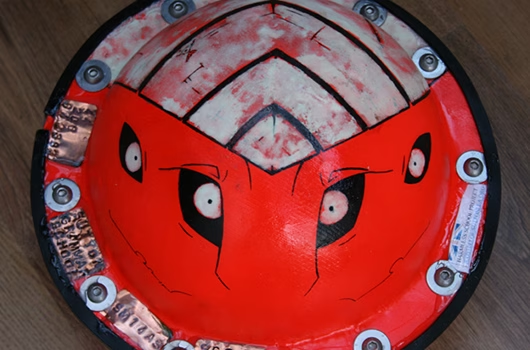
‘Kraken’ is a project by Sutton Grammar School, and this case study is written by them. The main concept behind the buoy is its primary use as an oil response system. The system is based around an oil response unit that aims to make it easier for oil companies to clean up spills quickly and effectively.
It consists of a series of buoys that cooperate to give an image of the spread of oil by using sophisticated GPS and radio technology. Using this, companies can get a picture of where oil has and will spread and then clean up spills as fast as possible.
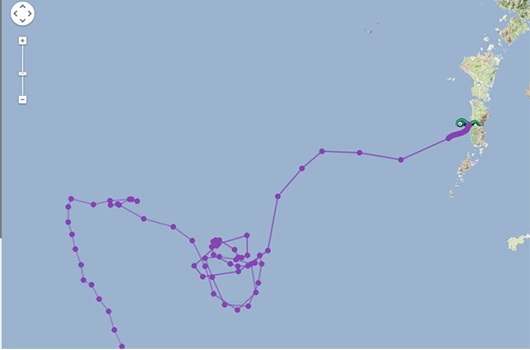
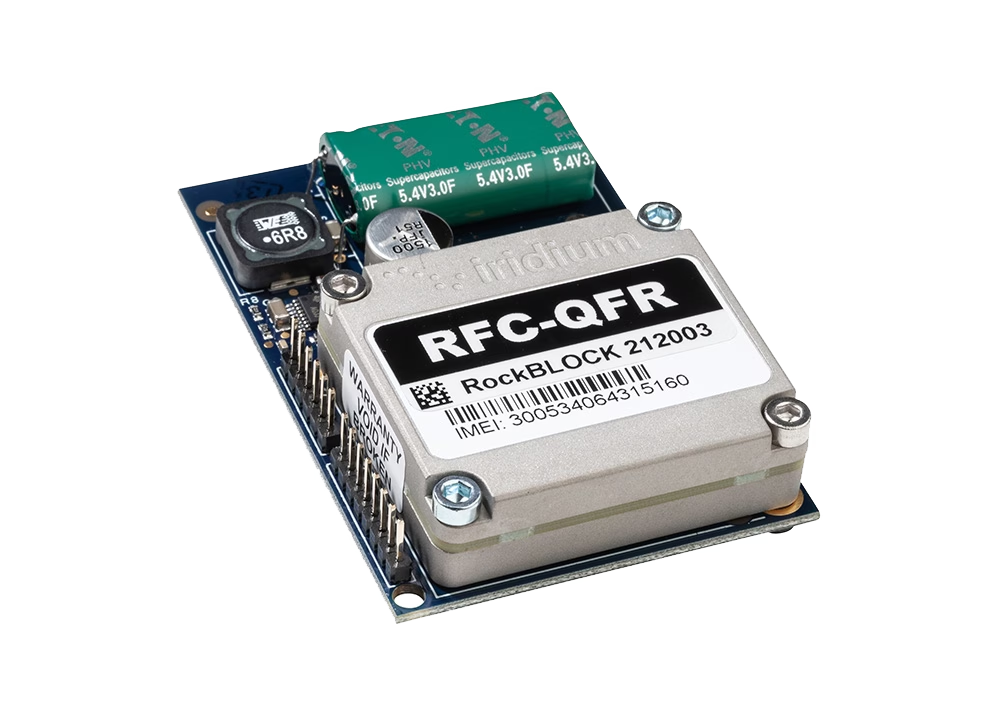
RockBLOCK 9602 is used to transmit the GPS position and other collected data back to a central management system to allow monitoring of the situation in near real-time.
Components of the Kraken Buoy:
- Arduino Atmega328 controller
- uBlock Max 6Q
- Inertial and Temp Sensors
- RockBLOCK 9602 naked unit.
GPS – U-blox Max 6Q
These determine the location of each buoy as a latitude and longitude, and provide accurate synchronised timekeeping (GPS time) for all buoys. GPS modules communicate with the Arduino via the UBX binary protocol over a serial RS232 interface and use Sarantel SL1202 (now discontinued) antennae. The modules have been optimized for 2-D ocean use in power-saving mode (positional fix every five minutes). The team used these receivers partly because they’re very small (so will fit into the ‘nymphs’) can be put into low power mode to extend the battery life of the buoys while at sea.
Hope Microelectronics RFM22B Transceiver
[Short Range Radios]
These are low-power boards used for short range communications (sending GPS data) between buoys in the Poseidon network. The team used this open source Arduino library for easy communication between the Arduino and radio modules. Packets of data are automatically encoded and decoded, further simplifying the Arduino programming.
Arduino Atmega328
This microprocessor chip is used by the Arduino Uno board (but is in surface mount form on our buoys). They are programmed in C with the Arduino IDE version 1.0.1 and coordinate the behaviour of each buoy, decoding and relaying data from various components, e.g. the GPS receivers or the IMU out to the RockBLOCK radio.
Buoy Network Concept
The students aimed to fully utilize the benefits of an entire network of buoys by allowing the ‘nymphs’ to relay each other’s transmissions to the ‘Kraken’, in case some drift out of range of the RFM22B radios. Each nymph broadcasts the GPS data it has stored in its memory to all other buoys, which receive and store this data in their own memories. This means that each time a buoy transmits its memory contents, it is transmitting GPS data on behalf of all the other buoys (not just its own location).
So if a buoy moves out of range of the ‘Kraken’, its data will still reach the Kraken providing that other nymphs are still in range to act as relays. The Kraken collects all these data transmissions to send back to the team via the Iridium constellation, enabling them to track the location of each buoy in the network whilst using only one RockBLOCK radio.
Kraken Buoy Features
- Iridium Satellite Constellation: The team use this satellite network to relay data from the buoys (wherever they are in the world) back to project HQ. The RockBLOCK radio sends data to a passing satellite. The satellite relays this data to a ground station that then emails it to the team. This includes GPS readings to update their live map.
- Inertial Measurement Unit (IMU): The IMU is sampled at 10Hz and data is transmitted back to the team to analyse.
- Additional Sensors: The buoy also contains an onboard battery voltage monitor, so they know how much longer the batteries will last. Internal temperature sensor (located near the edge of the buoy to be as close as possible to the outside water temperature). Connected to the Arduino via a one wire interface.
Supporting Educators
The work we support genuinely inspires us, and we’re proud to support educators bringing learning to life.
If you’d like to get in touch with the team either to discuss an opportunity or project similar to that of the one above, or something completely different our team of experts will be happy to provide objective advice.