Last updated
Keeping Uncrewed Systems on Course Through Jamming and Spoofing
In our recent webinar, Ground Control’s Drew Jackson and Jeff Staples introduced RockBLOCK APNT. They covered how it stands up to jamming and spoofing in the field, what it takes to integrate, how Iridium PNT licensing works and what it costs. Here are the highlights.
For anyone operating uncrewed systems, GNSS interference has moved from an edge case to a planning assumption. In the first quarter of 2026 alone, more than 1,100 vessels in the Gulf experienced jamming. Across the region, operators have reported thousands of individual interference events in busy shipping lanes.
With nobody on board, a jammed platform may simply lose its way or trigger a failsafe. As Jeff points out, spoofing can be harder to recover from. A jammed asset can often still be retrieved, while a spoofed one can be led somewhere else entirely. That’s the problem RockBLOCK APNT has been built to address.
Why Today’s Countermeasures Fall Short
We’ve written before about designing UAVs for GNSS-denied environments, including the limits of inertial, visual and multi-constellation approaches. In the webinar, Drew added two more countermeasures to the list:
- Anti-jam antennas steer their reception away from the source of interference. They work well against a single jammer in a known direction. When interference comes from above, which is increasingly common, they lose much of their advantage. They are also complex and costly
- Terrestrial backups such as eLORAN are seeing renewed interest, but coverage is limited mainly to some coastal regions.
Each has its place, and none covers every environment an uncrewed platform might work in.
How Iridium PNT Is Different
Iridium PNT takes a different approach to both jamming and spoofing.
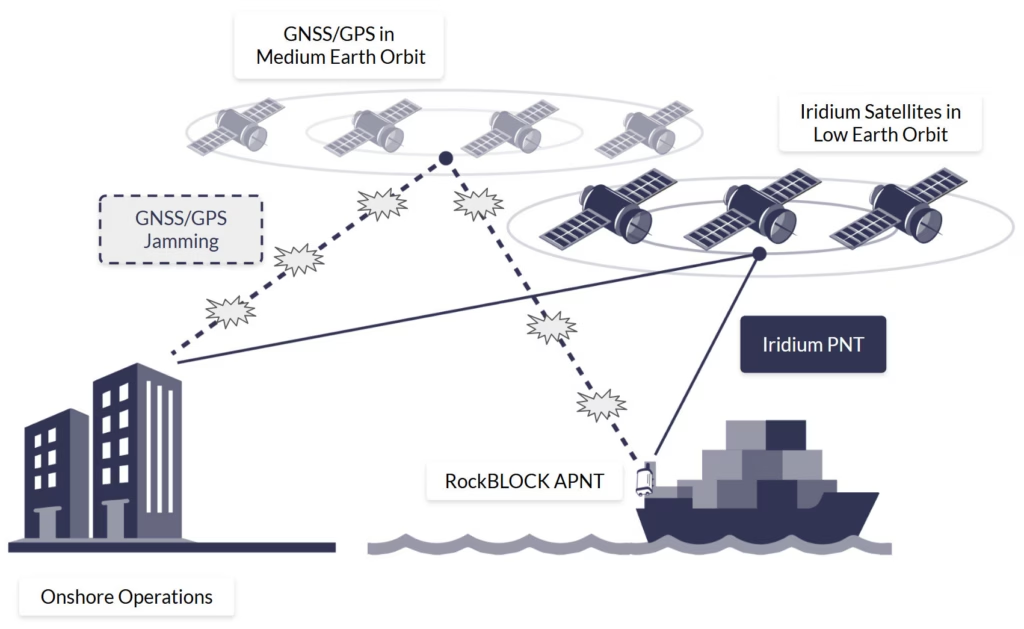
A much stronger signal. Jamming works by drowning out the faint timing signals a receiver needs to calculate its position. Iridium’s satellites sit in low Earth orbit, far closer than GNSS satellites, and focus their signal over a smaller area. The result is a signal around 1,000 times stronger than GNSS. To overpower it, a jammer has to match that difference and aim it accurately at the receiver. As Drew put it, “most of the time we’re just trying to shout louder than the jamming.”
The trade-off is that a receiver can see fewer satellites at once, which affects accuracy (more on that below).
An authenticated signal. A GNSS receiver cannot tell a genuine satellite signal from a convincing fake. Iridium PNT encrypts and authenticates its timing bursts, so the receiver knows each one comes from a trusted source. A spoofer cannot replicate that, so it cannot feed the receiver a false position.
Introducing RockBLOCK APNT
RockBLOCK APNT is a compact, receive-only module that brings Iridium PNT to uncrewed platforms. We were its first customer: it already provides assured positioning in our own maritime tracking product, RockFLEET Assured.
- Size: 59 x 36.5 x 7.7 mm (2.32 x 1.44 x 0.30 in), about half the size of a credit card
- Weight: 10 g (0.35 oz), excluding antenna
- Power: about 1 W average (0.95 W nominal, 1.2 W peak)
- Operation: receive only, one timing burst per second
- Output: NMEA-style sentences over serial
- Interfaces: USB-C, 3.3 V TTL UART via Molex Pico-Clasp header, dedicated 1PPS on MMCX
- Certification: Iridium certified.
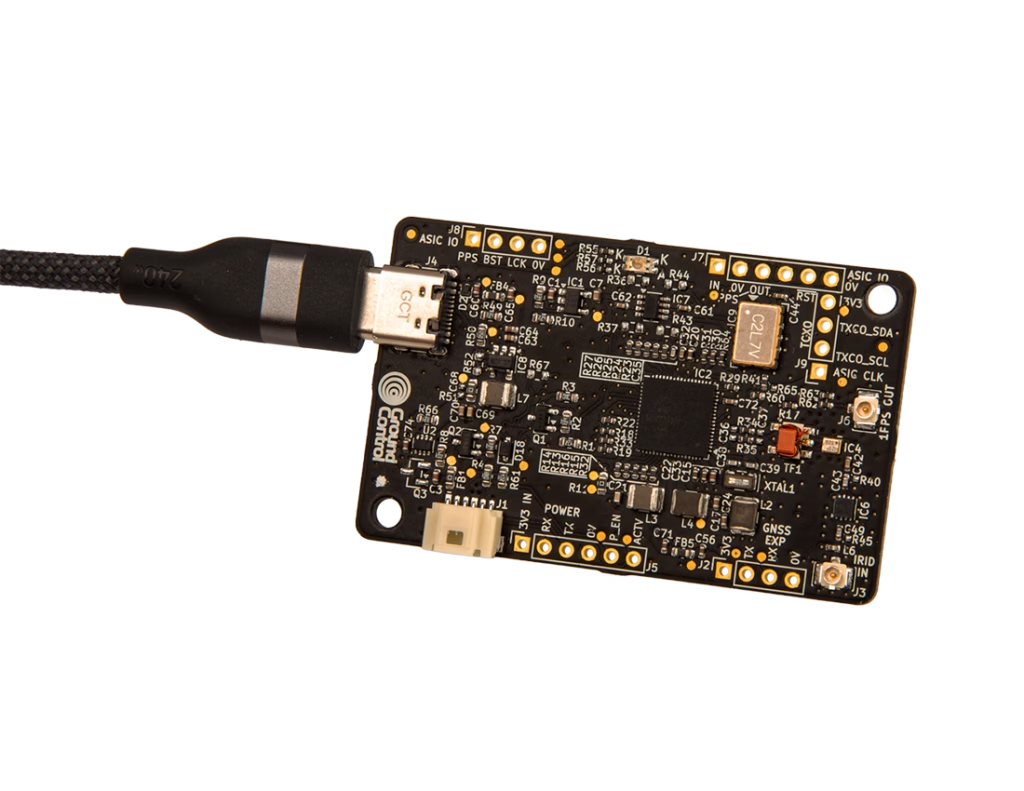
Like the rest of the RockBLOCK range, it’s designed to take care of the hard parts of Iridium’s technology so engineers can get on with building. Ground Control handles the oscillator, RF, power and certification. Every pin of the Iridium ASIC is broken out, so integrators aren’t constrained.
The developer kit arrives with a certified Calian antenna attached. Plug in the USB-C cable and the serial output appears on the host system right away. The output sentences are NMEA-style, so they’re human readable and familiar to anyone who has worked with GNSS receivers.
The board in the developer kit is the same board used in production. Teams can move from evaluation to embedding with no hardware changes, which matters in industries where speed and supply chain certainty are critical. RockBLOCK APNT is in volume production today.
A Layer of Resilience, and What to Expect From It
Iridium PNT is less precise than GNSS and is designed to work alongside it, giving the host system an independent check on its position. Accuracy depends on a few factors, which is why quoted figures can vary:
- Latitude. Iridium satellites converge toward the poles, so a receiver sees more of them at higher latitudes and resolves its position more accurately
- Motion profile. Platforms moving on a consistent heading and speed get better results than those changing direction and speed frequently. Consistent does not mean slow: within reason, faster movement gives the system more to work with.
RockBLOCK APNT is already operating in uncrewed surface, ground and aerial vehicles, keeping them on task through heavy interference. The best way to understand its performance is to test it on your own platform. Our team can help interpret the results and tune the settings for your use case.
We’ve also put it to the test at Jammertest in Norway, an event that deliberately subjects equipment to intense jamming and spoofing on land and at sea. RockBLOCK APNT continued to perform as intended against high power ground-based jammers. Devices in the field in the Strait of Hormuz have kept working while large coastal jammers were operating nearby.
Licensing Tiers and Pricing
Iridium PNT is licensed in three tiers, each giving a different output. Choosing the right one is key to getting the best performance.
| Tier | What It Provides | Typical Use |
|---|---|---|
| Time | Precise timing only | Static infrastructure such as cell towers or moored buoys |
| Locate | Position output as NMEA-style sentences | Moving assets, typically slower-moving uncrewed vehicles and vessels |
| Navigate | Locate output plus satellite vehicle information (satellite heading, speed and Doppler shift) | Platforms with a sensor fusion engine, for tighter IMU correction |
The Navigate tier is the natural choice for more sophisticated autonomous platforms. Feeding satellite data directly into a fusion engine allows much better correction of inertial drift. License availability depends on your application and region, so talk to our team and we’ll confirm which options apply to you.
Pricing
- RockBLOCK APNT module: $495 USD (single unit)
- Developer kit, including antenna and a threemonth evaluation license: $695 USD
- Licenses: typically under $1,000, depending on tier and use case. Some are lifetime licenses; some commercial licenses renew annually.
A license key is loaded onto each device and counts down from activation. When it expires, the device stops providing PNT output until it is renewed.
From the Q&A
What does “up and running quickly” really involve? Very little. One customer in the US received a unit, installed it on an aircraft the next day and emailed that evening to say it was working. Plug it in, read the sentences and start integrating.
How long is a cold start? Allow five minutes for the most reliable fix. It can work sooner, especially if the platform moves at a steady speed and heading after start-up.
Is there a maximum speed? RockBLOCK APNT supports speeds up to Mach 2. Within that range, a faster platform on a steady course can improve accuracy, as it gives the system more to work with.
Does it need USB-C power? No. USB-C is there for convenience during evaluation. The board can be powered through the Molex connector or wired directly via through-holes.
Can it be combined with an Iridium modem? Yes. RockFLEET Assured pairs RockBLOCK APNT with RockBLOCK Pro for two way communications. The module can gate its receiver while a nearby Iridium device transmits, so a platform doesn’t interfere with itself.
Does the antenna matter? Very much. The antenna, cable length and cable loss all need to be matched to the system. Our team can recommend the right setup for your platform and adjust settings to suit.
Get Started
We’ve spent nearly two years working with the Iridium PNT service and have learned plenty of subtleties along the way. If you’re building uncrewed systems that need a resilient, independent source of position and timing, we’d love to help you evaluate RockBLOCK APNT.
Boards are in stock and shipping now. Get in touch with our team to order a developer kit or discuss licensing for your application.