Last updated
Iridium NTN Direct for Cellular IoT: Gains and Trade-offs
We’re looking forward to Iridium’s NTN Direct service, activated in November 2026, which will let NB-IoT devices built on a compatible 3GPP Release 19 chipset roam onto Iridium’s LEO satellite network when they run out of terrestrial coverage.
Anyone building connected devices will know that coverage gap. Picture a cellular tracker on a shipping container, a farm vehicle or a utility asset. It works well within range of a cell tower, then crosses an ocean, drives into a valley or sits on a remote site, and goes silent until it’s back in coverage.
The standards have been working toward closing that gap for a while. 3GPP Release 17 brought satellite NB-IoT into the cellular standards, and services built on it have started to fill coverage holes in some regions. Iridium NTN Direct is the first standards-based service backed by a truly global network, although access will roll out operator by operator. Nordic Semiconductor’s nRF9151 module is the first Iridium has certified, with compatible firmware due in January 2027. Early adopters such as Nofence, which makes virtual fencing collars for livestock, are already building the service into their products.
For cellular designers, this opens up satellite connectivity to a new class of product. Go in with the right expectations, though. NTN Direct won’t behave like a 5G connection in the sky. It may suit some applications that use SBD today, but it won’t be the right fit for all of them. That raises a fair question for existing SBD customers: where does the new service fit alongside the one you rely on today?
In this post we’ll explain what Iridium NTN Direct is, how to design your application to make the most of limited satellite data, and how it compares with Iridium’s other services, so you can choose the right fit.
What is Iridium NTN Direct?
Iridium NTN Direct is a 3GPP standards-based service that delivers narrowband IoT (NB-IoT) over Iridium’s Low Earth Orbit (LEO) satellite constellation. NTN stands for non-terrestrial network: any network where part of the radio link runs through space rather than a cell tower. A compatible NB-IoT device roams onto Iridium’s network much as a phone roams between operators. In practice, though, the experience differs noticeably, as we’ll cover later.
Iridium activated the service on November 17, 2026. It’s sold through mobile network operators, with partners including Deutsche Telekom IoT and Vodafone IoT. Iridium is also positioning NTN Direct for direct-to-device (D2D) services such as smartphones, wearables and vehicles, which suggests it’s aimed mainly at large scale consumer and light industrial ecosystems built on standard cellular chipsets.
What Does Iridium NTN Direct Add To Cellular IoT?
- Global reach on a standard cellular design. Earlier services cover selected regions, while Iridium’s LEO network covers the whole planet, including oceans and polar regions.
- One radio, one stack, one SIM. On a compatible chipset, adding satellite to a cellular NB-IoT design comes down to a firmware update, Iridium certification and a roaming agreement. You don’t need a separate satellite modem or airtime contract, though it’s worth checking that your antenna covers Iridium’s L-band frequencies.
- Expanded IoT device classes. Cellular trackers, vehicles, logistics and agricultural devices that only need occasional check-ins beyond coverage can add satellite without a second radio.
Iridium NTN Direct extends a cellular device’s reach, but roaming from terrestrial onto a LEO network doesn’t recreate the cellular experience. Your device can reach space, but how much data it can practically send, and how often, is limited. That matters when choosing the right satellite service for your application.
Bytes, Not Bandwidth: Designing a Cellular Device For NTN
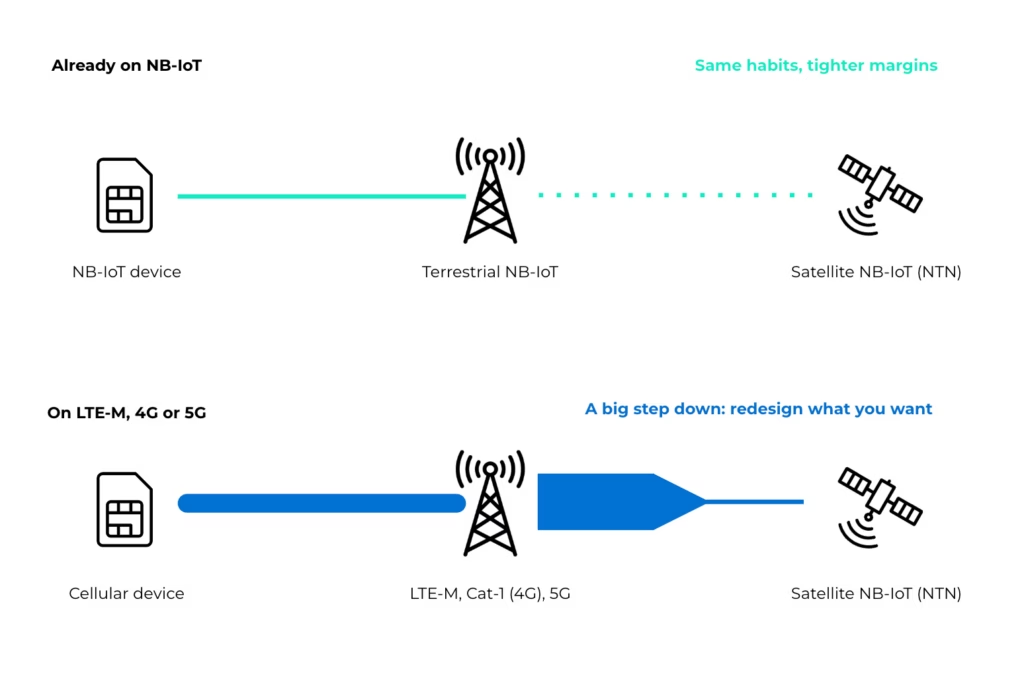
If your device already runs on terrestrial NB-IoT, moving onto satellite builds on what it does today. NB-IoT is already designed for small, infrequent messages, with low data rates, some tolerance for delay, power saving modes and lightweight protocols such as UDP or Non-IP Data Delivery (NIDD). The same chipset, SIM and habits carry across to NTN. What changes is the margin for error: satellite data costs much more per byte, throughput is narrower still, and delivery depends on satellite scheduling. Good practice on terrestrial NB-IoT becomes essential over satellite.
The bigger shift is for devices that use LTE-M, Cat-1 (4G) or 5G on the ground and fall back to NB-IoT over satellite. Many NTN-capable chipsets support LTE-M as well as NB-IoT. For these devices, leaving terrestrial coverage means stepping down from a link built for richer data to one built for a few bytes at a time.
Cellular IoT, and 5G especially, encourages an always-on mindset: devices keep sessions open and send whatever they need, whenever they need. Over satellite NB-IoT, signaling, network acquisition and satellite scheduling make delivery less predictable, so plan for longer, less predictable delays than on the ground.
NTN NB-IoT Transmission Checklist
Use this checklist when you set up your device’s satellite mode.

Treat satellite as its own mode
Satellite mode works best as a distinct device state, with its own reporting profile, rather than a simple change of network.

Send only what matters
For most applications that’s position, status, alarms and a periodic heartbeat, with everything else held for cellular.

Shrink the payload
Compact binary encoding keeps messages in the tens of bytes, where NTN is most cost-effective.

Drop the IP overhead
UDP works, but NIDD avoids header and session overhead altogether, which counts for more when every byte is billed.

Cut background chatter
Keep-alives, firmware checks, cloud syncs and time sync are worth suspending in satellite mode, as they add up quickly over satellite.

Batch, buffer and prioritize
Keep a prioritized queue so alarms go out first, and combine routine readings into fewer messages to cut per-message overhead.

Design for delay
Tolerant timeouts and commands that are safe to repeat handle the less predictable delivery times of satellite scheduling.

Limit downlink
Acknowledgments and commands count toward data use, so reserve them for messages that need confirmation.
Watch the signaling
Attach procedures, re-registrations and retries all use data on top of the payload, and they’re less predictable than the payload itself.

Save power with PSM and eDRX
Power Saving Mode (PSM) and extended discontinuous reception (eDRX) matter even more over satellite, where retries and longer delivery times can otherwise drain the battery.
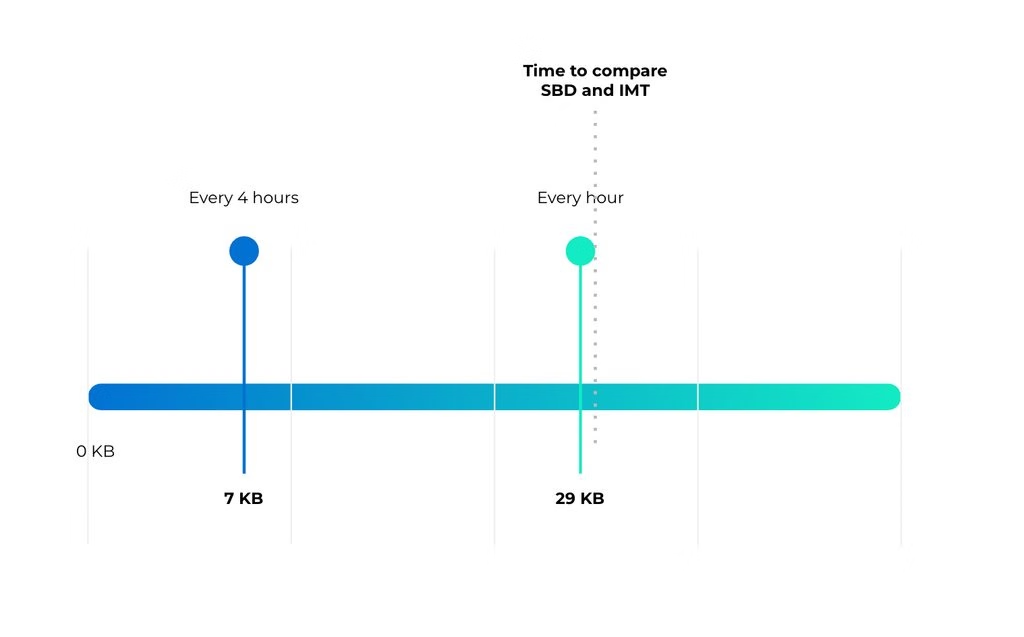
Consider a logistics tracker that sends a 1 KB status packet every 15 minutes on cellular. In satellite mode, it switches to a 20 to 40 byte position and alarm message every four hours and holds everything else until it’s back in coverage. That’s up to around 7 KB of payload a month before signaling overhead, well within NTN’s small data range. Send it hourly and the payload climbs to around 29 KB a month, enough that it’s worth comparing NTN costs with SBD and IMT below (figures are illustrative).
Where SBD And IMT Will Do The Job Better
NTN Direct doesn’t automatically replace Iridium’s existing IoT services. Each is built for a different job.
SBD: The Proven Short Message Workhorse
Iridium SBD has carried short messages for more than two decades, for buoys, trackers, remote sensors, defense systems and maritime equipment. Because it was built for satellite from the start, its delivery behavior is well understood. It supports two way messaging, and its modules are small and mature. Each message carries up to 340 bytes from the device (mobile originated) and 270 bytes to it (mobile terminated). For satellite first products that need consistent message delivery, or that send time sensitive alerts and commands from anywhere on Earth, SBD remains a dependable choice.
For industrial, defense and maritime customers, SBD has four practical advantages today:
- Global coverage now. Iridium’s constellation covers the whole planet, and an SBD device provisioned through Ground Control can use it everywhere straight away. NTN Direct connectivity depends on each mobile operator’s roaming agreements and local regulatory approval. These will roll out market by market, so some remote jurisdictions and territorial waters may not be covered at first.
- Reliable in tough conditions. SBD was designed specifically for Iridium’s network and has decades of field performance in heavy weather and with less than ideal antenna placement.
- Predictable billing. SBD airtime is billed per message or per byte, without the attach and signaling overhead of NTN roaming, and data pooling lets a whole fleet share one allowance.
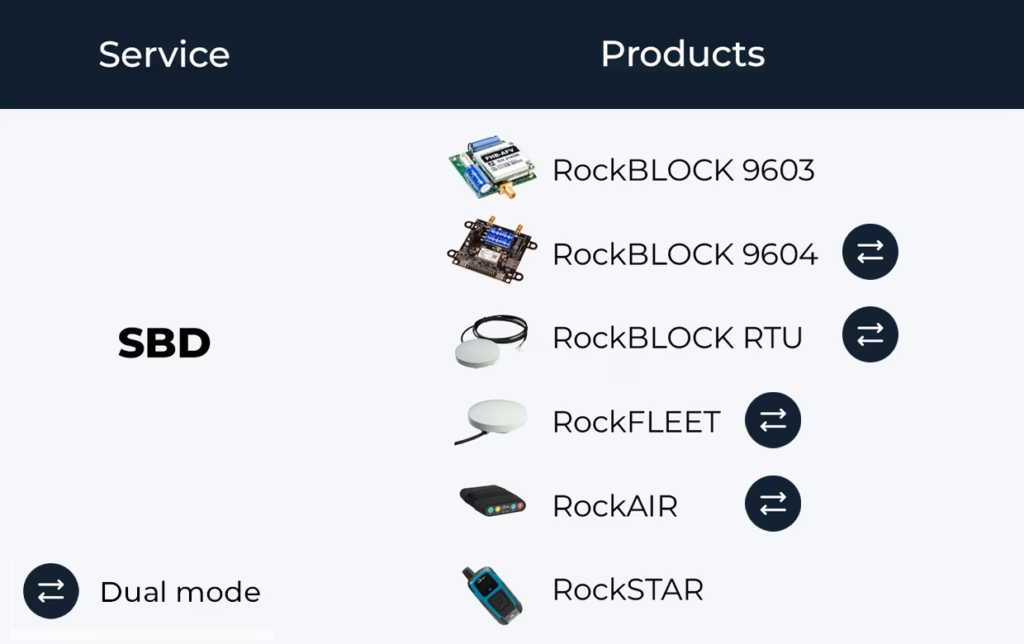
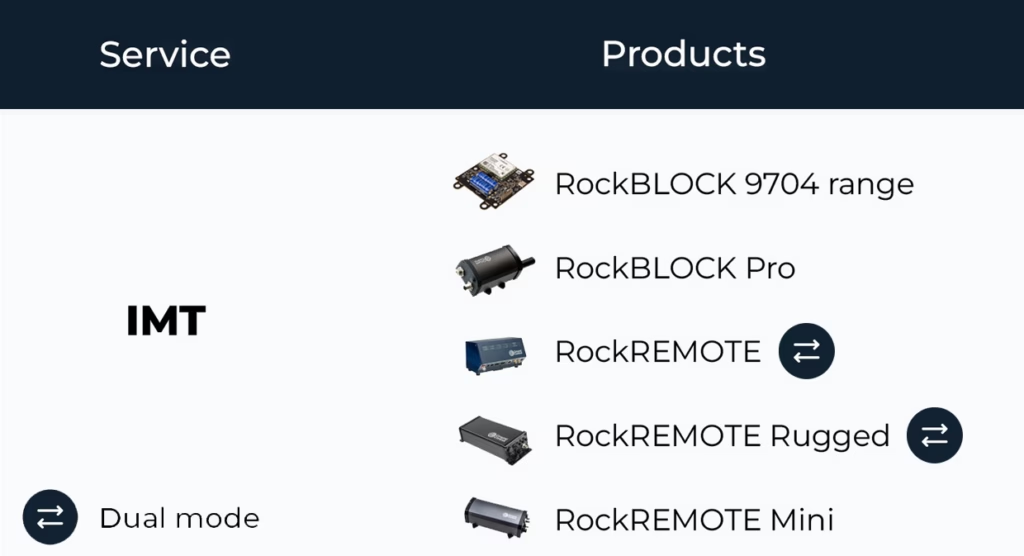
- Dual mode hardware already exists. If you want cellular and satellite in one device today, you don’t have to wait for NTN Direct. Dual mode Iridium and LTE devices are available now, including those built on the Iridium 9604 module (commercially available since June 2026), which combines SBD, LTE-M and GNSS.
IMT: When A Message Needs To Carry More
Iridium Messaging Transport (IMT) is the step up when messages outgrow SBD, carrying much larger messages for richer sensor logs, image thumbnails and configuration files. If your devices send more than about 10 KB a month, IMT is usually more economical per byte than SBD.
Stepping up to IMT brings:
- Up to 100 KB each way. Messages of up to 100 KB in both directions leave room for configuration files and updates sent to the device, as well as readings from it. IMT modules also manage message queuing and retries themselves, which takes that work off your application.
- Richer data for analytics and AI. Larger messages let you send full sensor logs and histories in place of single readings. In our 2027 satellite IoT trends report, 29% of satellite IoT users said AI will shape their industry over the next two to three years, rising to 47% in maritime. Models can only learn from the data you give them, so if AI is in your plans, start building those data sets now.
- A path to IP. Devices built on the Iridium Certus 9770 module, such as RockREMOTE Mini and Mini OEM, can also use the Certus 100 IP service when an application needs more than messaging, so you can scale up without changing network.
How These Iridium Services Compare:
| Iridium NTN Direct | Iridium SBD | Iridium IMT | |
|---|---|---|---|
| What it is | 3GPP NB-IoT over satellite | Proprietary short burst data | Proprietary messaging service |
| Message size | Small; most cost-effective at tens of bytes | Up to 340 bytes sent, 270 received | Up to 100 KB each way |
| Coverage | Global network, with access depending on operator roaming agreements | Global, available immediately | Global, available immediately |
| Access | Through mobile operators, with access terms set by each operator* | Direct through Ground Control, from a single device, with data pooling | Direct through Ground Control, from a single device, with data pooling |
| Status | Activated November 17, 2026; Nordic nRF9151 certified, with compatible firmware due January 2027 | In service | In service |
| Choose it if: | Your device is cellular first and only needs occasional satellite check-ins of tens of bytes | You need short, time sensitive messages delivered dependably, on satellite alone or as failover from cellular | Your messages have outgrown SBD, on satellite alone or as failover from cellular |
| Best for: | Trackers, vehicles, logistics and agricultural devices that mostly run on cellular | Buoys, trackers, remote sensors, alarms and remote commands, in industrial, defense and maritime applications | Richer sensor logs, image thumbnails and configuration files |
*NTN Direct is sold through mobile operators, not directly by Iridium. As our CEO Oliver Potter noted in our 2027 trends report, “we expect operators to be careful about who gets access, to protect their network capacity.” In practice, we expect that to mean operators prioritizing customers with hundreds of devices or more, at least at first.
Satellite Dual-Mode or Failover?
Dual mode and failover are often used interchangeably, but they aren’t quite the same thing. A dual-mode device simply has two connectivity paths available, such as cellular and satellite. Failover is the behavior: when the primary path drops, the device switches automatically to the backup so data keeps flowing. A dual-mode device can be set up for failover, or to choose a path by rule, for example sending routine data over cellular only and alarms over whichever link is available.
Iridium NTN Direct brings cellular to satellite failover to NB-IoT devices built on compatible 3GPP Release 19 chipsets, but satellite failover itself isn’t new. SBD and IMT already support it today, with the larger messages and consistent delivery of Iridium’s purpose-built services. Many applications will use more than one service for resilience, and the right choice depends on where your devices operate, what they send, how often, and how quickly the data has to arrive.
Adding Satellite Connectivity to a Cellular Product?
Talk to our team about NTN Direct integration and register your interest in our upcoming NTN products. Already using SBD and not sure whether NTN, SBD or IMT fits your next design? We can help you weigh up message size, timing and cost.
For your questions answered by our technical experts, complete the form, or email hello@groundcontrol.com and we’ll reply within one working day.