Topic: Utilities & Renewables
Secure data transmission: the key to unlocking Utilities’ operational success?
It’s a challenging time to be a Utility provider. Where once there was predictability, there is now uncertainty.
Consider the climate: temperatures are rising, which places greater strain on the grid as people seek to cool their homes and premises down. Further, extreme weather events are increasing, impacting power lines and towers, and the communication networks that help Utility companies find and identify the issue.
There’s also the growing threat around cyber security. In fact, 44% of respondents to our recent survey of US homeowners said that they considered hackers to present a threat to their Utilities supply.
Related to this is the challenge of ageing infrastructure. With the retirement of 2G and 3G networks impacting telemetry and control, Utilities providers need to explore new means of securely collecting data for their SCADA systems.
Ultimately, all three challenges pivot around reliable and secure data collection.
Data is the key to operational success in Utilities
The key to operational success in Utilities is to collect accurate, real-time data from infrastructure and assets, at every point in the supply chain – from networks to plants, treatment environments to customers.
Armed with better data, utilities companies can more effectively model the impact of extreme weather events, and plan accordingly. They can measure wind speeds and water levels at wind farms and hydro-electric facilities in real-time, knowing when the conditions are right to increase renewable energy production. They can determine when remote facilities are working optimally, and when they are not, and in some instances, they can even resolve the problem through remote commands, without having to send an engineer onsite.
However, the number and severity of cyber threats to utility companies continues to grow exponentially as the world becomes increasingly connected. According to research firm Gartner, in 2020, there were 20.4 billion internet-connected devices, with approximately 37 percent of these being used outside consumer settings—including large numbers dedicated to infrastructure monitoring and control.
What cyber security threats are utility and renewable companies facing?
For Utilities and Renewables, the remote site environments and silo operation sites are a tempting prospect for cyber attacks. McKinsey reports that both geographic distance and organisational complexity make the utility industry vulnerable. Indeed, there’s potential threat impact across the whole value chain:
However, the cyber threats to electric-power and gas security are not too great to overcome. McKinsey advises that a structured approach that ‘applies communication, organisational and process frameworks along with technical improvements in a few areas, can significantly reduce cyber-related risks for utilities.’
The adoption of secure and reliable remote connectivity services can provide an effective barrier and line of defence in the event of a cyber threat or attack.
Our latest ebook explores the challenges facing Utilities companies, but quickly turns to the connectivity options available to mitigate the risks of cyber attacks and ageing infrastructure.
Download eBook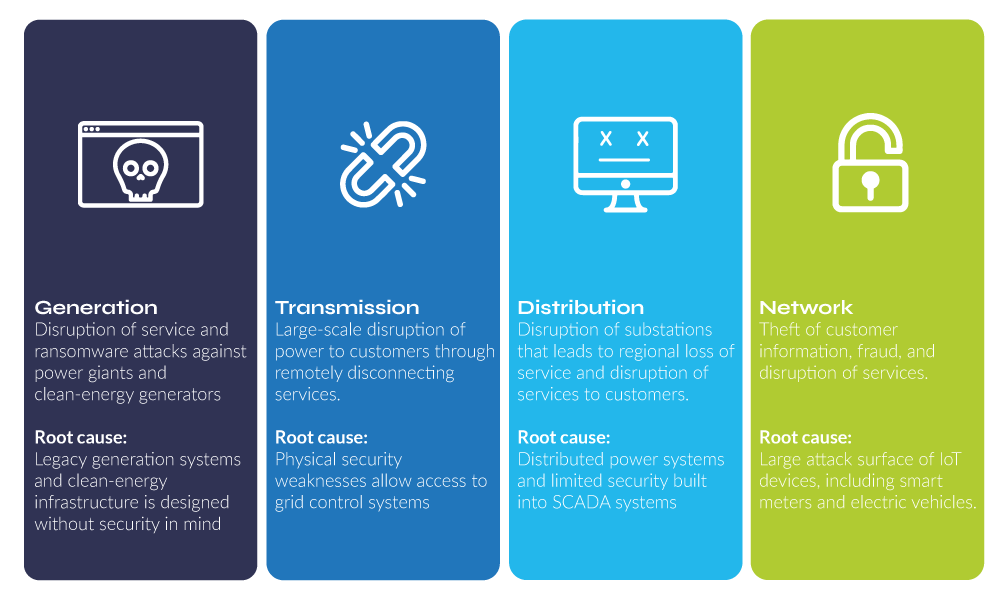
Get in Touch
Ground Control works with utilities and renewable energy companies around the world, and together we have devised strategies that provide robust, reliable and secure data transmissions, balancing the value of the data with the cost of retrieval.
If you’d like to find out more about our work with Utilities companies, get in touch today.
Powering Tomorrow: Challenges and Opportunities in Utilities
In this webinar, recorded live on 26th January 2022, four experts in the field of IoT / M2M connectivity discussed the challenges Utilities and Renewables companies face over the next decade, from ageing infrastructure to cyber security to climate change.
Industrial IoT in the time of COVID-19
First, Damian Lewis from Inmarsat revealed the findings from a recent research project into “Industrial IoT in the time of COVID-19“. In Electrical Utilities, Inmarsat discovered that IoT projects represented the highest proportion of overall IT budgets. When executed, IoT projects were delivering a 30% cost saving over a five year period.
But connectivity was plaguing these projects. 75% of the electrical utilities companies surveyed encountered connectivity problems, and 59% of respondents stated that terrestrial networks like fibre and cellular are not entirely suitable for their needs. Despite this, only 32% are using satellite connectivity – far below the survey average of 47%.
Unpredictability is the new normal
Christian Strarup from Cobham Satcom looked at the challenges Utilities companies face, with more and longer outages due to extreme weather. There is also governmental pressure to fix the issue without raising costs for consumers. Christian’s slides include a list of considerations Utilities companies need to make in order to shore up their infrastructure, and ensure that they can continue to deliver services under increasingly unpredictable weather conditions.
You can download Cobham Satcom’s eBook which goes into more detail on these topics here.
Weathering the storm – case studies
Liz Wilson from Ground Control looked at three examples from the Utilities and Renewables sectors, where companies have already started to respond to these challenges. In the first case study, we hear about a critical gas pipe which needs reliable sensor data in order to operate safely, and utilises satellite connectivity for reliability and security.
The second case study sees renewable energy company RWE using real-time data on water levels and precipitation to know when to increase the amount of energy they can supply to the grid. Because their reservoirs are out of terrestrial connectivity range, they’re leveraging satellite in a clever and cost effective way to extract the data.
Finally a community windfarm in the Shetland Islands who’ve anticipated that extreme weather *will* impact their infrastructure, and taken proactive steps to minimise the damage.
PSTN end of life – case study and impacts
Finally, Nigel Garnham from Atos looks at how British Utilities companies are responding to the switch off of the PSTN network, exploring a range of connectivity options. Ageing infrastructure impacts many Utilities companies worldwide, and the technologies that Nigel advocates you should investigate to future-proof your infrastructure are widely applicable.
We hope you enjoy the webinar!
Get in touch
We understand the challenges facing Utilities and Renewables companies. Our team are experts in getting data from hard-to-reach places – so you don’t have to be.
We are proud to have provided one of our utility customers, 27 years uninterrupted service, making satellite, that company’s most reliable system. To learn more about our solutions and how these can help you consistently provide better for your customers, get in touch today.
Lone worker safety: a snapshot of operations in North America
In its most basic term, lone workers are defined as employees who perform an activity in isolation from other workers, without close or direct supervision. Working in numerous industries, there are an estimated 53 million lone workers across the globe, with almost half (25 million) operating within North America.
In addition to safety concerns faced by lone workers simply as a result of being alone, many also work in remote areas. Communication plans and tracking can reduce the chance of accidents when lone working and ensure swift response times in the case of an emergency. While there are regulatory and contractual standards in place for lone workers, procedures surrounding lone worker safety are very much evolving.
With rapidly changing needs and increasingly challenging environments, it’s imperative organisations continually evaluate their strategies, hardware and software to ensure they are able to maintain worker safety and operational efficiency.
To better understand how lone workers in North America currently remain safe and connected when out of cellular range, Ground Control in partnership with TracPlus, surveyed almost 250 lone workers and individuals responsible for the safety and supervision of lone workers.
Lone worker operations in North America today
How often do lone workers travel out of mobile phone range?
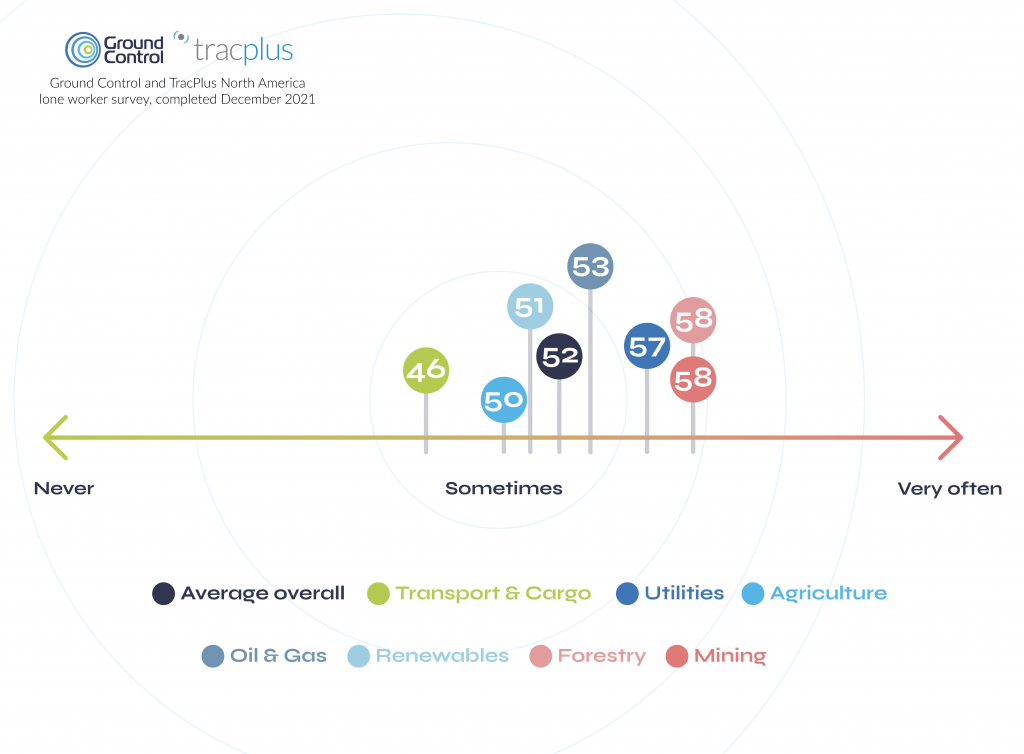
Lone workers and lone worker supervisors were asked to indicate on a scale from 0 – 100, whether they ever travelled out of mobile phone range. As can be seen in the above graph, on average, lone workers sometimes travel out of mobile phone range. It’s also worth noting that lone workers actually responded with a lower than average figure than those responsible for them (52 vs 58).
Our data also indicates that 10% of respondents are quite often out of mobile phone range, as these reported a figure of 75 or above.
When analysing the data grouped by industry, recipients from the Mining, Forestry and Utilities sectors provided the highest average scores, and those within Transport & Cargo, the lowest. This indicates that those working within Mining, Forestry and Utilities, are more likely to travel out of mobile phone range than those in the Transport & Cargo sector.
How many lone workers have experienced the following situations?
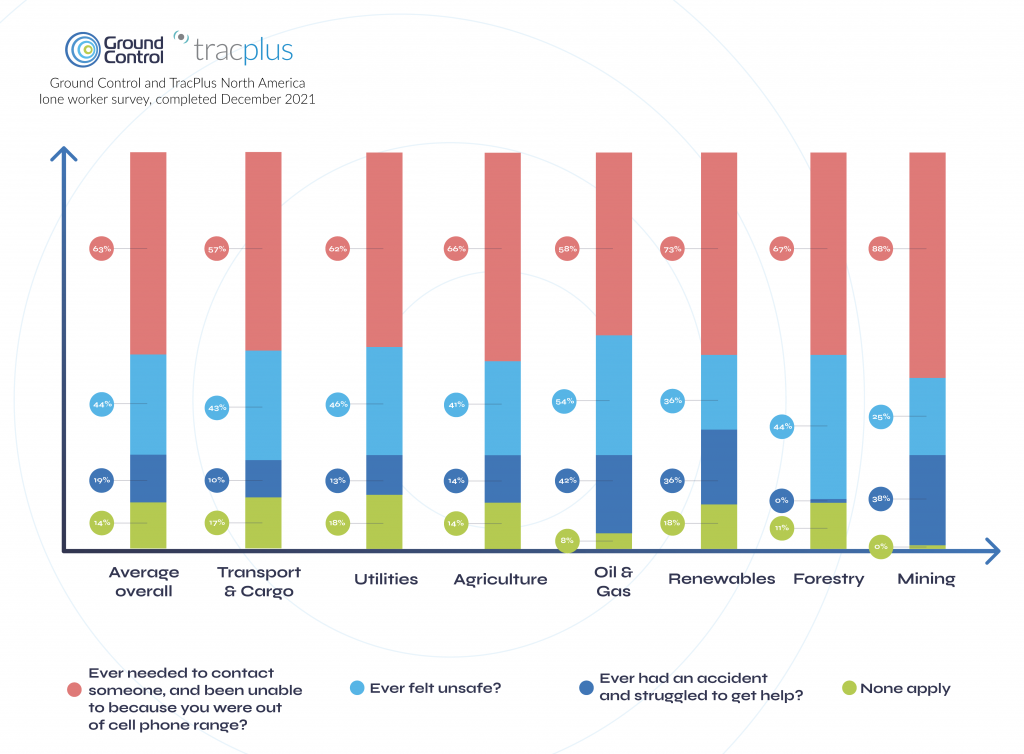
Results show over 60% of lone workers surveyed have been in a situation where they have needed to contact someone and were unable to, due to lack of mobile phone reception. Comparatively, for those within the Mining and Renewables industries, this figure rose to 88% and 73% respectively.
Further, almost one fifth (19%) of those surveyed reported having an accident, and struggling to get help. Encouragingly, none of the lone workers from the Forestry sector indicated having an accident when lone working, but this increased to over 40% within the Oil and Gas industry. Subsequently, workers within Oil and Gas were also most likely to report having felt unsafe (54%); 10% above the overall average.
How frequently do those responsible for lone workers check in with them?
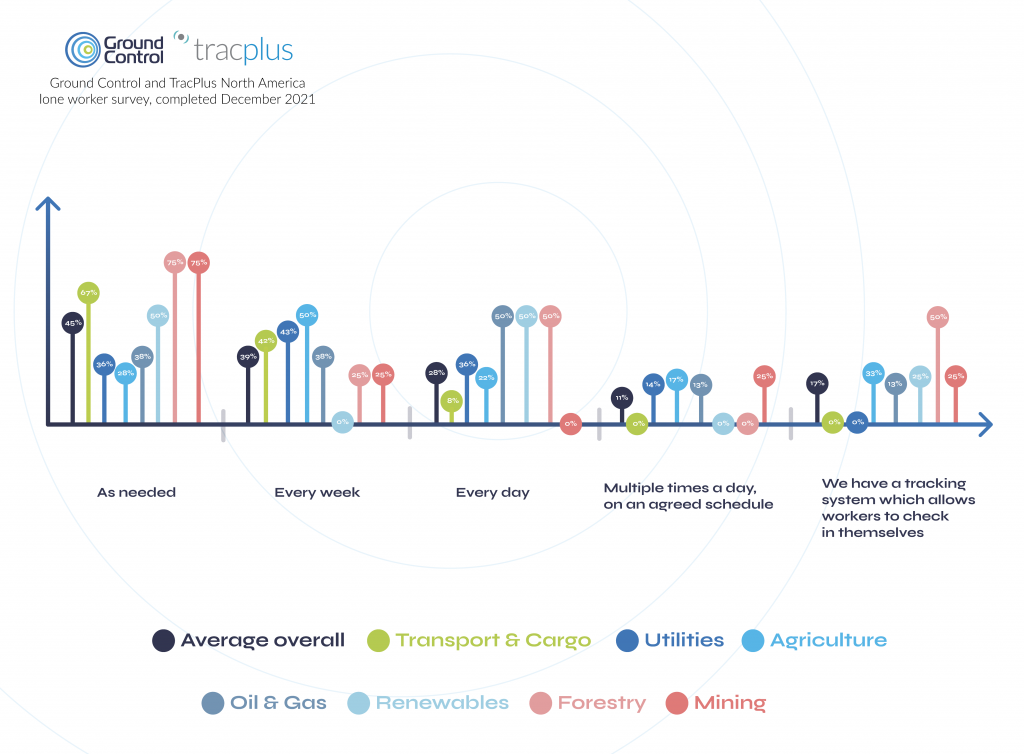
Overall 28% of respondents reported daily check-ins with their lone workers, 39% weekly and 45% as needed on a demand basis. Just 17% confirmed having a tracking system which allows lone workers to check in themselves, and over 10% disclosed checking in multiple times per day.
Interestingly, those within the Forestry sector were most likely to report more frequent check-ins – 75% indicating as needed and 50% every day. Additionally, 50% of those within Forestry also confirmed having a tracking system whereby their workers could check themselves in. This is particularly significant, considering the overall average reported was just 17%. In contrast, none of the respondents within the Transport & Cargo nor Utilities industries, indicated having a tracking system lone workers could use. Given the operational efficiency benefits these types of systems can deliver, this is quite surprising.
How robust are current lone worker communication strategies?
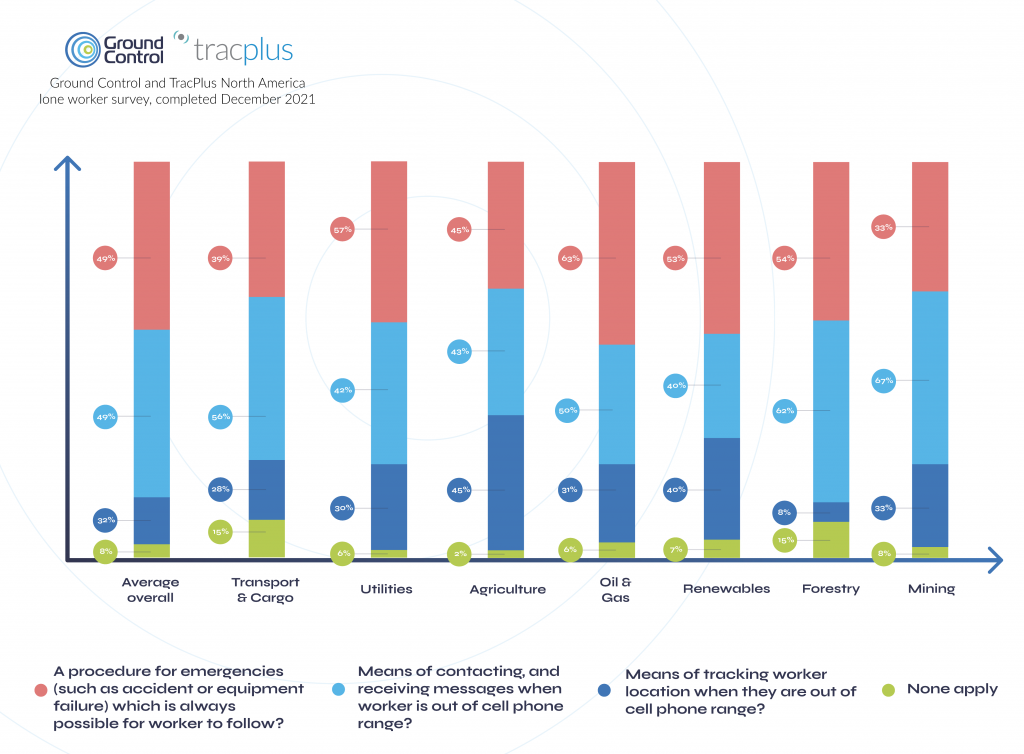
As illustrated above, only 49% of respondents reported having the ability to both send and receive messages while lone workers were out of mobile phone range. This figure remained the same when recipients were asked whether they had a procedure which could always be followed (even if there had been an accident or equipment failure), that enabled messages to be sent and received without mobile phone reception. Interestingly for those within the Mining industry, despite 67% reporting the ability to send and receive messages while out of mobile range, just 33% confirmed the ability to do this under all circumstances, for example in the event of an accident or equipment failure.
Additionally, less than one third (32%) of respondents overall confirmed they were able to track the location of a lone worker out of mobile phone range. This fell to just 8% in the Forestry industry.
Finally, 8% of respondents overall and 15% of those within the Transport & Cargo and Forestry sectors, indicated that they were unable to support any of these communication scenarios.
In summary, although our research represents just a snapshot of lone worker operations in North America, it does highlight that organisations still have some way to go in terms of safeguarding lone workers; a sentiment which holds true across all surveyed industries.
The future of lone worker safety: The RockSTAR
Communication plans and tracking are imperative to lone worker safety and increasing operational efficiency. With this in mind, it would be remiss of us to not talk about the RockSTAR device by Rock Seven (now trading as Ground Control). This powerful, handheld device allows the user to send and receive short messages from anywhere on Earth with a clear view of the sky. The unit is waterproof, ruggedized, and built to withstand the most challenging environments. And perhaps most importantly, the RockSTAR is able to transmit every minute with 15-second updates, ensuring teams know the whereabouts and safety of their lone workers at all times.
What is TracPlus?
TracPlus is a trusted real-time tracking and communication platform of first responders, government agencies, militaries, and other critical operators around the world. It has been developed to deliver situational awareness to first responders, irrespective of who owns the asset, what the asset is, who provides the tracking, or what the platform or signal type is – be it radio, cellular or satellite.
Get in touch
Ground Control and TracPlus have worked in partnership for over eight years, developing essential, cost-effective solutions for organisations and their remote field workers all over the world.
If you’d like to get in touch with our expert team, simply complete our online form, or you can email sales@groundcontrol.com or phone us on +1.805.783.4600 (USA) or +44 (0) 1452 751940 (UK).
Comparing the Cost of BGAN Satellite Connectivity with Field Engineers
Nobody questions the value of data extracted from oil well sites. From exploration to flowback testing, and drilling to recovery, there is both routine and failure data to be captured, stored, shared and analyzed.
In many cases, this data is out of reach of terrestrial communication networks, giving production companies two choices: send someone to retrieve the data, or set up a satellite communications network.
In this blog post we’re comparing the pros and cons of both options. Full disclosure: we believe satellite connectivity is the more scalable, cost-effective and safe approach, but we’ll be as objective as a satellite communications company can be!
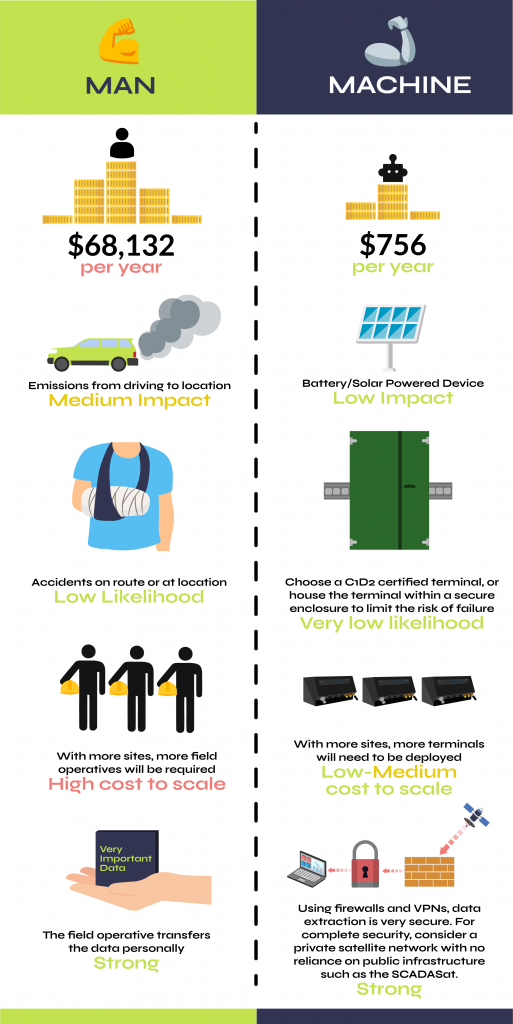
Field Engineer vs. BGAN machine
Here’s a full breakdown of the relative costs of operation
An experienced Field Engineer costs on average $68,132 per year. Plus expenses and other benefits including company vehicles and overtime charge out rates.
The cost of operating a BGAN satellite connectivity terminal can be as little as $63 per month for up to 20MB – a saving of $68,069 annually and $680,690 over the typical 10 years lifetime of a BGAN terminal.
Gas is an ever-increasing expense and the cost of fuel has increased around the world. The average Field Engineer will travel on average 25,000 miles per year. With the average gas price currently $3.34, this amounts to almost $3,500 in fuel costs alone; with insurance and taxable miles on top, and of course chargeable time.
Time is money. Onsite maintenance of traditional connectivity devices can take several hours to service – with on-site visits taking place on average once per week. Even then, there is no guarantee of the issues being resolved without further callbacks. Installation of a BGAN device mitigates the need for on-site Engineers. With a reliable uptime of 99.9%, BGAN requires minimal servicing, maintenance or ongoing equipment checks.
A single weekly call-out based on the average Field Engineer’s salary is a day rate of $272.52. With expenses, it is likely to be around $500, each time the system fails and on the basis that the fault can be rectified the same day. BGAN is highly reliable – even when installed in the most remote locations. Installation of one BGAN satellite connectivity device across the oil well network of ten pumps could save tens of thousands of dollars each year.
Servicing, ongoing maintenance and fault checking is costly work. In addition, equipment required to measure and transmit data from oil well sites often costs hundreds, if not thousands, of dollars per month. Installation of a BGAN satellite connectivity device mitigates these costs completely. Reporting on exception, the costs to transmit and measure data are as little as $2 a day.
BGAN satellite connectivity devices are incredibly cost-efficient. The typical hardware and airtime requirements for a remote oil site are just $2 a day, or $756 per year. Compared with the average cost of a Field Engineer, the savings to your business are in excess of $67,376 every, single, year.
Want to know how you can reduce your call out costs?
We’re a preferred Iridium and Inmarsat partner and can help you to reduce your daily, annual and ongoing connectivity costs. It’s what we do best and we’re always here to help. Email us on hello@groundcontrol.com or call:
UK and RoW +44 (0) 1452 751940
USA +1.805.783.4600
Can Satellite be an Effective PSTN Replacement?
In this webinar, recorded in September 2021, we explore the challenge presented by the PSTN switch off, particularly the impact upon utilities companies.
As you might anticipate, we’ll propose satellite connectivity as a solution to these challenges, but this offers you a broad spectrum of possibilities, so we explore the best options for this application.
Finally, we address some of the frequently asked questions about this service.
Why are British Utilities Companies Affected by the PSTN Switch Off?
Utilities companies are particularly exposed by BT OpenReach’s decision to switch off the PSTN network, as they operate many thousands of sites currently connected using this technology. And it’s worked really well – PSTN’s astonishing availability (99.992%) is something that even FTTP may struggle to match. Security is another concern: as many utilities companies are requesting more and more data to facilitate the “smart grid”, if that data can be intercepted, that could lead to costly and reputation damaging outages.
Cellular connectivity will be the solution for most utilities sites – but not all. Remote sites may have no cellular coverage because they’re in a valley, for example, and you can’t simply move the site into 3G or 4G range. Or you may have some cellular coverage, but it’s unreliable – and so a backup, or failover, system is needed to ensure that the data can always get out.
Why is Satellite a Viable Solution?
Satellite connectivity has long been the failover for really remote utilities sites where not even the PSTN network reaches. You need very limited infrastructure – a clear view of the sky, and an antenna plus transceiver that can connect with the satellite network. These devices are not weather or location dependant; they have a 10-15 year life span, and have been built with your existing infrastructure in mind. The key here is resilience: when the cellular network is unavailable or unreliable, satellite provides an excellent primary or failover system.
Not all Satellite Connectivity is Created Equal
Satellite connectivity ranges from very small daily data volumes which are transmitted hourly, to high throughput live video streaming-capable solutions. For the PSTN switch off, you are looking at something towards the smaller end of that scale, with kilobytes of daily data, and transmission frequency measured in minutes. We would recommend either the RockREMOTE or the Cobham Explorer 540. The video explains the differences between the two services, but if you’ve any questions, please get in touch.
Get in touch
We’ve implemented satellite IoT infrastructure for decades, and there’s very rarely been an obstruction issue we couldn’t overcome with a bit of knowledge and ingenuity.
We’d be happy to talk to you about your project and offer impartial advice on the best antenna and satellite service for your particular requirements.
Selecting The Right Solution Ready For The PSTN Switch Off
Why is a satellite solution needed?
For years, PSTN lines have facilitated many remote data collection applications. On December 31 2025, in the UK, these lines will be switched off, as BT Openreach focuses on developing its fibre network, which delivers IP telephony – the “new” means by which data will be transferred. And this pattern is being repeated across the developed world. However, it will be many years before fiber finds its way to remote locations – if indeed it ever does – and it’s cost-prohibitive for most companies to fund this privately. While cellular connectivity provides a viable alternative, some sites are so remote that there is no cellular coverage.
Satellite connectivity is the clear choice in this scenario, allowing organizations to securely extend IT infrastructure to every remote corner of their operations, create complete visibility of assets and allow process control. Satellite-based technology also offers cyber-secure scalable communications.
Not all satellite services are the same. Indeed, the diversification of satellite services has made this option much more flexible and cost-effective than it was several years ago. By understanding the application, the frequency of transmission, and volume of data, you can ensure the best communications solution fit.
We’re exploring the two most popular options for satellite connectivity in the context of the PSTN switch off, to help you choose the best solution for your needs.
Viasat IoT Pro
Viasat, who own and operate a network of geostationary satellites and ground stations, provide IoT Pro – previously known as the Broadband Global Area Network (BGAN M2M) service. With full IP connectivity, and as it’s a lower bandwidth M2M service, it’s a good fit for the types of applications currently served by PSTN lines.
Designed as a low data volume service for monitoring process control type applications such as SCADA, monthly data plans start at 2MB per month, going up to 50MB per month and beyond. By scrutinizing how the application is generating data, and the structure and format of the files, it is possible to reduce data volumes. Inmarsat use data compression to reduce data volumes to one-third of the cellular volume used for the same application.
Top four benefits of IoT Pro (BGAN M2M) as a PSTN replacement solution:
- Terminals are less than 30cm by 30cm – much smaller in size than traditional satellite dishes and consume far less power.
- Terminals are designed to be externally mounted giving zero-footprint inside a communications cabinet.
- Low power requirements enhance the appeal of BGAN for sites with power constraints.
- Some devices have the option of a bolt-on cellular module, which allows them to use LTE in addition to satellite.
Terminals designed to use the IoT Pro service are produced by several manufacturers and Ground Control supplies various options; the Cobham Explorer 540 is a particularly popular M2M device.
Iridium Certus 100
Iridium Certus 100 is a relatively new mid-band service that sits between Iridium’s Short Burst Data service, and its high throughput Certus 700 service. It is designed for applications that require small weight, size and power requirements. Ground Control is one of a very small number of manufacturers worldwide licensed to use the Certus 100 network, and the result is our RockREMOTE series of terminal. RockREMOTE also has a full Linux OS, and storage allowing edge computing-based processing, future-proofing the device and enabling more cost-effective data packet transmissions.
Top five benefits of RockREMOTE as a PSTN replacement solution:
- Iridium Certus-connected enabling data anywhere with an easy to deploy omni antenna
- Integrated LTE capability offering a turnkey solution for critical infrastructure
- Serial to IP forwarding allowing for simple integration with control systems
- Comprehensive power management (9v-32v) including toggling via a Power IO input
- Robust, designed for industrial use with standard DIN rail mounting.
Making the right choice for you
In many respects, the RockREMOTE and Cobham Explorer 540 perform similarly. Both offer dual satellite / LTE connectivity, to help you balance costs with service availability. Both have very low power requirements so they can run on battery and solar power. Both are small and easy to install, and have expected lifespans of 10-15 years. The latency for the Explorer is approx. 2 seconds, and the RockREMOTE is 1 second – both are perfectly adequate for industrial IoT applications (the difference between the distance between the satellite and the earth – here’s more about how satellite orbit heights affect communication).
The Explorer – using the Inmarsat satellite network – connects to a single geostationary satellite, and, once established, the connection is very stable. However, the Explorer must be able to ‘see’ the satellite, which can make it unsuitable for hilly or wooded areas. The RockREMOTE connects to the Iridium constellation of 66 satellites, which are constantly passing overhead; this means that the antenna can point in any direction and still be picked up by a satellite. That’s a key advantage if your remote site is in a valley or surrounded by trees.
The Explorer is a single unit with both antenna and transceiver in the same casing, which is great for ease of deployment; it does present a slight security risk in the respect that if it were stolen or vandalized, the entire unit is compromised. The RockREMOTE is a two piece design with the transceiver designed to be situated in your facility. The antenna is small and discreet, making this design less vulnerable.
RockREMOTE benefits from frequent firmware updates, and the Linux kernel processor and SD storage create endless opportunities for edge processing of data including MQTT, and local applications for 2025 and beyond.
If you need any further help, that’s what we’re here for. Please contact us and we’ll be happy to provide impartial advice on the best satellite PSTN replacement for you.
Can We Help You?
We understand the challenges facing Utilities and Renewables companies. Our team are experts in getting data from hard-to-reach places – so you don’t have to be.
We are proud to have provided one of our utility customers with 27 years uninterrupted service, making satellite that company’s most reliable system. To learn more about our solutions and how these can help you consistently provide better for your customers, get in touch today.
Could your Business Achieve More with Better Connectivity?
In the world of industrial IoT, cellular connectivity is the default means of transferring sensor data back to your SCADA system. But what happens if the location your sensors are in is too remote to reliably connect to cellular? Or what if your sensors are on the move, dipping in and out of cellular range? In these scenarios, satellite-enabled IoT is an obvious choice, but has long been viewed as too expensive, too complicated, too fragile, or even not secure enough.
In this webinar, recorded in September 2021, Solutions Architect Matthew Ellison and Channel Partner Manager Rory Ashley seek to dismantle these perceptions, and give real-life examples of where the extra data provided by satellite IoT connectivity has materially improved outcomes – from smart farming to disaster management, environmental monitoring to renewable energy production.
Connectivity Challenges
Terrestrial networks only cover 15% of the Earth’s surface, and focus on populated areas. This leaves a number of businesses unable to reach their assets remotely, and having instead to resort to manpower – with the time delays and additional costs presented by that solution. In these scenarios, satellite connectivity is an obvious choice.
Further, the number one challenge The IoT Magazine stated that IoT faced was cybersecurity, and the risk of hacking. Satellite has a huge advantage over cellular here, as, if needed, an entirely private satellite network can be created with no reliance on, or exposure to, public networks at all.
Satellite vs Cellular from a Cost Perspective
Satellite is not as low cost as cellular, but it is moving in the right direction. Greater competition, better technology, and diversification of offerings has seen the wholesale price of high-throughput satellite tumble in recent years, and it’s our view that prices will continue to lower, as the established players – Inmarsat and Iridium, for example – come up against well funded new entrants like Elon Musk’s Starlink, and Amazon’s Kuiper satellite offerings.
That said, it’s improbable that satellite will replace cellular, as it is likely to always remain a little more expensive; so the applications for satellite IoT are, not unexpectedly, those where cellular networks are unavailable, such as ocean data buoys or remote farms, or where the asset is moving in and out of terrestrial connectivity – such as transport and cargo ships.
Make sure to watch the webinar to see great examples of satellite connectivity in action – and if you have any questions, we’re here to help.
Get in touch
We’ve implemented satellite IoT infrastructure for decades, and there’s very rarely been an obstruction issue we couldn’t overcome with a bit of knowledge and ingenuity.
We’d be happy to talk to you about your project and offer impartial advice on the best antenna and satellite service for your particular requirements. Call or email us, or complete the form.
Calling UK Utility Providers…Get Switched on About the Big Switch Off
Many UK businesses still heavily depend on copper wire-based services to collect data and communicate with remote sites. These hardwired connections have offered reliability and resilience for decades. However, the cost of operating and maintaining outdated copper wire-based analogue services is high, and the limited bandwidth and speeds no longer meet customer expectations. BT Openreach, who own and manage these lines, have therefore called an end to analogue based services. The PSTN network will be switched off in December 2025.
The decision to switch off PSTN creates a necessity for organizational change and large-scale investment. The switch off provides an ideal opportunity for digital transformation, and the removal of existing legacy systems. Businesses are also changing. Organizations are merging Operational Technology (OT) with IT services, drawing the worlds of physical infrastructure and data management closer together. Further, expansion into process control and automation, and data sharing across an organization, creates efficiencies through optimization and greater visibility.
Fibre optic cable as a PSTN solution
Openreach is focused on fibre optic cable as the solution for replacing PSTN. It’s cheaper and more resilient as a product and it offers faster speeds and greater bandwidth to carry more data. The area around an exchange and its network infrastructure which can use fibre, is known as a ‘fibre footprint’. The size of the footprint may be due to economics or physics, but the real communication challenge for PSTN switch off lies outside the footprint.
Utilities providers can pay for a fibre connection to be added to remote sites, and this is a good choice if applications will benefit from 20 times more bandwidth and higher speeds of up to a gigabit per second. However, millions of active PSTN lines at remote sites won’t benefit, and increased sophistication of cyber threats and the prohibitive economic cost of digging fibre to remote locations means a different approach is required.
Satellite communication as a PSTN solution
Several satellite communication services offer secure solutions with varying bandwidth and speeds at viable pricing. What’s more, satellite services go one step further and provide more than an like for like replacement for remote sites with no coverage. Satellite also offers cyber security and resilience at critical locations, even where there is cellular coverage. Implementing built in satellite and cellular communication paths reduces the risks posed by the switch off PSTN lines.
BT Openreach findings
The number and variability in locations, applications and data requirements, means the PSTN replacement will be a mix of solutions. With 16 million lines and channels to manage, most replacements will be simple, straightforward swaps to cellular or fibre. The distance from the exchange and the data volumes are key questions. Certain lines will be better served by fibre connections and some will be more easily replaced by a cellular solution. This leaves an estimated 10% of sites too far from the exchange to be serviced by fibre or broadband over copper, with many of these also requiring more resilience than cellular coverage offers.
RockREMOTE as a satellite-based solution
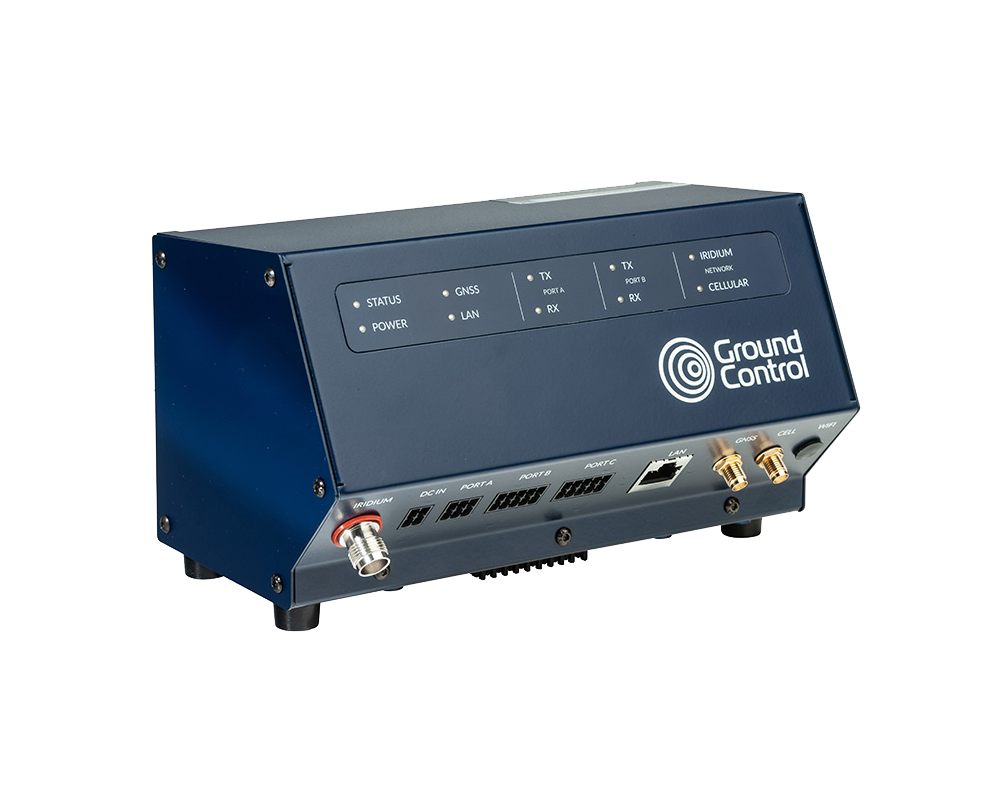
The potential loss of connection and data transfer from assets can carry heavy penalties, both monetary and reputation damage. The challenge of converting traditional lines into digital communications without such loss can be resolved effectively by adopting the new RockREMOTE technology. The unit, with its hybrid LTE / Iridium Certus connectivity, facilitates data transfer from and to anywhere – only solar power is required to run the RockREMOTE continuously and without loss of connectivity.
With RS232 and RS485 built in, supporting serial to IP migration for telemetry devices, RockREMOTE has a full Linux OS, and even has storage allowing users to move closer to the benefits of edge computing-based processing.
Key Features:
- RockREMOTE reaches where other solutions can’t – cellular doesn’t always provide reliable connectivity in remote areas and there is a lack of capacity in rural locations. Also, this will likely get worse with the sunsetting of 2G/3G over the next few years
- Provides backup comms – some sites are connectivity-critical and require backup comms when all else (namely cellular or fibre) fails
- More cost-effective than fibre – fibre solutions remain costly and difficult to implement, especially if channelling to and installing in remote locations
- Requires only solar – it is not uncommon for sites to be powered entirely by renewable energies. RockREMOTE can run purely through solar and does not require a generator or other power source, making it both energy- and cost-efficient.
Final Thoughts…
Understanding the practical business requirements for data transmission from remote sites and then designing a matrix of viable options is undoubtedly a major project. For non-essential applications in areas of good coverage, cellular will always, and appropriately, be considered the easy win.
Utility companies who count PSTN lines in their thousands need to make a start swapping to robust and secure digital IP-based communication technologies. Technologies that allow organizations to securely extend IT infrastructure to every remote corner of their operations, create complete visibility of assets, and allow process control. Satellite technologies also offer proven cyber-secure scalable communications. RockREMOTE is therefore ideal for industrial use cases where sites are remote and satellite communication is the only sensible PSTN switch off solution.
Video guide
This webinar has also been put together as a handy guide for using satellite communication as your PSTN replacement:
Get in touch
We’ve implemented satellite IoT infrastructure for decades, and there’s very rarely been an obstruction issue we couldn’t overcome with a bit of knowledge and ingenuity.
We’d be happy to talk to you about your project and offer impartial advice on the best antenna and satellite service for your particular requirements. Call or email us, or complete the form.
Selecting Remote Locations for the Renewables Industry
Renewable energy sources tend to be in remote or hostile locations. Any land-based installation has to deal with the planning process and meet the inevitable objections from local residents and countryside campaigners. This is one of the reasons why land-based wind farms tend to be situated in isolated spots, on hilltops and moors away from settlements and livestock.
Secondly, remote locations are simply better natural environments to generate renewable energy. Wind farms are sited offshore or on remote hilltops because that’s where they’re most efficient – where the wind is strongest. Similarly, solar energy is more accessible in higher, more remote locations where people choose not to settle and tidal power has to be harvested out at sea.
“Customers rarely know exactly what they’re being billed for or what to expect and this makes it impossible to set – and keep to – precise budgets.”
Finding a suitable location
One of the biggest challenges in the renewable energy industry is finding a suitable location. To justify the investment involved in building and installing a wind turbine array, a prospective site has to meet stringent requirements with regard to wind speed and frequency. Too little wind and the array won’t deliver the required amount of power; too much wind and the array is vulnerable to damage.
Similar feasibility calculations apply to solar and tidal installations, all of which require careful and prolonged monitoring to ensure the energy yield from a particular site justifies the investment.
The need for monitoring doesn’t end once the installation has been built. In order to ensure that a solar or wind array is operating at maximum efficiency, a range of key components need to be measured day and night. That data has to be transported securely and in real-time to a control office where metrics such as wind speed, solar radiation power, and individual component performance can be assessed.
For most cellular tracking solutions, this causes significant problems. Moving from one territory to another requires moving from one cellular carrier to another and most cellular tracking services simply don’t have the coverage required to deliver uninterrupted contact or offer a choice of roaming partners. Customers are tied to a single partner in each territory, regardless of the cost or quality of the service. More importantly, this means that if the main signal is lost there’s no fall-back partner and coverage fails.

Moreover, there are significant billing and administrative shortcomings with traditional cellular solutions. Most carriers have different models for billing (fixed price, minimum quantity, per kilobyte of data etc) and this tends to be reflected in the complicated billing structure of most cellular services. Customers rarely know exactly what they’re being billed for or what to expect and this makes it impossible to set – and keep to – precise budgets.
A Track Record of Success in Renewables
Ground Control provides a simple, cost-effective solution to the problem of retrieving assessment and monitoring data. Unlike other M2M solutions, Ground Control provides the flexibility for engineers to design the service that suits them best. This might mean regular ‘heartbeat’ signals or time stamps to confirm the condition of specific instruments. It might mean a series of alarms or triggers configured to meet specific thresholds. Or it might mean a complex combination of variables. Whatever the precise solution required, Ground Control’s services can be configured to deliver exactly the data that’s needed in the most cost-effective way.
Ground Control provides the most comprehensive coverage available from any M2M cellular service. With multiple partners in more than 160 countries, Ground Control’s service gives customers an unrivalled choice of carrier partners and the security of knowing that if their chosen service fails, a fall-back can be configured with an alternative carrier. This failsafe service can be a crucial factor in important infrastructure projects.
In safe hands
If you’re seeking a solution to a critical communications challenge, we can help.
Please call or email us, or complete the form and we’ll be in touch. We have offices in the USA and UK, and over 20 years’ experience in satcomms and IoT, plus access to the best airtime, devices and services available.
Introducing Intelligent Cellular ‘i-Cell’
Ground Control welcomes its newest cellular offering – the i-Cell range.
The Smart Solution
The sun is soon to set on the second- and third-generation (2G and 3G) networks around the world. In response, we’ve developed a smart solution to automatically switch from 2G to LTE spectrum encompassing eUICC technology.
We’ve already developed a number of products in the i-Cell range that have been rolled out in beta to a number of our customers – the response has been phenomenal. With the third product just released, we thought it was high time we started to shout louder about this amazing step in cellular technology.
The i-Cell range of cellular communication products are ideal for utility, IoT, retail, and many other applications – thanks to its compact size and cost effectiveness. These next-generation products support all the new features specified by 3GPP to boost IoT applications, such as power-saving mode (PSM) and extended discontinuous reception (eDRX), which, along with proprietary firmware from Wireless Innovation, allows the modem to wake up periodically to deliver data and then go back to sleep, providing ultra-low power consumption for long-term battery applications.
Products Available
- i-Cell D-Sub 2G/LTE – The i-Cell D-Sub 2G/LTE modem supports worldwide LTE CATM1 and NB-IoT communications, as well as providing legacy 2G quad band support. It features a maximum downlink and uplink data rate of approximately 300Kbps.
- i-Cell OEM Communicator – Connect your information via the cloud from low-rate, ultra-low power to video streams with i-Cell Communicator, the Swiss Army Knife of IoT.
- i-Cell 1140 2G/LTE – The i-Cell 1140 is designed to fit the standard Elster A1140 meter range, and interfaces with the proprietary interface via an RJ12 connector.
- i-Comm Secure – The i-Comm Secure is an encrypted communications device, linking assets via a WiFi or LAN connection, with full remote management and supervision.
Telit
The i-Cell range utilises the Telit ME910 module for its D-Sub product. This features eDRX and PSM support, a highly compact 28 × 28 mm LGA form factor, and maximum downlink and uplink data rates in the range of 300Kbps. The overall range also uses Telit connectivity solutions for SIMs and data plans. Find out more about our work with Telit.
Ground Control will project manage and deliver the complete solution, from the delivery of the hardware and the integration to the customers’ equipment, so they can understand the latency they can work with and the required space segment to meet the required latency.
Want to know more?
Our team of industry experts designed and manufactured the i-Cell range to meet the discerning needs of Utilities and Retail organisations needing a solution to the sunsetting of 2G and 3G networks.
To talk to us about your requirements, please call or email us, or complete the form, and we’ll be happy to help.
The Rise and Rise of Renewables
In 2018, solar and wind energy production rose to a record high. According to UK-based climate science and energy policy experts Carbon Brief , renewable energy accounted for 33% of all UK energy production in 2018, with wind making up 17%, solar producing 4%, and biomass with the remaining 11%.
Interestingly, while renewable energy is on the rise, analysts have calculated that the electricity used per person has decreased by almost 25% since its peak in 2005, falling to its lowest level since the mid-1990s. This decrease can be attributed largely to individuals making a conscious decision to use their energy more efficiently and economically, and large corporations striving to use more renewable energy to meet regulatory requirements and customer expectations. It’s heartening to see a positive impact from these changes in behavior.
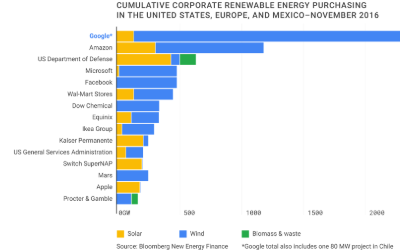
Unsurprisingly, we’re now also seeing an increase in the creation of more large-scale photovoltaic (PV) farms, as big players such as Google and Apple compete for the ‘renewable energy crown’. Facebook and Amazon have committed to using 100% renewable energy by 2020. As such, development is now focused on much larger PV schemes to help companies meet their sustainability targets.
The Winds of Change
The Wireless Innovation (now trading as Ground Control) team have supplied satellite and cellular communications to the renewable energy market for many years for wind and solar resource assessment campaigns, array monitoring, and SCADA data.
As wireless communications supplier to the four leading global data logging and data acquisition companies, our clients rely on us to provide the wireless backhaul for their sophisticated measurement campaigns with bespoke cellular, satellite, and hybrid solutions. Once a potential site is identified and an initial desktop survey determines that the site is viable, we supply the communications for the measurement campaign that determines the exact resources available.
We currently deploy communications equipment and airtime to renewable energy sites in over 100 countries, on more than 3,000 sites. Our biggest market is the USA, followed by Europe and the UK, and we’re seeing strong growth in emerging markets like South America. Whereas previously we’ve undertaken a fairly even balance of wind and solar projects, offshore wind projects are increasing significantly, particularly in the UK, as it takes the global lead in this area.
Offshore Renewables Projects
Offshore wind is already a UK success story. We’ve installed more capacity than any other country and offshore wind farms are becoming the backbone of the UK’s energy network. The long-awaited UK Offshore Wind Sector Deal, announced by the government on March 7 2019, is a game-changer for the UK and will see offshore wind go from strength to strength and, in the foreseeable future, dominate the clean-energy landscape.
When operating far offshore, beyond cellular reception and before any fiber optic cables are laid or available, the only way to reliably and securely communicate back to shore is via satellite. As we’re not tied to any particular network, we can create tailored, end-to-end solutions with a robust and secure communication infrastructure, to cover all offshore requirements for both data and voice. For mission-critical data, which often includes SCADA, we use a totally private and secure satellite network service called TSAT, or SCADASat. Wireless Innovation (now trading as Ground Control) is TSAT’s exclusive partner in the UK, so this ‘bullet-proof’ communication channel is available only to our clients.
Any Way the Wind Blows
When measuring the commercial viability of wind plants, clients usually require a minimum of 12 months of measurements for a serious large-scale project, with continuous measurements throughout that period. This gives our clients a good representation of the wind speed and directions over the entire year, as it varies greatly from season to season. Further monitoring is needed when a site passes the energy yield assessment and once the Wind Turbines have been installed. Once the plant has been constructed, key components still need to be measured around the clock in order to ensure that a wind farm is operating at maximum efficiency.
The Future of Renewables Data
Climate change concerns and global pressure to reduce CO2 emissions continue to drive an enormous shift towards renewable energy production. We’re seeing a huge increase in the number of companies seeking more innovative, secure, and cost-effective solutions to overcome the challenges of wireless backhaul for renewable source monitoring. It’s an exciting time to be working in renewables data.
Projects are varied from creating solutions for wind power ramp events, energy storage, integrating distributed data systems and assessment data in remote locations to providing a satellite failover for continuity in the event of natural disasters. Our work is not only having a positive impact in our clients’ businesses, it’s also contributing to global efforts to protect the environment.
Can We Help You?
When it comes to retrieving precise data from distant renewable sites, Ground Control is the solution. With our reliable connectivity, available around the clock and accessible from anywhere, you can achieve seamless data monitoring without any interruptions. We also offer hybrid cellular and satellite connectivity solutions to cater to your specific needs.
No matter what communication or connectivity requirements you have, we are here to assist you. Contact us today to get started.
Satellite Solutions for Solar Resource Assessment
Finding a suitable location is one of the biggest challenges in the renewable energy industry. For a solar installation to be successful, it has to deliver a consistent and reliable supply of energy. To do this, it must be situated in exactly the right place. To justify the investment that a solar thermal power plant requires, developers need detailed knowledge of the environment as well as data on the performance of installation equipment.
Since these sites are often in remote and inaccessible desert locations, data gathering stations have to be designed to withstand harsh conditions – they need to be robust, efficient, and low-maintenance. It’s impractical and hazardous to retrieve data manually so measurement stations also need to provide reliable and secure remote connectivity, ensuring data can be collected and equipment monitored.
To provide the reliable data backhaul required for a recent solar energy assessment project developer, organisations need a robust satellite, such as the RockREMOTE solution from Ground Control.
The RockREMOTE is an Iridium-based solution that provides secure, reliable satellite connectivity in places where GPRS coverage is poor. It’s a flexible and programmable solution that removes any reliance on the existing terrestrial infrastructure. RockREMOTE allows data logging solutions to be deployed in remote and hostile locations, seamlessly integrating with data loggers to provide secure, reliable connectivity over the Iridium satellite network.
Ground Control’s extensive experience in renewable energy and detailed technical understanding of the entire infrastructure ensures customers receive a complete end-to-end solution. So, instead of agonising about the challenges of installing a renewable energy resource, why not take advantage of our ‘solutions without strings’ approach?
Get in touch
Accurate solar resource assessment in remote areas depends on reliable data transmission. Ground Control’s RockREMOTE, powered by Iridium satellite connectivity, ensures continuous monitoring where terrestrial networks aren’t available.
Designed for integration with remote systems, RockREMOTE supports uninterrupted delivery of irradiance and environmental data—critical for site evaluation and performance modelling.
Whether you need a primary link or satellite failover, get in touch to find out how we can help you with your remote connectivity requirements.