Topic: Viasat
The Truth About “Everywhere IoT” for Water Monitoring
Whether you’re working in oceanographic science, hydrology, utilities, aquaculture or offshore renewables, you’ve probably heard some of the noise around “NTN” – using cellular IoT standards like NB-IoT and LTE Cat-1 to send data over satellite. It’s very promising: one chipset roaming between cellular and satellite networks, lowering hardware costs, broadening coverage and simplifying integration.
As is so often the case, the reality is a little more nuanced. In this blog post, we aim to separate myth from reality, and help teams capturing data from remote water sensors design robust data paths that will stand the test of time. We’ll start with one of the most pervasive myths.
Myth #1: Satellite Coverage Is Global
Reality: It depends heavily on the network and the service.
This is routinely overstated, particularly by cellular IoT specialists now branching out into satellite – “true global coverage” appears all over their marketing material.
Here’s what you need to know.
First, you usually need to separate networks designed for IoT services from networks designed for broadband internet. The services designed for broadband internet generally use radio spectrum in the Ku- and Ka-bands. This is ideal for carrying large volumes of data, but has several drawbacks for IoT applications: they’re power hungry and not well suited to battery or small solar installations; and they’re affected by poor weather conditions. If your asset is frequently exposed to rain, high winds, spray or sea fog (which is often the case at sea or up in the mountains), your data will not transmit reliably.
The sweet spot for satellite IoT is services in the L-band radio frequency, as these need very little power and are largely unaffected by poor weather. They’re suited to much smaller data volumes, and fit an IoT use case perfectly, for example, regular level and water quality readings from a buoy, float, or river gauge.
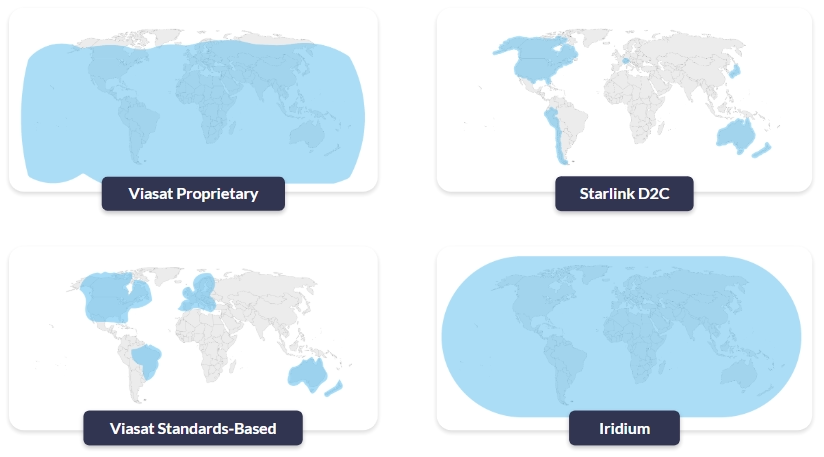
So, who offers L-band services? The pre-eminent Satellite Network Operators (SNOs) are Iridium, Viasat (Inmarsat) and Globalstar. Of these three, Iridium is the only one that is truly global. Viasat has great coverage but doesn’t cover the poles, and Globalstar has some big gaps over Asia, the polar regions and the oceans.
Now we have to go one level deeper (sorry!). Of these three, currently Viasat is the only network that offers both proprietary and standards-based services.
- “Proprietary” means that you have a Viasat chipset that works with Viasat satellites; you can’t use it to communicate with Iridium satellites, or vice versa.
- “Standards-based” refers to the use of cellular standards over satellite, namely NB-IoT and LTE Cat-1. As these are all built to the same standard, it should – when the services mature – be possible to switch supplier without needing to change your hardware.
Viasat’s proprietary services (IoT Nano, IoT Pro) are well established and available everywhere where Viasat’s satellites can see the Earth. Their standards-based service, NB-NTN, is in its infancy, and they’re turning on coverage where there’s sufficient demand. Currently that’s North America, parts of Europe, Brazil, Australia and New Zealand. Huge swathes of the ocean are not covered, and if your application is in South America (excluding Brazil), Africa or much of Asia, you’re also out of luck.
In short, check coverage carefully, particularly for maritime devices like offshore buoys, USVs or drifting floats, as claims often don’t live up to reality. For inland water sensing, don’t assume that “country-wide” includes your upland reservoir or remote abstraction point either.
Myth #2: More Bandwidth Solves Everything
Reality: Power, airtime and antennas still call the shots.
As mentioned earlier, the higher bandwidth services (e.g. Starlink, OneWeb) operate in Ku- and Ka-bands, and while these are great for moving large volumes of data, the trade-off is a higher power draw and larger, more complex antennas. If you’re operating a coastal station or treatment works with reliable power and solid mounting options, they may be a good fit. If you’re building a wave buoy with tiny solar panels, they simply can’t power these sorts of satellite terminals.
If you don’t have mains power, and therefore do need a power-efficient satellite terminal, L-band IoT services will best serve your needs. Viasat and Iridium have a wide range of IoT services that span from IP-based options such as Iridium Certus 100 (speeds up to 88 kbps) to message-based services like Viasat NB-NTN (optimized for ~50 bytes per message).
Even within specialist services for IoT, the more throughput or volume you need, the larger the antenna, and the greater the power draw. Message-based services can be more challenging to work with (we’ll come back to this), but they are the most efficient means of utilizing a satellite link, especially for water sensors that only need to report periodically.
The following simplified table lays out the trade-offs.
| NB-NTN | Short Burst Data (SBD) | Iridium Messaging Transport (IMT) | Certus 100 | IoT Pro (BGAN M2M) | |
|---|---|---|---|---|---|
| Operator | Viasat | Iridium | Iridium | Iridium | Viasat |
| Link Type | Message-based (NTN NB-IoT) | Message-based (proprietary) | Message-based (proprietary) | IP-based | IP-based |
| Data Volume | 50 bytes per message* | Up to 340 bytes per message | Up to 100 kB per message | 22/88 kbps | 464 kbps |
| Power Consumption | Very low | Very low | Low | Medium | Medium |
*There’s no hard protocol limit that stops you above a certain size; NB-IoT can technically carry up to around 1.6 kB of user data in a single packet. But current NTN NB-IoT services are engineered around tiny messages (tens of bytes) and tens of kilobytes per month per device. Anything bigger quickly becomes slow, power hungry, and uneconomic.
Myth #3: Standards Make It Simple
Reality: Coverage gaps and physical constraints still apply.
We’re very excited about the potential of standards-based (or NTN) satellite connectivity; once it matures, it should unlock massive IoT use cases that would be cost prohibitive for a proprietary solution. But it isn’t a lower cost version of the proprietary solutions that exist today; it’s a different class of connectivity.
NTN NB-IoT is designed to connect a large number of latency tolerant end points sending very small amounts of data, such as a grid of rainfall and runoff gauges across a catchment for flood risk modelling. It’s not designed for more than around 50 kB of data per month per device, and it’s not suited to real-time communication.

This is in contrast to cellular NB-IoT, which can move 1-2 kB per transmission, and is generally economically viable up to ~5 MB of data per month per device. That’s more than enough for frequent level and quality readings from a river, reservoir or pipeline monitoring point, but if you try to replicate that pattern over satellite, both cost and power consumption quickly become challenging.
If you’ve been working with cellular NB-IoT and enjoying the larger volumes of highly economical transmissions that terrestrial networks facilitate, you’re in for a bit of a shock when it comes to moving that data over satellite. You will need to be able to work within the data constraints of the NTN version, which is likely to need some data optimization (we’ll come back to this shortly).
Another consideration that may stand in the way of seamless transition between cellular and NTN NB-IoT is your antenna.
- Cellular NB-IoT is designed to work with small, low gain antennas – often just a simple PCB or stub antenna in a plastic box. While antenna placement requires some forethought (not inside a metal box, not under a pump skid etc.), it doesn’t need to be outdoors.
- NTN NB-IoT over GEO satellites is a different beast. Connecting to a satellite which is – in the case of Viasat NB-NTN – 35,786 km from Earth requires a higher gain antenna and clear line of sight to the satellite. The antenna needs to be on the roof, on a mast, on top of a buoy, not buried in a pit or down in a plant room.
Not dissimilarly to your cellphone trying to find a network, a poorly positioned antenna drains power and is more likely to drop data.
The bottom line is that NTN is viable and workable for a myriad of water-sensing applications; just not all of them. And while working with data constraints might take some getting used to, doing so has cost, power and battery life benefits. So here are our top tips for optimizing your data for streamlined transmissions.
Working With the Constraints: Design Patterns That Actually Work

Send Data Less Frequently
Instead of transmitting every second, trigger messages only on events or stretch your interval to every few minutes or hours, so you cut airtime and power without losing useful insight.

Send Less Data
Replace continuous raw streams with compressed or aggregated values (min/max/average/exceptions), sending only the fields your application actually needs rather than every sample.

Choose the Right Transport
Where you don’t need interactive sessions, use compact, message-based protocols instead of IP to avoid chatty handshakes and headers, reducing connection time, airtime use and power draw.

Position Your Antenna Well
If your satellite network is in geostationary orbit (e.g. Viasat) you need line of sight to the satellite; if it’s in Low Earth Orbit (e.g. Iridium, Globalstar) you need a clear view of the sky as the satellites move overhead
Most of the above is fairly self-explanatory, but it’s worth a quick dive into message-based protocols, because this is where many water monitoring applications can win back cost and battery life.
Why Message-Based Protocols Matter
Because cellular connectivity is abundant and cheap, most IoT applications use an IP connection to move data. We often liken this to a telephone call: an interactive, two way communication path which, while very widely used, has some drawbacks from an IoT perspective, particularly when operating with data constraints.
Firstly, the real time “conversation” between the sensor and your control centre is relatively hard on battery life. Secondly, the amount of overhead passed over that connection in addition to the actual data you need is considerable.
When you’re sending data into space, every byte matters.
Sending data over IP is not the most cost-effective, nor battery-conservative, means of using satellite IoT.
The alternative is a message-based solution, which we touched on earlier. NTN NB-IoT is message-based, as are Iridium SBD and IMT, and Viasat IoT Nano. Message-based connections are more like a text message: you send the message, receive an acknowledgement (note: not all services include this), and close the connection.
The message contains much less overhead, and the connection stays open only as long as is needed to transmit. This is the most economical way to use satellite IoT, both from a cost and power perspective. While it often requires a little more engineering work to format your data appropriately, it is usually worth the effort.
On the server / cloud side, platforms like Ground Control’s Cloudloop will decode the data on receipt and send it to your destination of choice, properly formatted, so there’s no need for engineering work on the cloud / server side.
Many applications can move to message-based transmission: data buoys, weather stations, reservoir level sensors, groundwater monitoring wells, water quality sondes and static flow/abstraction meters where data isn’t needed in real time.
If you do need real-time command and control, for example, remotely piloting a USV, or actively managing gates and valves in a complex hydraulic system, there are reliable services available, including Iridium Certus 100 and Viasat IoT Pro. But it’s definitely worth investigating message-based services if you can work with a few seconds’ latency and slightly less interactivity.
Choosing a Network: Matching Technology to Use Case
To bring this to life, we’ve put together this table to illustrate a few use cases.
| USV | Data Buoy | Profiling Float | Reservoir Level Station | |
|---|---|---|---|---|
| Movement | Mobile | Stationary | Free floating | Stationary |
| Location | Open ocean | Open ocean | Open ocean | Upper catchment / remote reservoir |
| Power Source | Solar | Solar | Battery | Solar |
| Data Volumes | High | Medium | Low | Low-Medium |
| Transmission Frequency | Real time to every 5 minutes | Hourly | Hourly to every 10 days | Every 5-15 minutes + event driven |
| Suggested Service | Iridium Certus 100 or Viasat IoT Pro | Iridium Messaging Transport (IMT) | Iridium Short Burst Data or (if within coverage) Viasat NB-NTN | Iridium Messaging Transport (IMT) |
| Suggested Device | RockREMOTE Mini | RockBLOCK 9704 | RockBLOCK 9603 | RockBLOCK Pro |
If the device needs a real time connection, it needs an IP-based service, but if it’s solar powered, it needs to couple that requirement with high power efficiency. Iridium Certus 100 or Viasat IoT Pro meet both requirements, and are your best options here.
If the device is running exclusively on a battery, and has very low data requirements, this is a great application for NTN NB-IoT (Viasat’s brand for this service is NB-NTN). However, you need to check coverage. If coverage is not available, Iridium’s Short Burst Data (SBD) service is a cost effective and global alternative.
If data volumes are larger, Iridium Messaging Transport (IMT) can carry up to 100 kB per message, and the modules can also be powered by a battery. In each case, there are several options for the device that houses the module, ranging from enclosed and vibration-tested devices with simplified commands (RockBLOCK Pro) to developer PCBs with a choice of internal or external antennas (RockBLOCK 9704 / 9603).
Designing the Right Data Path for Your Water Sensors
The headline story around NTN is seductive: one chipset, everywhere connectivity, cellular-like costs. For water monitoring teams under pressure to instrument more assets – more rivers, more reservoirs, more outfalls, more offshore platforms – it sounds like the silver bullet we’ve all been waiting for.
It isn’t. But it can be a powerful new tool in the box if you treat it as such.
If there’s one takeaway from this post, it’s this: everywhere IoT is not something you buy; it’s something you design.
For water sensing, that design work boils down to a handful of questions:
- Where are my sensors, really? Open ocean, estuary, upland catchment, plant room? Coverage claims matter less than the actual map.
- How is each device powered? Battery, micro-solar, or a nice fat cable from the control room?
- How quickly do I genuinely need the data? Seconds, minutes, hours?
- How much data do I actually need to move? Raw streams, or carefully chosen summaries and alarms?
Answer those honestly, and the right combination of L-band IoT, NTN, cellular and (where appropriate) broadband satcom usually reveals itself.
Need Help Getting Data Home?
If you’re looking at a new water-monitoring project, from data buoys and USVs to flood-warning networks and smart reservoirs, and you’re not sure where to start, we’re happy to help.
Ground Control has spent the last two decades getting data out of some of the world’s most awkward places. We can’t promise magic, but we can promise clear advice, realistic trade-offs, and solutions that actually work when it’s dark, cold and raining sideways.
Complete the form, or email hello@groundcontrol.com, and we’ll reply within one working day.
How Standards-Based Satellite IoT Will Transform Renewable Energy Monitoring
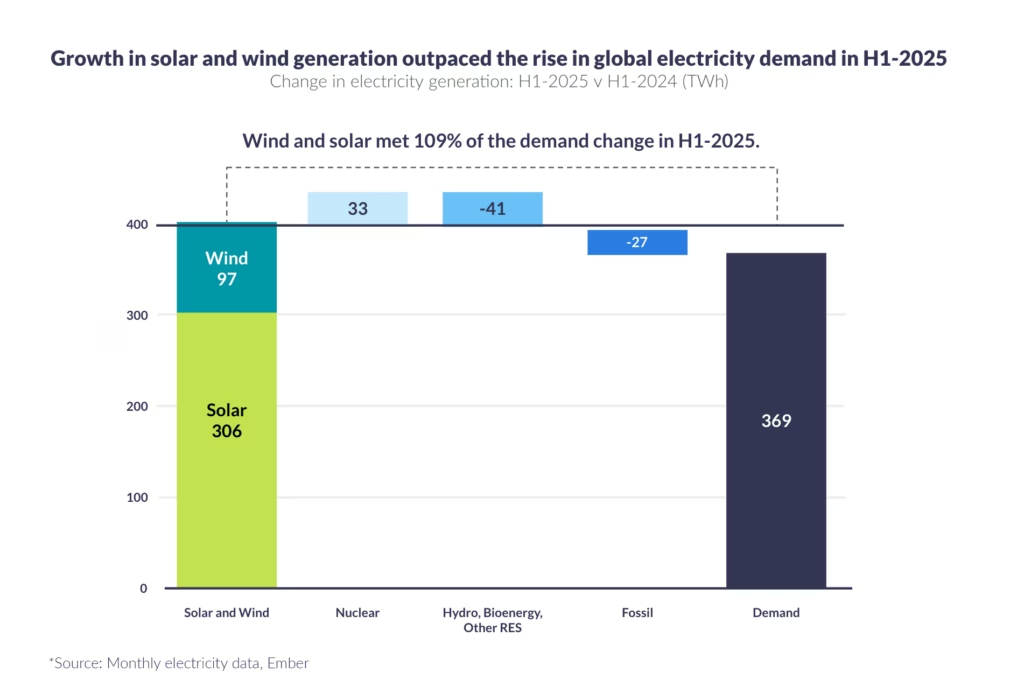
Wind and solar farms are fast becoming the backbone of our green energy future. The first half of 2025 marked a defining moment for global power generation. According to Ember’s Global Electricity Mid-Year Insights Report, global electricity demand rose by around 2.6%, yet renewables grew even faster. Solar output jumped by 31% and wind by 7.7%, helping renewables overtake coal for the first time in history, supplying 34.3% of global electricity compared with coal’s 33.1%.
That growth isn’t slowing either. Ember’s latest report forecasts that global renewable capacity additions will reach almost 793 GW in 2025 (an 11% increase on 2024) driven by 21% growth in wind and 9% in solar. At this pace, the world is within reach of tripling global renewable capacity by 2030, a central COP28 goal.
Yet as the scale of renewable infrastructure expands, new challenges arise: managing millions of connected devices, capturing continuous data, and maintaining visibility across installations that often sit far beyond the reach of terrestrial networks.
It’s not just about generating clean power anymore. It’s about keeping every asset connected, visible, and performing at its best.
The Connectivity Challenge in Renewable Energy
On remote coastlines, in vast deserts, or far offshore, wind and solar farms are typically built where natural resources are strongest. These prime energy locations often sit well beyond the reach of cellular and fiber networks, creating a growing connectivity gap that directly affects operational efficiency.
Without reliable links between assets and control centers, operators face a series of compounding challenges. Performance and fault visibility is limited, fault alerts can take minutes or even hours to arrive, and manual inspections are often required where remote diagnostics should suffice. The result is higher maintenance costs, slower response times, and an incomplete picture of system performance.
For years, proprietary satellite IoT networks, such as Iridium and Viasat, have bridged this gap. These systems provide the ultra reliable, low latency connectivity essential for mission critical operations like SCADA backhaul, emergency shutdown commands, and safety alerts. Their reliability is proven, but it comes at a price. Proprietary networks rely on specialized terminals and dedicated airtime contracts, delivering access to radio spectrum that’s dedicated to critical connections; this can, however, make these cost prohibitive for large scale sensor deployments across thousands of wind turbines or solar panels.
As renewable capacity surges and asset counts multiply, this challenge is only intensifying. Between 2023 and 2025, renewable additions have grown by an average of 29% annually. To connect every turbine, inverter, and panel without escalating operational costs, operators now need a new model for connectivity, one that blends reliability with scalability, and cost efficiency with coverage.
The Next Wave: Standards-Based NTN NB-IoT
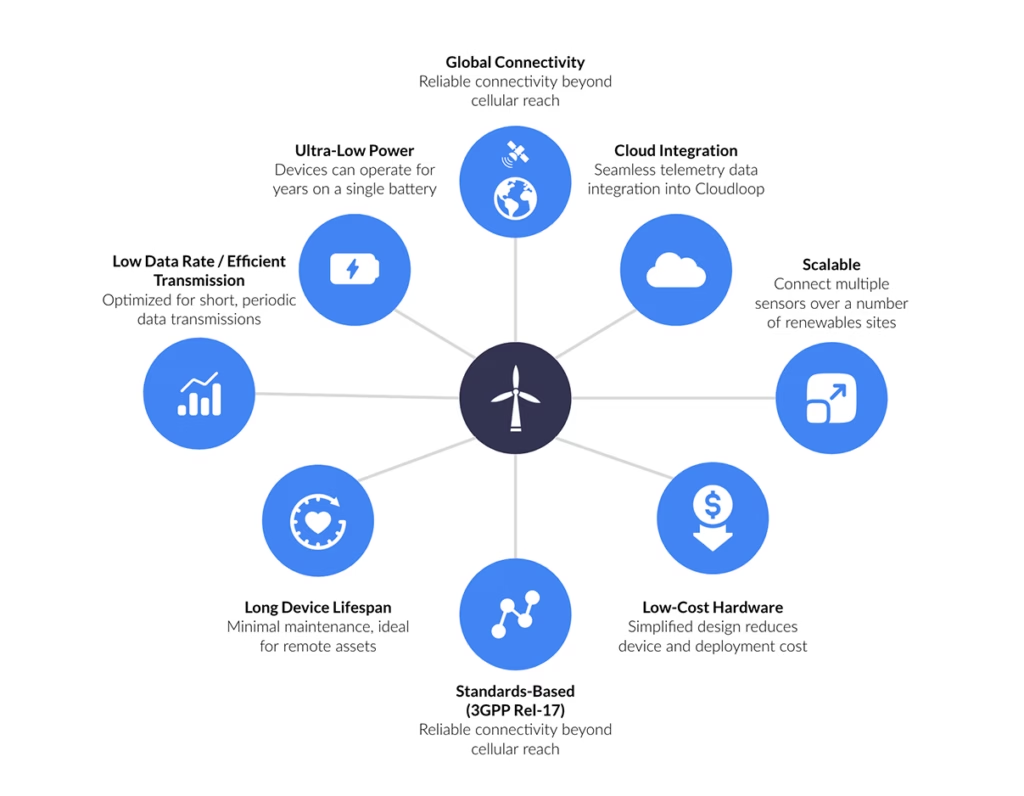
The introduction of standards-based Non-Terrestrial Networks (NTN) by 3GPP has the potential to revolutionize satellite connectivity for renewable energy. By extending Narrowband IoT (NB-IoT), a low power, low cost communication standard already widely deployed in terrestrial networks, into satellite networks, operators can achieve consistent, affordable connectivity across even the most remote wind, solar, or storage sites.
For renewable operators, this evolution opens a new era: from connecting a few critical assets to connecting everything.
Benefits of NTN NB-IoT for Renewable Energy Operators
- No proprietary modem required
Sensors use standardized NB-IoT components instead of bespoke satellite hardware, reducing integration costs. - Lower device and service costs
Shared standards and simpler connectivity models drive down both equipment and airtime expenses. - Future proof infrastructure
Global NB-IoT standards ensure long term interoperability and technology alignment across networks.
- Cost effective scalability
Thousands of low power sensors can be deployed across expansive solar or wind farms without heavy infrastructure investment. - Flexible connectivity options
As multiple satellite operators adopt the standard, service pricing and network choice become more competitive.
Applications for Standards-Based NTN NB-IoT in the Renewable Sector
For renewables, NTN NB-IoT fits best where thousands of low power sensors send small, infrequent updates from remote wind, solar, or storage sites; when reliable reach matters more than real time control.
Wind Energy: Smarter, Predictive Operations
Blade and drivetrain monitoring: Detect anomalies in vibration, strain, or temperature early to enable predictive maintenance before faults escalate.
Structural health: Monitor the integrity of towers and foundations to prevent costly structural damage.
Environmental insight: Collect temperature, humidity, and wind condition data to support condition-based maintenance in remote or offshore installations.
Solar Energy: Panel-Level Performance at Scale
Efficiency tracking: Sensors measure real time output, temperature, and irradiance across thousands of panels.
Environmental optimization: Track dust, shading, and humidity to plan cleaning schedules and maximize efficiency.
Predictive maintenance: Use AI-driven analytics on live panel data to anticipate issues before they affect yield.
Substations and Energy Storage: Always On Visibility
Operational intelligence: Monitoring of non-critical systems such as HVAC, enclosures, and backup units.
Battery and inverter performance: Sensors measure temperature, usage, and degradation to inform maintenance planning.
Local environment tracking: Monitor heat, moisture, and vibration to prevent minor issues from becoming outages.
Where it fits:
NTN NB-IoT is ideal for high volume, low data, latency tolerant applications. It gives operators affordable, long life visibility at scale across their renewable infrastructure.
Proprietary Satellite IoT: Real-Time Insight Where It Matters
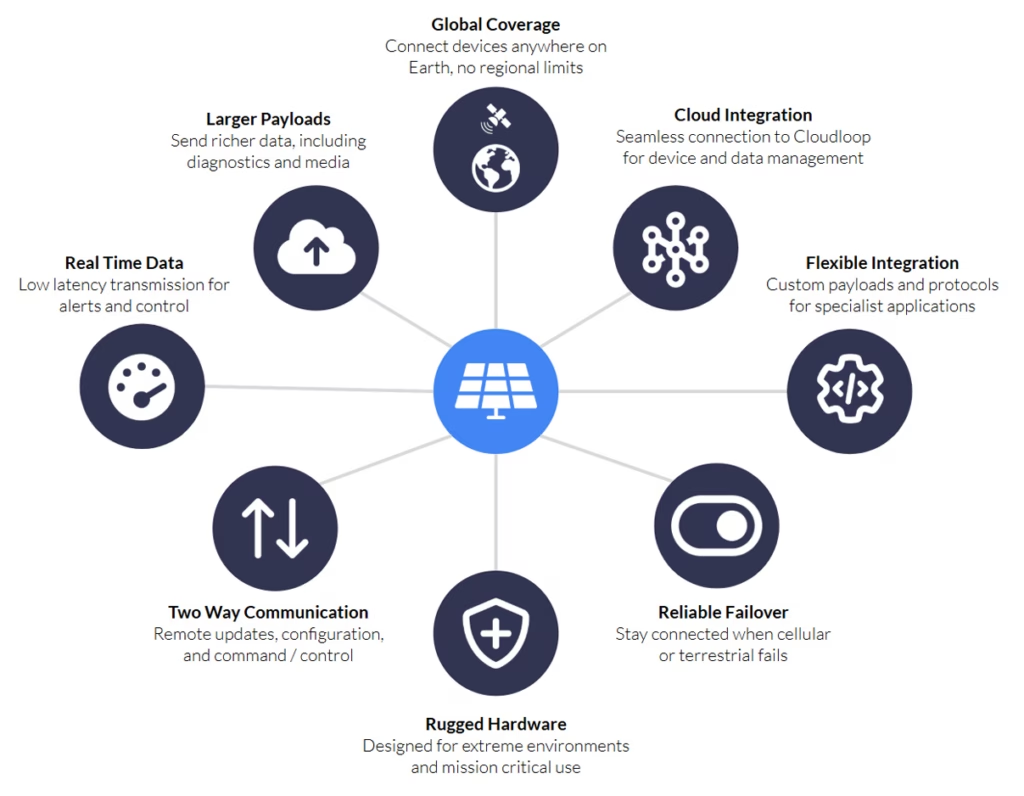
While NTN NB-IoT delivers scalable connectivity for thousands of sensors, proprietary satellite IoT systems provide the other half of the equation: real time, high reliability communication for mission critical operations. These networks offer ‘always on’ control, richer data throughput, and the assured latency required for safety and command functions.
Wind Energy: Instant Awareness in Dynamic Environments
Turbine control and fault response: Enable immediate shutdown or restart commands when thresholds are exceeded, ensuring equipment protection and safety in offshore or isolated farms.
Crew safety: Maintain two way communication and emergency alerts for personnel working in remote or hazardous environments.
Data rich diagnostics: Support higher bandwidth uploads of vibration or acoustic data for detailed drivetrain and gearbox analysis.
Solar and Storage: Real Time Control and Reliability
Critical fault alerts: Provide sub-minute notifications for inverter trips, arc faults, or temperature spikes, with confirmed two way acknowledgments.
Grid dispatch and load balancing: Coordinate distributed storage and solar assets for rapid response to grid frequency or demand changes.
Remote updates and control: Push firmware and configuration changes securely to field devices.
Substations and Microgrids: Control-Plane Resilience
SCADA continuity: Maintain command and telemetry when terrestrial networks fail to ensure operational visibility.
Command assurance: Provide guaranteed message delivery with acknowledgments for critical operational controls.
Local environment tracking: Monitor heat, moisture, and vibration to prevent minor issues from becoming outages.
Where it fits:
Proprietary satellite IoT excels in real time, safety critical, or data rich applications where latency, reliability, and assured control are essential.
Working Together: The Hybrid Model for Connected Renewables
Across the renewable ecosystem, both satellite technologies have distinct but complementary roles. Together, they can create a resilient hybrid connectivity framework: NTN NB-IoT for scalable insight, and proprietary satellite for mission critical control. This combination ensures every renewable asset, from panel to turbine, stays connected and performs at its best.
| Standards-Based NTN NB-IoT* | Proprietary Satellite IoT* | Hybrid Model (NTN NB-IoT + Proprietary Satellite) | |
|---|---|---|---|
| Max Practical Payload | Up to 256 bytes | Up to 100,000 bytes (100 KB) | Mix of both profiles depending on use case |
| Typical Latency | 10–60 seconds (can extend to 2–5 minutes depending on satellite pass) | 10 seconds under optimal conditions | Flexible. Real time via proprietary satellite IoT, scheduled via NTN NB-IoT |
| Best For | Low data, latency tolerant sensing across large asset fleets | Real time, safety critical, or data rich communication | Combining scale with responsiveness |
| Example Applications | Blade or panel monitoring, inverter and battery health, environmental sensing | SCADA backhaul, curtailment commands, crew safety, firmware updates, detailed diagnostics | Wide area condition monitoring plus selective real time control |
| Key Benefits | Ultra low power, long battery life, affordable scaling | Near real time, two way connectivity, proven reliability, supports richer datasets | Delivers cost efficiency and resilience. Low power coverage for mass assets and real time connectivity for critical operations |
*Example service information based on Viasat NB-NTN (Standards-based NTN NB-IoT) and Iridium IMT (Proprietary Satellite IoT)
Hybrid Connectivity Roadmap for Renewables Operators
As renewable energy networks expand, the goal isn’t to replace what works, it’s to build on proven reliability while scaling smarter, standards-based connectivity. Proprietary satellite IoT remains invaluable for mission critical operations and guaranteed uptime, but the arrival of standards-based NTN NB-IoT opens the door to a new class of affordable, low power devices that can extend data collection to every corner of a wind or solar site.
The most effective strategy is hybrid: utilize the robustness of proprietary satellite for control, command, and safety, while using NTN NB-IoT to scale data visibility across assets, sensors, and environmental systems. This staged approach allows operators to evolve without risk, modernizing their infrastructure, reducing costs, and enabling massive IoT integration at their own pace.
Stage 1: Proven Reliability (Today)
Focus on mission critical control and safety using proprietary satellite IoT for SCADA backhaul and alarms.
Stage 2: Scaling Visibility (2026–2027)
Introduce NTN NB-IoT sensors for turbine gearboxes, inverter performance, and solar panel strings. Hybrid solutions use satellite where cellular fails.
Stage 3: Massive IoT Integration (2027–2028)
Deploy thousands of NB-IoT sensors across all assets. Integrate data streams into unified cloud platforms such as Cloudloop for full fleet visibility.
Stage 4: Intelligent Operations (2028 Onwards)
Apply edge analytics and AI for predictive maintenance, automated scheduling, and output optimization. Proprietary satellite remains for safety; NB-IoT drives efficiency at scale.
Building Smarter, Greener, More Connected Energy Systems
As renewable energy capacity continues to expand, the focus is shifting from generation to ensuring every asset, from turbines and inverters to panels and storage systems, remains visible, connected, and performing efficiently. Connectivity is now the foundation that enables data driven operations, predictive maintenance, and long term resilience.
Standards-based satellite IoT is making that connected vision achievable. By combining the reliability of proprietary satellite networks for mission critical control with the scalability of NTN NB-IoT for widespread monitoring, operators can design hybrid systems that balance performance, coverage, and cost. This approach turns isolated assets into part of a cohesive, intelligent network, one capable of supporting the next phase of renewable energy growth.
The transition to hybrid connectivity isn’t just about technology; it’s about creating the operational flexibility to expand confidently. By integrating both proven and emerging IoT standards, renewable energy operators can maintain uptime where it matters most, scale visibility across every site, and continue to build an energy generation system that’s smarter, cleaner, and ready for the future.
Need help building hybrid connectivity?
With over two decades of experience connecting critical infrastructure in some of the world’s most remote environments, Ground Control helps organizations design reliable, scalable satellite and IoT networks.
From mission critical systems to large scale sensor deployments, our team can guide you in combining proprietary and standards-based solutions to keep every renewable asset online and visible.
What 2026 Really Looks Like for Standards-Based Satellite IoT
Standards-based satellite IoT is finally usable for real workloads, but only if you understand where it works today, what it costs, and how to design for its constraints.
Our new eBook, Decoding NTN: The Reality Behind Standards-Based Satellite IoT, sets out a pragmatic view of NTN for IoT teams planning 2026 – 27 deployments.
Inside, we translate standards-speak into decisions you can act on: when NB-IoT vs LTE Cat-1 over satellite makes sense, how minimum session size and protocol overhead (NIDD vs UDP/IP) shape data budgets, and what today’s coverage and SCS approvals mean for rollout planning. You’ll get a plain English decision matrix and realistic timelines so you can deploy with confidence rather than hype.
Read Free eBook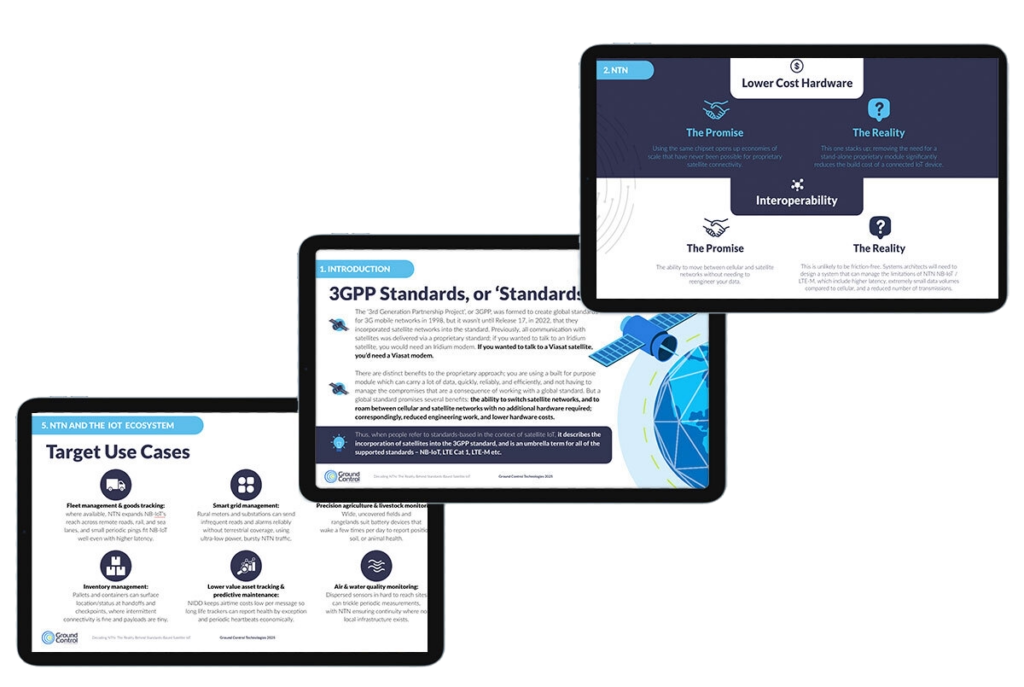
What’s Inside

Coverage, not hype
Current footprint, line of sight, and SCS approvals
Payload Economics
Minimum session size, NIDD vs UDP/IP, and payload planning

Right Tool, Right Job
NB‑IoT vs LTE Cat‑1 over satellite vs proprietary

Plan with Dates
2026 expectations and the 2027 ecosystem ramp
Why This eBook, Now
There’s been no shortage of headlines about direct to device (D2D) and “everywhere coverage”, yet many claims blend marketing terms with evolving standards. In practice, NTN means running existing cellular standards – NB-IoT or LTE – over a satellite link. That shift promises simpler hardware and a shared device ecosystem, but it also introduces satellite-specific realities: higher/variable latency, small cost-optimized data volumes, line of sight requirements and country by country enablement.
Our goal with this eBook is to separate signal from noise. We focus on what works now with NTN NB-IoT, what’s likely next with LTE Cat-1 over satellite, and when a proprietary service remains the right answer.
Coverage Today: Useful, Not Universal
The phrase “global coverage” is seductive. The reality is more localised. Current NTN availability concentrates in specific regions (with notable gaps over oceans and in many countries), and depends on national approvals often referred to as Supplemental Coverage from Space (SCS). In other words, you switch service on country by country, which means deployment plans should be validated market by market. The eBook explains how to assess coverage for your intended regions, including practical placement advice for your antenna.
Payloads and Minimum Session Size: Every Byte Counts
If you’re coming from terrestrial NB‑IoT, airtime budgeting over satellite is different. The cost optimized range for NB‑NTN is small (tens of kilobytes per device per month), and protocol choice has an outsized impact. Non‑IP Data Delivery (NIDD) keeps overheads lean for micro‑telemetry; UDP/IP is often simpler to integrate but adds bytes you’ll pay for. Some providers impose a minimum session size that can negate NIDD’s benefits for very small payloads. The eBook includes concrete examples of payload budgeting and shows when NIDD becomes attractive as commercial offers evolve.
Reliability by Design
Satellite introduces distance and scheduling. Expect higher/variable latency than cellular, and design sensible send cadences if you want predictable costs and battery life. If your use case needs near‑real time interaction or frequent updates, a proprietary IP service is usually the right tool; if you’re moving small, delay‑tolerant telemetry a few times a day, NTN services can be an excellent fit.
NB‑IoT vs LTE Cat‑1 Over Satellite
NTN is an umbrella that covers both NB‑IoT and LTE Cat‑1 waveforms. They serve different jobs. NB‑IoT over satellite fits tiny, infrequent messages on multi‑year batteries. LTE Cat‑1 over satellite suits lighter, less time critical IoT sessions where you may need occasional configuration changes or small bursts of data, typically with external power or larger batteries. The eBook includes a decision matrix to help you map each device profile to the right path.
Timelines You Can Plan Against
We outline what’s available now, what’s expected in 2026 (including anticipated support that may improve minimum session sizes), and how the broader ecosystem is likely to ramp into 2027. We also provide a sober view on “ubiquity”: harmonised experiences across orbits and architectures will take time, and national approvals will continue to shape availability.
When Proprietary Services are Still the Better Choice
If your application needs interactive, two way IP sessions, predictable low latency, or larger payloads, proprietary services remain the workhorses. The eBook compares message‑based proprietary options (efficient for small bursts) with IP‑based services (best for control loops, richer telemetry or firmware deltas), so you can decide on merit rather than ideology.
Get the Full eBook
If your devices operate beyond terrestrial coverage, this eBook gives you the practical guidance to de-risk deployments: how to validate coverage market by market, budget payloads with minimum session size in mind, and decide when NB-IoT or LTE Cat-1 over satellite (or proprietary alternatives) will best serve your requirements.
You’ll find vendor-agnostic explanations, real world constraints stated plainly (line of sight, latency, approvals), operator perspectives from recent panels, and a simple decision matrix you can adapt into your specification. It’s written for product, firmware and operations teams who want clear, testable criteria – not hype.
Download Free eBook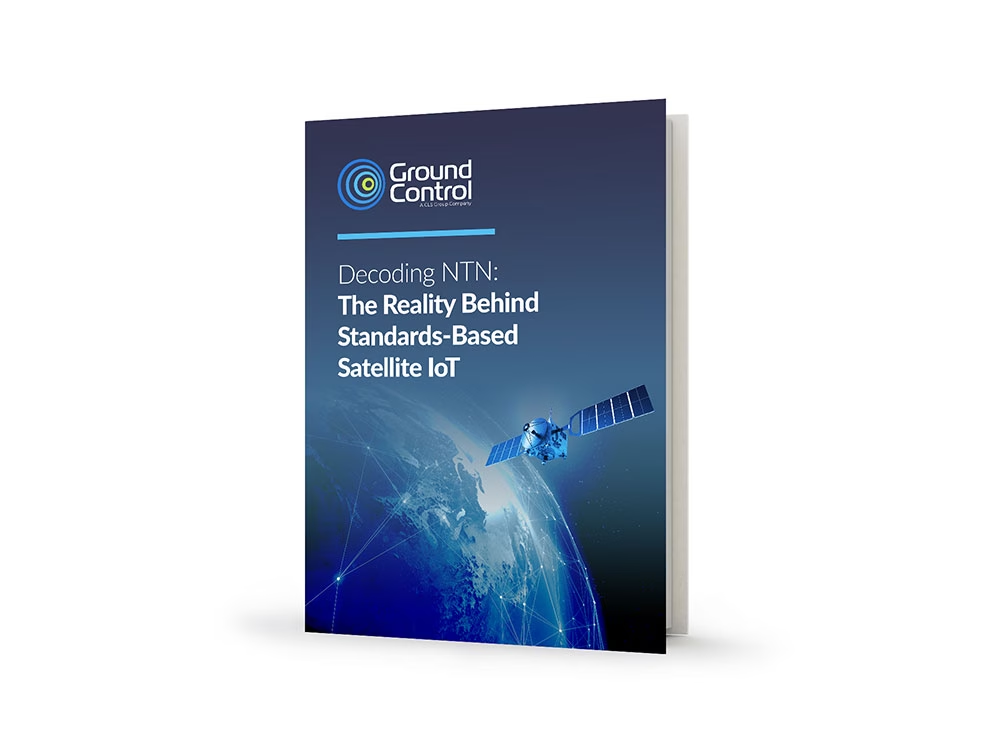
Talk to our Team
If you’d like to talk to the Ground Control team about your remote IOT application, please email hello@groundcontrol.com or complete the form. We have over 20 years of experience in delivering satellite connectivity, and work with major satellite network operators including Iridium, Viasat, OneWeb and Starlink.
Note: You don’t need to complete the form to get the eBook; just click on one of the links, it is an ungated resource.
Remote Environmental Monitoring: Matching Connectivity to the Challenge
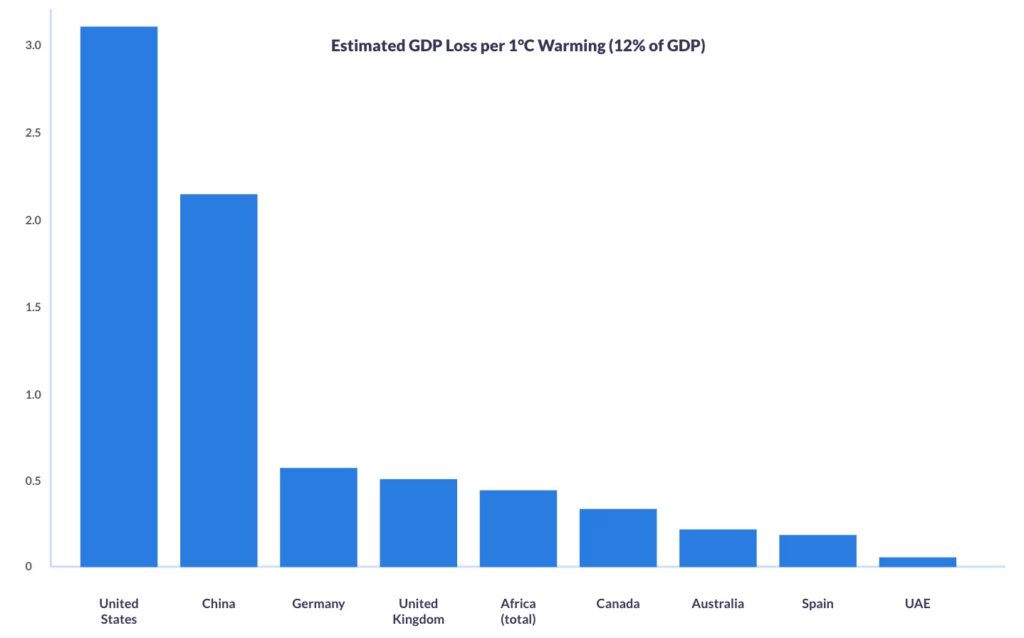
A recent macroeconomic study cited by the World Economic Forum suggests climate warming could cost the world 12% of GDP per °C of temperature rise.
Applied to national economies, this equates to annual losses of over $3.2 trillion for the United States, more than $2.1 trillion for China, and hundreds of billions for other major economies and regions such as Germany, the UK, Africa, and Australia.
These figures underline why investment in environmental monitoring and early warning systems is not just planet saving, but economically essential.
IoT opens new possibilities for environmental insight and protection, but many monitoring sites lie beyond cellular networks, making connectivity difficult.
The Challenge of Monitoring Our Planet
Why is environmental monitoring so hard in remote areas?
Often, the places we most need data from are the hardest to reach. Accessing remote rainforests, high mountain ranges, vast deserts, polar caps and oceanic regions can be difficult, costly, and dangerous. They don’t have cell towers or power lines, and sending people out to check sensors manually isn’t just impractical, it’s unsustainable. IoT for climate monitoring has opened the door, but the logistics of gathering reliable, continuous data in these places remain challenging.
One essential component of success is collaboration. Environmental monitoring is not something one agency or organization tackles alone. Governments, NGOs, researchers, universities and private tech providers all bring pieces of the puzzle, from scientific insight to provision of physical sensor networks, to the connectivity and platforms that make data flow. When these threads are woven together, they provide a picture accurate and complete enough to act on, but without them, data is disparate, narrow, and potentially unreliable.
Today, many of these agencies rely on proprietary satellite IoT to monitor the environment and keep people safe.
Environmental Monitoring via Proprietary Satellite IoT
Proprietary satellite IoT refers to connectivity solutions built on closed, vendor specific satellite networks, platforms and hardware. With a history of reliability and low latency, they’re trusted for mission critical applications, and form the backbone of systems that send wildfire alerts from remote forests, trigger flood warnings when rivers surge, or provide SOS capabilities for Rangers far from cellular coverage. These use cases work, and they save lives.
For reference, here’s a quick refresher on a couple of established proprietary satellite services, but feel free to skip ahead if you’re already familiar.
Iridium runs a Low Earth Orbit (LEO) satellite network using L-band spectrum. Coverage is truly global, including the poles, and terminals don’t require antenna pointing. For IoT, Iridium Short Burst Data (SBD) and Iridium Messaging Transport (IMT) handle low-power telemetry and tracking, while Iridium Certus 100 provides lightweight IP backhaul at up to 88 kbps down / 22 kbps up.
Viasat (through its acquisition of Inmarsat) operates primarily in Geostationary Orbit (GEO) at ~35,786 km. GEO satellites appear fixed in the sky, so you get near-global coverage (excluding the polar regions) but you do need to point the antenna and you’ll see higher latency than LEO. Viasat’s proprietary IoT options – IoT Nano and IoT Pro (previously called BGAN M2M) – are chosen for economical, stable, and reliable links where there’s a clear line of sight to the satellite.
Proprietary satellite IoT is trusted because it is proven. Networks like Iridium and Viasat offer global reach, near-real time communication, a broad range of data capacity tariffs, and connectivity that covers the most inaccessible global locations. In situations where seconds or accurate time-stamped data count, that reliability is non-negotiable.
But this approach does come with trade offs. Proprietary satellite IoT devices have added cost, limiting their widespread deployment. Agencies also face vendor lock in due to a lack of interoperability. And the data can end up siloed, with wildfire sensors on one platform, flood gauges on another, and SOS devices elsewhere. The result is a patchwork of insights that are difficult to unify. We’ve previously highlighted the problem of global data disparity and its impacts. The tension between reliability, availability and scalability, proven systems and siloed ones, defines the current status quo.
The Expanding Toolkit: LoRaWAN and NTN
Over the last decade, LoRaWAN broadened the toolkit for low power, local sensor networking, and now 3GPP’s Non-Terrestrial Networks (NTN) are emerging to extend cellular protocols such as NB-IoT and LTE into areas with no terrestrial networks.
Market Incumbents:
LoRaWAN
An open, community-driven protocol maintained by the LoRa Alliance, LoRaWAN gained momentum from ~2015 onward for low power, low cost sensing. It’s ideal for clustered local or regional deployments (e.g., watersheds, forest plots, landslide corridors). Sensors communicate to nearby gateways; those gateways then backhaul data to the cloud, often over satellite in truly remote sites. LoRaWAN is inexpensive, flexible, and easy to deploy, but coverage is only as broad as your gateway network – there’s no inherent global reach.
Proprietary Satellite IoT
Where time- or mission-critical alerts and global reach are non-negotiable, proprietary satellite services remain best in class. They offer deterministic delivery, global footprints (often including the poles), and proven reliability for safety of life or regulatory use cases. The trade off is cost, which can limit the number of sensors you can field at scale.
Market Newcomers:
Standards-Based Satellite (NTN)
3GPP Release 17 (2022) brought Non-Terrestrial Networks (NTN) to life; extensions that take familiar cellular IoT into space. In practical terms, standards like NB-IoT and LTE-M can now connect via satellite using widely available, standards-based chipsets instead of proprietary hardware.
For remote environmental IoT, that shift really matters. A unified ecosystem means terrestrial and satellite links share the same standards, improving roaming, module availability, and making it easier to switch suppliers. Devices can stay simpler too: the same class of modules can reach the network by satellite when there’s no ground coverage, reducing hardware variants across deployments. And as NTN coverage and device support expand, you can scale sensor footprints without redesigning your stack – ideal for basin-scale hydrology, fire risk perimeters, or multi-site geohazard monitoring.
It’s important to be aware that NTN coverage is still limited, so availability will be patchy for some time. Data rates are small (under 50 KB per month) and duty cycles are constrained, so plan for tiny payloads, compression, and aggressive batching. Applications must be latency-tolerant, with buffering, retry, and out-of-order handling. Unlike cellular, antenna positioning and sky view become first-order concerns, and power budgets are tighter due to longer air-time and higher TX demands.
In this expanding marketplace, there is no single winner in terms of connectivity choices. The toolkit is widening, broadening opportunities and use cases.
Within the current climate (pun intended), with high demand and fast evolving tech, the expertise lies in matching the right connectivity to the right environmental challenge, and future proofing the technologies selected.
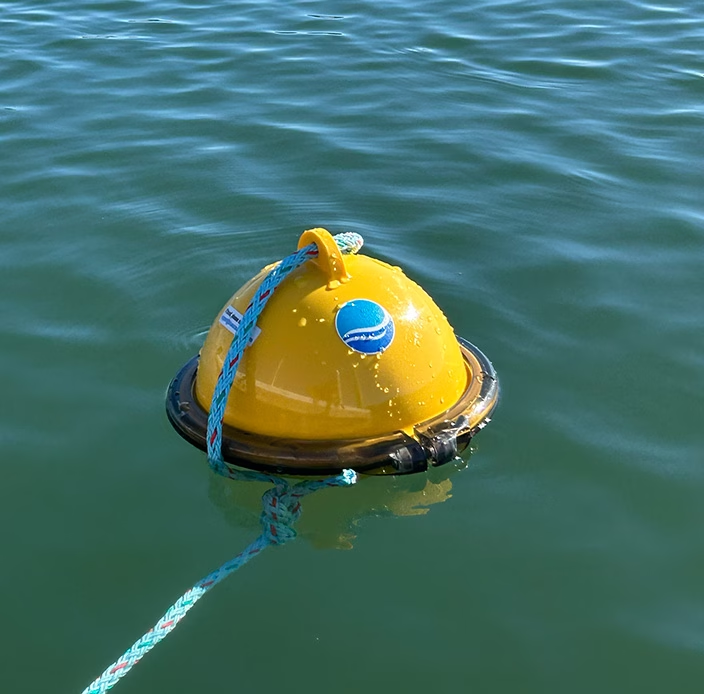
Marine Pollution Tracking
For high-priority stations (spills, hypoxia, critical metrics), proprietary satellite IoT delivers dependable, low latency, global links for continuous reporting.
For dense regional warning nets, NTN NB-IoT can enable hundreds of small, cheap nodes (open-ocean coverage still limited). Near shore, LoRaWAN meshes clusters and backhauls via cellular or satellite, avoiding coastal congestion.

Wildfire Detection
For split-second fire alerts, proprietary satellite links are best: low latency, global reach, reliability when smoke / weather / power knock out terrestrial, and reserved capacity that avoids congestion in crises.
For predictive fire risk monitoring across thousands of low cost sensors, NTN NB-IoT excels: standards-based, massively scalable, and usable as primary or failover connectivity.

Flood Monitoring
For dam breach or flash flood alarms, proprietary satellite IoT is best: real time, low latency alerts that bypass damaged ground networks and keep working when towers or power fail.
For regional flood modelling – rainfall, soil moisture, groundwater – use NB-IoT NTN or LoRaWAN clusters with satellite backhaul: dense, long term data at scale for forecasting and early mitigation.
Biodiversity Tracking
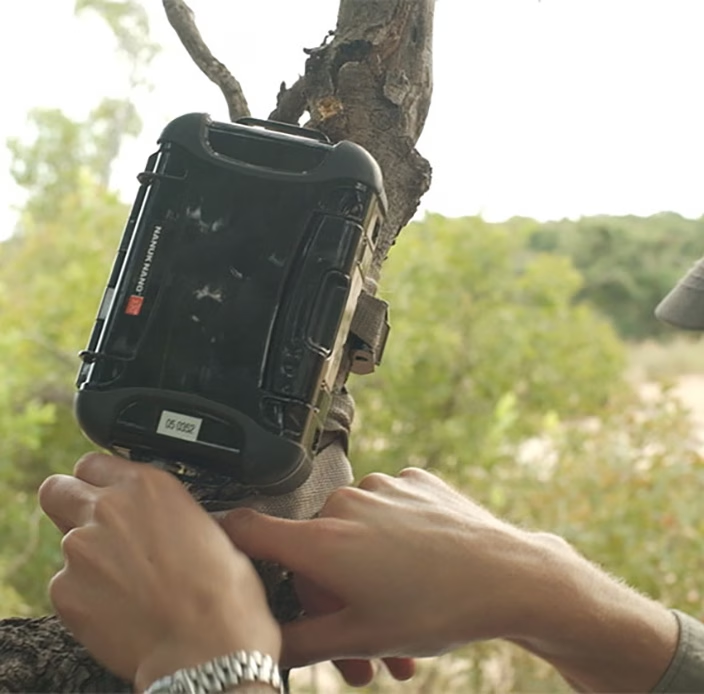
For remote conservation patrols, proprietary satellite GNSS trackers are essential, delivering reliable two way comms, SOS, and precise location in forests or mountains.
For large scale tagging (cattle, migration studies), standards-based NTN NB-IoT fits: smaller, cheaper tags sending intermittent updates, delivering months-to-years battery/solar life and scalable data for movement, breeding, and habitat models.
Soil and Water Quality Monitoring
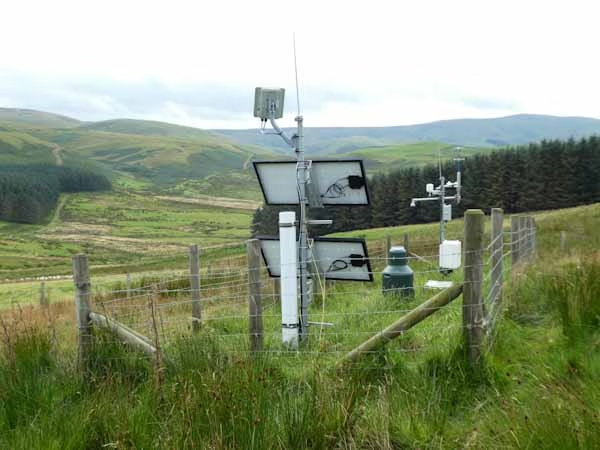
For regional farm networks and watersheds, choose by balancing coverage, power use, and data density. Proprietary satellite IoT fits isolated test sites or large estates needing guaranteed uptime and two way control.
Standards-based NTN NB-IoT enables thousands of low cost soil/moisture sensors across distributed fields, ideal for basin-wide modelling and predictive irrigation.

Glacial and Permafrost Monitoring
For polar or alpine deployments with extreme conditions and no cellular, proprietary L-band satellite IoT is the only mature option for real-time, all weather, pole to pole links.
Where coverage allows, NB-IoT NTN can send intermittent, timestamped updates – think small payloads and higher latency.
Exploring the Deployment Realities
Let’s talk coverage: How “global” are these options?
- Proprietary Satellite IoT
Iridium: Truly global, pole to pole, provided the device has a clear view of the sky. No antenna pointing required.
Viasat (Inmarsat L-band): Near-global footprint excluding the extreme polar regions; requires antenna pointing for a stable link. Best when you want economical, stable links, and have a clear line of sight to the satellite. - LoRaWAN
Coverage is inherently regional: each node talks to a nearby gateway. In open areas, practical node-to-gateway distances are roughly up to ~15–16 km (terrain and clutter can reduce this). If your monitored area is wider than that, you either give each endpoint its own satellite connection, or build a local LoRaWAN network and backhaul one or more satellite-connected gateways. - NTN (e.g. NTN NB-IoT, NTN LTE Cat-1, NTN LTE-M)
Coverage is early and patchy. Commercial availability today is concentrated in specific countries/regions with little to no ocean coverage (view current NTN coverage map from Viasat). Viasat has the most coverage, but is restricting services to areas where there is sufficient demand; thus, as more hardware / devices reach the market, and the use cases become clearer, we would anticipate coverage growing.

Reducing Silos With a Unified Data Plane
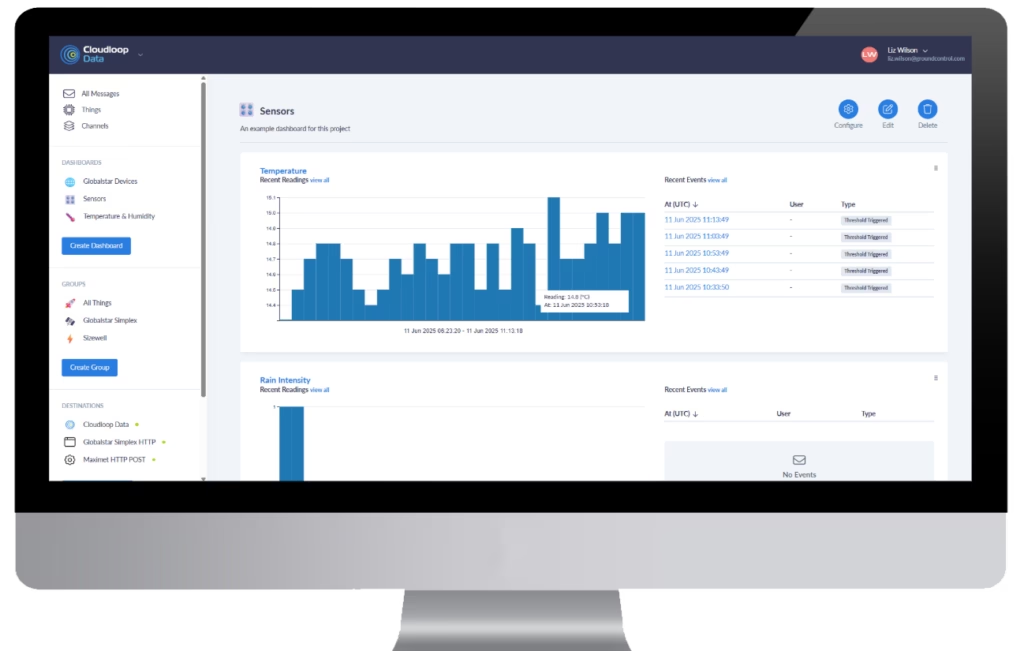
Successful deployments depend on how easily devices, platforms, and networks exchange data. The practical goal is a single pane of glass where you can see, manage, and act on data from mixed networks – proprietary satellite, NTN (as it rolls out), and, where available, cellular- without rewriting everything each time you add a site or change a bearer.
A pragmatic way to get there is an API-first platform that’s device- and network-agnostic. For example, Cloudloop is designed to ingest data from heterogeneous bearers and present it through one interface. It doesn’t make coverage universal, but it can reduce integration work and lower the risk of data silos as footprints grow.
Security: Keeping Environmental Data Trustworthy
Environmental monitoring data increasingly informs safety, regulation, and policy, so protecting its integrity matters as much as collecting it. For remote environmental monitoring, satellite IoT reduces exposure to common internet borne threats because links don’t rely on local terrestrial infrastructure or public ISPs. In practice, that means fewer attack surfaces between field sensors and your platform.
Advantages and limitations of satellite IoT security:
High Encryption Standards by Default
Professionally operated, mature satellite networks such as those operated by Iridium and Viasat encrypt data using AES-256, a symmetric block cipher algorithm recognized for its security and efficiency.
Avoids Man-in-the-Middle Attacks
Satellite networks are much harder to compromise via MitM attacks due to their direct transmission methods, reduced ISP reliance, high-altitude signal paths, and strong encryption. However, they’re not completely immune. The means by which data is routed from the ground station to the user’s application needs consideration.
There are several options here with varying degrees of security:
- VPNs / Firewalls – The most commonly deployed method for securing data being moved from a ground station is to utilize a combination of firewalls and VPNs.
- Private Wire – Private wire connections create a direct, secure link between a satellite ground station and a customer’s network, bypassing the public internet entirely. This can be achieved through dedicated leased lines or private Layer 2 circuits (such as MPLS or SD-WAN). This results in a closed, high-security data path that prevents exposure to cyber threats like DDoS attacks or data interception.
The bottom line: Satellite won’t eliminate risk, but its independence from local infrastructure, combined with private routing, encryption, segmentation, and failover, gives environmental programs a materially stronger default security posture than relying on terrestrial connectivity alone.
From Insight to Action: Key Considerations for Choosing the Right Connectivity
Understanding these findings is just the start. The next step is applying them, choosing the right technology mix to meet real world monitoring goals while staying compliant, scalable, and resilient.

“We can only afford a handful of sensors, but we need scale.”
Utilize NB-IoT/NTN NB-IoT for assured security or LoRaWAN sensor networks with satellite backhaul for affordable, dense deployments.

“We need reliable alerts for emergencies.”
Use a proven, proprietary L-band satellite IoT link e.g., Iridium SBD/IMT or Certus 100, or Viasat IoT Nano/Pro that’s stress-tested for mission critical use.
“Coverage is patchy, how do we know what will actually work in our region?”
Iridium’s proprietary services are global, LoRaWAN is regional, and NTN NB-IoT is emerging. Check coverage maps for more detailed information, or speak to a remote connectivity professional.

“Our systems don’t talk to each other.”
Utilize Cloudloop functionality with APIs for interoperability. Consume your data in a way that is right for the collaboration, including sending data securely to multiple (pre-integrated) destinations.

“We’re worried about data security and compliance.”
Choose partners that prioritize end-to-end encryption, secure APIs, and compliant cloud hosting. Ground Control’s Cloudloop platform ensures data integrity across hybrid networks while maintaining full customer control over data destinations.

“We can’t do this alone.”
With proven expertise, Ground Control is a valued technical partner, not just a provider. Helping NGOs, agencies, and companies to deploy hybrid, collaborative solutions.
Building a Smarter, More Connected Planet
The future of environmental monitoring isn’t about replacing one connectivity technology with another; it’s about building hybrid IoT networks that combine the best of each. Proprietary satellite IoT will continue to deliver life- and mission-critical reliability, providing resilient links and accurate, time stamped data from even the most remote regions. Meanwhile, standards-based NB-IoT and LoRaWAN are unlocking scalable, low-cost sensor deployments bringing environmental data collection to new levels of density and insight.
When agencies, NGOs, and research partners collaborate across these ecosystems, we can turn isolated measurements into continuous, planetary-scale intelligence.
Looking to Find Your Connectivity Partner ?
At Ground Control, we bridge today’s proven systems with tomorrow’s scalable standards, helping organizations deploy what works now while preparing for what’s next. If you’re exploring how to expand your monitoring capability, talk to our team about designing a solution that fits your goals, your environment, and your stakeholder needs.
Email hello@groundcontrol.com or complete the form, and we’ll be in touch within one working day.
Your Top Questions About NTN NB-IoT, Answered
On September 4, 2025, we co-hosted a webinar on NTN NB-IoT Uncovered: What It Is, What It Isn’t, and Where It Wins with Viasat. This is emerging technology with a great deal of promise, and we had a large audience, with an accordingly large number of questions! We’ve collated these questions into several topics in this blog post, which we will keep updated as the roadmap progresses.
Quick Links:
- What is the expected cost of hardware (e.g., modem, antenna)?
- What will ongoing connectivity cost, for example at 50 KB per month or one transmission per hour?
- How does NTN NB-IoT communication cost compare to terrestrial NB-IoT and proprietary satellite solutions?
- Does the device include a subscription, and are any licenses required to use the service?
- What are the expected power requirements for receiving and sending messages?
- Will latency in satellite NB-IoT significantly impact battery performance?
- What counts as “small data volumes,” and how is data usage calculated (uplink vs downlink)?
- Is TCP/IP supported, or is NB-IoT limited to other protocols like UDP or NIDD?
- Are message acknowledgements supported, and do they consume billable data?
- What countries and regions are currently covered, and what are the rollout plans?
- Will the service work at sea or in harsh environmental conditions (e.g., offshore, deserts, extreme temperatures)?
- What are the main technical differences between NTN NB-IoT and cellular NB-IoT?
- How does NTN NB-IoT compare to proprietary satellite services like Iridium SBD?
- What frequencies are used, and how do they integrate with mobile networks?
- How does network selection work when both terrestrial and satellite networks are available?
- Is NIDD part of the 3GPP standard and supported by the network?
- Can we manage NTN NB-IoT devices and integrate using existing patterns in Cloudloop?
- What applications are best suited to NTN NB-IoT?
- How suitable is NTN NB-IoT for UAVs, HAPs, or other mobile applications?
- How does NTN NB-IoT compare to Starlink Direct to Cell?
- Could it replace or compete with services like Iridium or Starlink in the future?
- How well does it perform in environments with heavy metal or interference, such as steel plants?
- Does the service require direct line-of-sight, and how does it perform under partial obstruction (e.g., forest canopy)?
- Are the satellites GEO, LEO, or a mix?
Pricing and Licensing
What is the expected cost of hardware (e.g., modem, antenna)?
Hardware pricing varies widely depending on the capabilities your project requires. Some modules are designed purely as basic modems to connect to NTN NB-IoT networks and are relatively inexpensive, but they only provide connectivity.
Products like RockBLOCK RTU are far more than just a connection point. In addition to NTN NB-IoT access, they include:
- Edge processing to handle data locally and reduce transmission frequency (saving airtime and battery life).
- Configurable sensor reading and alerting, so you can trigger transmissions only when thresholds are met.
- A plug-and-play design, enabling faster deployment and simpler integration with cloud platforms like Cloudloop.
Because of this added functionality, RockBLOCK RTU and similar devices sit at a different price point than a simple dongle, but they often reduce overall project costs by lowering airtime usage, extending battery life, and minimizing field maintenance.
In short, the “right” hardware investment depends on whether you need just connectivity or a complete field-ready solution that simplifies operations and scales with your project.
What will ongoing connectivity cost, for example at 50 KB per month or one transmission per hour?
Viasat has not yet published official NTN NB-IoT pricing, but early indications suggest it will be competitive for the specific niche of very small, infrequent data transmissions. Final rates are expected to be announced in Q1 2026.
Because of the complexity and scale of satellite infrastructure, NTN NB-IoT data will not follow the same pricing model as terrestrial NB-IoT. In practical terms, this means far less data for a higher cost, making it best suited to scenarios where devices send tiny payloads, such as tens of bytes per hour, rather than continuous data streams.
When compared to proprietary satellite services, NTN NB-IoT can be more cost effective for ultra-low data volumes (typically below 30-50 KB per month per device). This makes it a strong choice for applications like remote sensors, infrequent tracking, and metering.
Around 50 KB per month, message-based services like Iridium Messaging Transport (IMT) and NTN NB-IoT become roughly equivalent in cost.
Above 50 KB per month, proprietary services like IMT quickly become far more economical, especially for higher data throughput or near-real time applications.
In summary, NTN NB-IoT fills a valuable gap for low data, low power use cases, but it is not simply a continuation of cellular NB-IoT pricing in space. For higher data needs, traditional satellite services remain the better fit.
How does NTN NB-IoT communication cost compare to terrestrial NB-IoT and proprietary satellite solutions?
Satellite NB-IoT is designed for very small, infrequent data transmissions, such as a few tens of bytes per hour or day. Because of the complexity of delivering data over satellites, the cost per kilobyte is much higher than for terrestrial NB-IoT, which benefits from existing cellular infrastructure and is inexpensive for high volume, high frequency data.
For ultra-low data applications, Satellite NB-IoT promises to be more affordable than traditional proprietary satellite services, which are built for higher throughput, always-on connections. However, as data usage rises beyond roughly a few dozen kilobytes per month per device, the cost of satellite NB-IoT can quickly become more expensive, making other satellite solutions like Iridium Messaging Transport, or Viasat IoT Nano, more economical.
In short:
- Terrestrial NB-IoT is the lowest cost option, but only works where there is cellular coverage.
- Satellite NB-IoT fills the gap where coverage is missing, offering lower costs than legacy satellite services for small, infrequent messages.
- Proprietary satellite solutions remain the best fit for higher data volumes, real time control, or truly global coverage.
Does the device include a subscription, and are any licenses required to use the service?
NTN NB-IoT works much like cellular IoT. Devices use a SIM card to authenticate on the network, and subscriptions are managed separately. These can be as short as one active month or discounted for 12 months or longer, depending on your needs.
No additional licenses are required as long as you are using a certified device. If you’re building your own hardware, it must first go through Viasat’s certification process before it can connect to the network.
Power Consumption
What are the expected power requirements for receiving and sending messages?
Final power profiles are still being confirmed, but early testing of devices shows very low power consumption, similar to cellular NB-IoT at the edge of coverage. Typical behavior is short, high-power bursts during transmission, with the device in deep sleep the rest of the time.
- Transmit (TX): Brief bursts at a few hundred milliamps for fractions of a second per message.
- Receive (RX): Much lower current for very short listening periods.
- Deep Sleep: Extremely low standby current between events.
For ultra-low data use cases – such as one small (50-byte) message per day – battery life can be measured in years. Even at one message per hour, multi-year operation is still realistic with careful design, especially when payloads remain small, retries are minimized, and devices have a clear view of the sky.
Tip: Use short, infrequent messages and Non-IP Data Delivery (NIDD) where possible to maximize battery life.
Will latency in satellite NB-IoT significantly impact battery performance?
Not directly. Latency in satellite NB-IoT (typically tens of seconds) affects how long a device stays “awake” waiting for confirmation or downlink data, but it doesn’t require the radio to transmit continuously. Most of the time, the device is idle and consuming minimal power.
Where battery performance can be affected is in retry scenarios. If poor antenna placement or obstructions cause repeated failed attempts, the radio will need to re-send messages, increasing total energy used. This is why clear line of sight and well planned message scheduling are key.
For applications sending small, infrequent messages, latency has little impact on battery life, and multi-year operation remains realistic, even when end-to-end message delivery takes longer.
Data & Protocols
What counts as “small data volumes,” and how is data usage calculated (uplink vs downlink)?
For NTN NB-IoT, small data volumes generally mean 30-50 KB per month per device. This roughly equates to one small message (around 50 bytes) every hour, making it ideal for applications like periodic sensor readings or exception-based reporting.
Data usage is calculated as the total of both uplink and downlink traffic, combined.
- Uplink: Data sent from the device, such as sensor readings or alerts.
- Downlink: Data sent to the device, such as configuration updates or acknowledgements.
In most deployments, uplink traffic dominates, with only small amounts of downlink data needed. However, frequent acknowledgements or commands sent to the device will eat into the monthly budget, so it’s best to minimize downlink usage wherever possible.
Rule of thumb: If your device sends a 50-byte message hourly, you’ll be close to the 30-50 KB/month sweet spot, but adding regular downlink messages or retries can quickly push usage higher.
Is TCP/IP supported, or is NB-IoT limited to other protocols like UDP or NIDD?
TCP/IP is not supported for NTN NB-IoT. By avoiding the heavy overhead of TCP/IP, devices can send and receive data far more efficiently, using fewer bytes per message and significantly reducing power consumption.
Instead, NTN NB-IoT uses lightweight protocols such as UDP and NIDD (Non-IP Data Delivery), which are purpose-built for small, infrequent IoT messages. This means:
- Lower airtime costs: No wasted data on headers or session management.
- Lower power draw: The radio stays on for less time per message.
- Simpler design: Devices can focus on sending just the essential payload.
Result: Your data goes further, your batteries last longer, and you stay well within the ideal 30-50 KB/month sweet spot for NTN NB-IoT.
Are message acknowledgements supported, and do they consume billable data?
In principle, acknowledgements are supported, but whether they’re available depends on the hardware and how it’s configured. Some devices, such as RockBLOCK RTU, can be programmed to generate acknowledgements, while others may not include this functionality out of the box.
Because an acknowledgement is just another downlink message, it does consume data and counts toward the device’s total monthly allowance (both uplink and downlink combined).
Frequent use of acknowledgements can quickly increase data consumption, so it’s best to:
- Use them sparingly, such as for critical alerts where confirmation is essential.
- Keep acknowledgement messages very small to stay within the <30 KB/month sweet spot.
- Design systems so that most reporting is uplink-only, with acknowledgements reserved for exceptions or configuration updates.
Tip: If battery life and cost are key priorities, minimize acknowledgements and focus on efficient, uplink-driven workflows.
Coverage & Availability
What countries and regions are currently covered, and what are the rollout plans?
Currently, NTN NB-IoT service is available in the United States, Canada, New Zealand, Australia and Europe (partially). It is globally capable, but not yet globally available; effectively, there have to be enough end points / applications in a particular region for the service to be unlocked. We anticipate that coverage will expand rapidly over the next 1-3 years.
Will the service work at sea or in harsh environmental conditions (e.g., offshore, deserts, extreme temperatures)?
The service is certainly capable of this, but today it isn’t available for maritime applications (see above). Instead, explore message-based solutions like Viasat IoT Nano or Iridium Messaging Transport (IMT) for an economical alternative that has truly global coverage.
Technical
What are the main technical differences between NTN NB-IoT and cellular NB-IoT?
These are summarised in the below table, and discussed at length in the webinar (watch the recording on Youtube).
| Standards-Based NTN NB-IoT* | Cellular NB-IoT | Proprietary Satellite IoT** | |
|---|---|---|---|
| Max Practical Payload | 1,000 bytes | 1,400 – 1,600 bytes | 16,000 bytes |
| Min. Practical Payload | 10-30 bytes | 30-50 bytes | 10 bytes |
| Typical Latency | Medium (10 – 60s); MVNO scheduling could increase this to 2 – 5 mins) | Low (1 – 10s) | 10 seconds under optimal conditions |
| Coverage | United States, Canada, Brazil, Australia, New Zealand and select European markets | Where supported by regional MNOs, and there is terrestrial infrastructure | Global, exc. Polar regions |
| Cost-Optimized Monthly Data Volume | < 50 KB | < 5 MB | < 1 MB |
*Based on Viasat NB-NTN | **Based on Viasat IoT Nano
How does NTN NB-IoT compare to proprietary satellite services like Iridium SBD?
NTN NB-IoT is designed for very small, infrequent data transmissions, such as tens of bytes per hour, making it a cost effective choice for applications like remote monitoring, tracking, and metering where usage stays below roughly 30-50 KB per month. It currently offers regional coverage rather than true global reach and has moderate latency, typically tens of seconds, which is acceptable for periodic updates but not for time-critical control.
Message-based proprietary services such as Iridium SBD share some similarities with NTN NB-IoT, as they also focus on small, discrete payloads and are well-suited for remote reporting. However, SBD offers truly global coverage, including oceans and polar regions, and has both lower latency and higher throughput, making it more robust for mobile or mission-critical assets.
In contrast, IP-based satellite services like Viasat IoT Pro or Iridium Certus 100 provide a continuous, always-on connection. This enables real time command and control, streaming data, and more complex integrations, something neither NTN NB-IoT nor SBD can deliver. These services are typically more expensive and consume more power, but they are essential for applications such as autonomous systems, live video feeds, or continuous telemetry.
In summary:
- NTN NB-IoT is ideal for ultra-low power, ultra-low data needs.
- Message-based services like SBD are better for mobile or global small data applications.
- IP-based services are the only option for real-time control and high throughput use cases.
What frequencies are used, and how do they integrate with mobile networks?
Viasat’s NTN NB-IoT service (and indeed all of its satellite IoT services) operates in the L-band (around 1–2 GHz), a frequency range well suited for satellite IoT because it enables reliable coverage, compact, low power antennas, and resilience to weather related interference.
Because Viasat’s service follows the 3GPP NB-IoT standard, a single SIM and chipset can, in theory, support both terrestrial (TN) and satellite (NTN) networks, allowing devices to roam or fail over between them when agreements are in place.
Although TN and NTN NB-IoT share the same core standard, they operate under very different data and power constraints. TN NB-IoT supports larger, more frequent data transfers, often over IP-based protocols. NTN NB-IoT is optimized for tiny, infrequent messages and while it can utilize UDP/IP, Non-IP Data Delivery (NIDD) is desirable to keep airtime and costs low.
As a result, systems designed for terrestrial NB-IoT often need re-architecting to perform well over satellite. Key factors such as payload size, message frequency, and downlink strategy should be carefully planned to avoid unexpected performance or cost challenges.
How does network selection work when both terrestrial and satellite networks are available?
Most devices come with lowest-cost routing built in, so will use terrestrial when available, switching to satellite when cellular drops out, and allow control over when the device will attempt a satellite connection once cellular is not available.
Is NIDD part of the 3GPP standard and supported by the network?
Yes. Non-IP Data Delivery (NIDD) is fully part of the 3GPP NB-IoT standard and is supported by Viasat’s NTN NB-IoT network. We are strong advocates of NIDD because it’s the key to unlocking the true economics and efficiency of satellite IoT.
Unlike traditional IP-based messaging, which adds significant overhead to every transmission, NIDD allows devices to send only the essential data payload, with no IP headers or session management. This brings three major benefits:
- Lower airtime costs – every byte transmitted is meaningful data.
- Lower power consumption – shorter transmissions mean devices stay in deep sleep longer, extending battery life.
- Simpler, leaner design – ideal for very small, infrequent messages typical of NTN NB-IoT use cases.
For ultra-low data applications like environmental sensors, asset tracking, or metering, NIDD is the preferred approach. While IP-based transport is still supported in the NB-IoT standard, it can quickly drive up airtime costs and power usage, especially over satellite links.
We’ve written a detailed explainer on why NIDD is so important for NTN NB-IoT; you can read it here: Unlocking NTN NB-IoT with NIDD.
Can we manage NTN NB-IoT devices and integrate using existing patterns in Cloudloop?
Yes. NTN NB-IoT devices can be fully managed and monitored within Cloudloop, alongside other satellite IoT devices, giving you a single, unified view of your entire deployment.
Through Cloudloop Data, information from NTN NB-IoT devices is automatically reformatted and standardized, so it can be delivered to a wide range of destinations, including cloud platforms, analytics tools, and third-party systems. This means you can continue using your existing integration patterns and workflows, with no need to rebuild or redesign your backend systems to handle NTN NB-IoT traffic.
Examples of integration destinations include:
- AWS IoT Core
- Azure IoT Hub
- Google Cloud IoT
- REST APIs and custom endpoints
- Webhooks for custom workflows.
Because Cloudloop is network- and protocol-agnostic, it works seamlessly with both standards-based NB-IoT devices and proprietary satellite solutions, making it ideal for organizations running mixed technologies.
Use Cases & Comparisons
What applications are best suited to NTN NB-IoT?
NTN NB-IoT, whether delivered via UDP/IP or NIDD, is ideal for low data, low power applications where devices send small, infrequent messages and where a short delay (latency) is acceptable. Because the technology is optimized for tiny payloads and long battery life, it excels in deployments where maintaining coverage in remote or hard to reach locations is the priority.
The three strongest application areas are:
- Monitoring – environmental sensors, infrastructure health checks, soil moisture, or weather stations.
- Tracking – livestock, wildlife, or remote assets where location updates are needed periodically, not in real time.
- Metering – water, gas, or energy usage reporting where daily or hourly readings are sufficient.
The service is designed to support large numbers of endpoints, each sending very small amounts of data. The sweet spot is around 30-50 KB per device per month, which equates to roughly one transmission per hour. This works well for applications like periodic sensor readings or basic status updates, but it’s not ideal for frequent updates, such as continuous tracking where you want to see location changes every few minutes.
How suitable is NTN NB-IoT for UAVs, HAPs, or other mobile applications?
NTN NB-IoT is not well suited for UAVs (Uncrewed Aerial Vehicles), HAPs (High-Altitude Platforms), or similar mobile applications. These platforms typically require an always-on, real time connection for tasks such as command and control, continuous telemetry, or video streaming.
NTN NB-IoT, by design, is optimized for tiny, infrequent data messages with latency measured in tens of seconds. This makes it perfect for periodic reporting, such as a water level sensor or asset tracker, but completely unsuited for dynamic, fast moving systems where constant situational awareness is required.
For UAVs, HAPs, and other highly mobile assets, you’ll need an IP-based satellite connection, which provides a continuous, reliable data link. Good options include:
- Iridium Certus 100 – a truly global service for mobile platforms, ideal for command and control and small data streams.
- Viasat IoT Pro – an IP-based L-band solution offering higher throughput for more complex or data-intensive applications.
- Hardware like the RockREMOTE Mini OEM, designed specifically for integrating into UAVs or other custom mobile systems.
How does NTN NB-IoT compare to Starlink Direct to Cell?
Starlink originally positioned Direct to Cell as a future option for LTE phones and IoT devices, including Cat 1 hardware. Its current roadmap, however, is focused much more heavily on extending mainstream mobile services to smartphones. The service has been rebranded as Starlink Mobile, with future development centred on higher speed data, voice, video and a terrestrial-like 5G experience for mobile subscribers. IoT is no longer prominent in Starlink’s current positioning.
That makes Starlink Mobile difficult to treat as a near-term alternative to NTN NB-IoT for industrial deployments. Availability still depends on agreements with mobile network operators, access to suitable spectrum and regulatory approval in each market. SpaceX’s agreement to acquire EchoStar’s AWS-4 and H-block spectrum supports its next-generation US service, but it does not remove the need for country-specific spectrum and commercial arrangements elsewhere.
For low power sensors and remote monitoring applications, NTN NB-IoT therefore offers the clearer and more mature development path. Starlink Mobile may eventually support a broader range of connected devices, but its present direction is toward consumer and mobile broadband rather than purpose-built, low power IoT.
The same application questions still matter when comparing satellite connectivity options: how much data must be transferred, how frequently and urgently it is needed, what power is available, whether the asset moves, and where it will operate. Ground Control can help assess those requirements and identify the most appropriate network, protocol and hardware.
Could NTN NB-IoT replace or compete with services like Iridium or Starlink in the future?
In the foreseeable future, the answer is no. NTN NB-IoT and proprietary satellite systems are designed to solve different problems and will coexist for many years to come. Viasat continues to invest in its IoT Nano and IoT Pro services, and similarly, Iridium is planning to launch its own NTN NB-IoT service in the next two years and that will exist alongside their SBD, IMT and Certus 100 IoT services.
NTN NB-IoT opens up entirely new classes of applications that were previously cost prohibitive, thanks to its lower device and connectivity costs. However, this comes with trade-offs in data volumes, latency, coverage, and potential congestion. It is, at its core, a cellular standard adapted for satellite use, whereas proprietary systems were purpose-built for satellite, optimized to send data as efficiently as possible while conserving power and bandwidth.
Looking further ahead, in the mid-2030s, we expect to see the introduction of NTN NR (New Radio), a next-generation standard that supports much higher data rates and lower latency. While this could significantly change the landscape, it’s too early to predict what the commercial proposition will look like or whether it could compete directly with purpose-built satellite services.
Ultimately, the physics of satellite communication impose unavoidable constraints: it will always be more expensive and power hungry than terrestrial cellular networks, which limits its use to specific scenarios. The deciding factor over the next decade will not just be technology, but commercial dynamics – which service delivers the best mix of coverage, performance, and cost for a given application.
How well does it perform in environments with heavy metal or interference, such as steel plants?
No satellite IoT service – including NTN NB-IoT – can transmit reliably through heavy metal structures. For successful operation, the antenna must have a clear, unobstructed view of the sky. In environments such as steel plants or shipping yards, this usually means placing the antenna outside the structure or in a location with minimal obstructions.
For more guidance on what “clear view of the sky” really means and how to plan antenna placement, see our article: What Does a Clear View of the Sky Mean?
Antenna Requirements
Does NTN NB-IoT require direct line of sight, and how does it perform under partial obstruction (e.g., forest canopy)?
Viasat’s NTN NB-IoT service requires direct line of sight between the antenna and the satellite because it operates on GEO (geostationary) satellites. If the signal is obstructed, for example, by buildings, thick forest canopy, or even certain vehicle structures, performance will degrade significantly, and the connection may fail altogether. This makes careful antenna placement essential.
By comparison, services using LEO (Low Earth Orbit) satellites, such as Iridium’s forthcoming NB-IoT service, NTN Direct, are a little more forgiving. With multiple satellites constantly moving across the sky, a general “clear view of the sky” is sufficient, and temporary obstructions are less of a problem.
For practical guidance, see our article: What Does a Clear View of the Sky Mean? This explains how to evaluate your site and position antennas for reliable connectivity, whether you’re dealing with trees, rooftops, or industrial environments.
Are the satellites supporting NTN NB-IoT GEO, LEO, or a mix?
Viasat’s IoT satellites are currently all geostationary (GEO), meaning they orbit approximately 35,786 km above the Earth’s equator and remain fixed over a point on the planet. Once a link is established with a GEO satellite, it’s highly stable (if the endpoint is static) and reliable; however the greater distance means longer latency than satellites in Low Earth Orbit (LEO).
In 2027, we anticipate Iridium will launch its NTN NB-IoT service on their LEO satellites. This will create competition and allow devices to potentially connect to both GEO and LEO satellites for the same class of service.
For anyone interested in diving deeper into how satellite orbit height affects performance, our definitive guide is here: How Satellite Orbit Heights Impact Satellite Communication.
In Summary
NTN NB-IoT opens up exciting new possibilities for connecting devices in remote or hard-to-reach locations, enabling low cost, low power communication at a scale that was previously out of reach for many industries. However, like any technology, it has its strengths and limitations. It’s best suited to small, infrequent transmissions where latency is acceptable, and less suited to real time or high data volume applications.
If you’d like to explore NTN NB-IoT further, we’ve included some recommended resources below. And if you still have questions or want to discuss how NTN NB-IoT might fit into your specific project, please get in touch using the form at the bottom of this page, or email hello@groundcontrol.com; our team will be happy to help.
Any more questions?
If you didn’t find the answer you were looking for, or if you’d like to discuss how NTN NB-IoT could fit into your project, our team is here to help.
Simply fill out the form, and one of our experts will get back to you to talk through your requirements, explore possible solutions, and help you plan your next steps.
Whether you’re just starting to explore NTN NB-IoT or are ready to move ahead with a deployment, we’ll work with you to find the right approach for your application.
Ultra Low Power at Scale: Unlocking NTN NB-IoT with NIDD
According to IoT Analytics, the global market for satellite IoT connectivity is projected to grow at a CAGR of 26%, reaching $4.7 billion by 2030. Currently, the satellite IoT market is dominated by proprietary modules – meaning that if you want to use Iridium’s SBD service, you need an Iridium SBD module. These modules and accompanying protocols have been tailor-made for satellite communication, and can move large data payloads quickly and reliably, making them perfect for critical IoT applications such as alerts, command and control, and critical infrastructure.
The growth projected by IoT Analytics is anticipated to largely come from standards-based, rather than proprietary, IoT connectivity. This means using standards built for cellular to move data over satellite, so you can use the same chipset that you would use for cellular NB-IoT to access non-terrestrial NB-IoT (in this context, satellite-based connectivity is almost always referred to as NTN – non-terrestrial network). Analysts believe that the lower cost of modules, ability to switch suppliers, and extremely low power requirements will facilitate new, massive IoT applications.
That said, the cost of manufacturing proprietary modules – which have historically commanded a higher premium – is falling, as scale manufacturers like u-blox and Quectel have started to produce these at a much lower cost. Any massive IoT application which is not latency-tolerant, and/or needs to move larger volumes of data, will have options to explore in the proprietary module space, too.
In this blog post, however, we’re exploring NTN NB-IoT in detail, with the goal of helping systems integrators and network architects evaluate whether this emerging technology will suit their remote connectivity application.
What is NTN NB-IoT?
NB-IoT, or Narrowband Internet of Things, is a cellular technology standardized by 3GPP Release 13 in 2016. It was specifically designed for the Internet of Things. NB-IoT falls into the category of Low Power Wide Area Network (LPWAN) technologies. LPWAN technologies are tailored for devices with specific requirements, distinct from smartphones or mobile broadband connections. Key characteristics include:
Small Data Amounts
Devices are designed to send relatively small amounts of data, typically a few bytes or kilobytes, infrequently. This is suitable for simple sensor data or control commands.
Long Battery Life
Due to minimal data transmission and optimized radio usage, these devices are built to operate for extended periods on battery and/or solar power, often for several years.
Low Hardware Cost
LPWAN technologies typically have low cost hardware costs, which is essential for IoT deployments involving hundreds or thousands of devices spread over large geographical areas.
Wide Area Coverage
LPWAN technologies offer long range, low power, small packet connectivity over extensive areas, enabling huge numbers of devices to run for years on a single battery.
NB-IoT achieves these goals by using a subset of features from traditional LTE cellular technology, operating within a narrow slice of the radio spectrum (80 kilohertz bandwidth). This narrow bandwidth and simpler protocols are key to power efficiency and low cost, reducing the complexity and power consumption of the device’s modem. However, terrestrial NB-IoT devices can only send data in areas with reliable cellular coverage.
Non-Terrestrial Network Narrowband IoT (NTN NB-IoT) combines NB-IoT’s low power, low cost cellular technology with satellite communication, enabling devices to connect via satellites in addition to, or instead of, terrestrial towers.
NTN NB-IoT will, when fully mature as a technology, enable global IoT deployments, for projects involving large numbers of simple, low power, low data devices spread across remote areas and across borders. It extends the benefits of NB-IoT beyond its terrestrial limitations, delivering (depending on the satellite network) up to 100% global coverage.
What are the Benefits of NTN NB-IoT?
In addition to being extremely power efficient, the key benefits of cellular NB-IoT is that it operates in licensed spectrum controlled by Mobile Network Operators (MNOs) and standardized by 3GPP, which offers dedicated capacity, more flexibility in the cellular network for switching and roaming, and multi-vendor support for devices and network infrastructure.
NTN NB-IoT similarly operates within licensed spectrum, in this case, controlled by Satellite Network Operators (SNOs) like Viasat and Iridium. It is actively being standardized within 3GPP; initial support for NTN was introduced in Release 17, and Release 18 (launched mid-2024) is significantly advancing NTN integration into the 5G system. It uses a narrow spectrum of the L-Band, S-Band and Ka-Band frequencies, allowing IoT devices to communicate with LEO, MEO and GEO satellite constellations.
Mobile IoT devices equipped with NTN NB-IoT modules can move from terrestrial networks to satellite networks without needing to use a proprietary module. This means IoT devices can be built with a single chipset that delivers NB-IoT connectivity over both cellular and satellite networks, reducing hardware costs because of production economies of scale.
As noted earlier, proprietary modules are also set to benefit from these scale economics, as large chipset manufacturers like u-blox and Quectel are adding the production of these to their portfolio. A key distinction, however, is that a proprietary module will only allow you to connect with one satellite constellation, whereas an NTN NB-IoT module could connect to any satellite network that supports NTN NB-IoT, which could reduce airtime pricing thanks to competition. It will be some years before there is adequate coverage for this to be realized, however.
The promise of NTN NB-IoT lowering the cost of satellite connectivity has the potential to unlock new massive IoT applications in fields such as environmental monitoring, agriculture, and global asset tracking.
Challenges for NTN NB-IoT
Like its cellular counterpart, NTN NB-IoT is designed for large scale, battery-powered deployments. However, communicating with a satellite using a standards-based module, rather than a proprietary satellite modem, brings a new set of technical and economic challenges to overcome.
Higher Latency
While cellular NB-IoT can achieve sub-second latency, NTN NB-IoT introduces significantly higher delays due to the long round-trip to orbiting satellites. Latency can range from several seconds to tens of seconds depending on link quality, protocol, and retry mechanisms. Applications must be tolerant of delayed responses and asynchronous communication.

Increased Battery Usage
Satellite transmissions require higher power output from the radio module to maintain a stable link, particularly in marginal conditions or at low elevation angles. Combined with longer active sessions (due to higher latency), this can drain batteries faster than in terrestrial NB-IoT deployments. Efficient power management and optimized duty cycling become critical.
Antenna Positioning
Terrestrial NB-IoT signals can penetrate walls and underground spaces, allowing flexible antenna placement. NTN NB-IoT requires a clear, unobstructed view of the sky to connect to a satellite, and in many cases, line of sight to a specific satellite at a fixed angle. This can complicate deployments, especially in mountainous or forested environments.

Coverage
NTN NB-IoT coverage is currently limited to specific regions: spot beams lit over North America, Europe, parts of South America, and Australasia. Coverage is expanding, but it’s far from global. Cellular NB-IoT, by contrast, offers much broader regional coverage wherever networks have been deployed and roaming agreements are in place.
Costs
Although standards-based NTN NB-IoT is cheaper than some proprietary satellite services, it’s many times more expensive than cellular NB-IoT. It is more expensive than proprietary options if you exceed monthly data volumes ~30 kB. Cost models are evolving, but pricing will reflect the more limited spectrum and capacity available in space.

Network Congestion
Satellite networks have far less capacity than terrestrial ones, and as NTN NB-IoT adoption grows, so will contention. Congestion may lead to failed transmissions, backoff delays, or restricted access during peak times, especially in areas with high device density or where consumer direct-to-device (D2D) services compete for bandwidth.

Lower Data Rates
NTN NB-IoT operates at significantly lower physical data rates than terrestrial NB-IoT – typically 1-2 Kbps vs. tens or hundreds of Kbps – and enforces small message sizes (e.g., 256 bytes max). This makes it well-suited for small, infrequent payloads, but unsuitable for bandwidth-heavy or real-time applications.
Data Optimization for NTN NB-IoT
For remote NTN NB-IoT applications, sending occasional small data packets becomes essential to reduce signaling duration and battery energy usage, as well as to minimize costly per-byte satellite usage.
When it comes to selecting how data is transferred, there are two options provided by the key players in the industry: IP and Message-based protocols. And to meet the data constraints of remote NTN NB-IoT applications, these protocols become a choice between UDP/IP and NIDD (Non-IP Data Delivery).
Here’s an example to highlight the differences between UDP/IP and NIDD data packet sizes.
A simple water level sensor is sending a status reading and the raw data is 18 bytes long. On top of that, the application running on the device is using CoAP (Constrained Application Protocol), which adds a 4-byte header. This creates a payload of 22 bytes of application data.
To send this message using a traditional UDP/IP stack, the IP and UDP headers add a further 28 bytes, resulting in a total packet size of 50 bytes. By contrast, using NIDD the message is transmitted without any IP or UDP headers, so the total packet size remains just 22 bytes. This efficiency makes NIDD particularly well suited to low-power, low-data IoT devices operating over NTN networks, where every byte of airtime and every milliwatt of battery power matters.
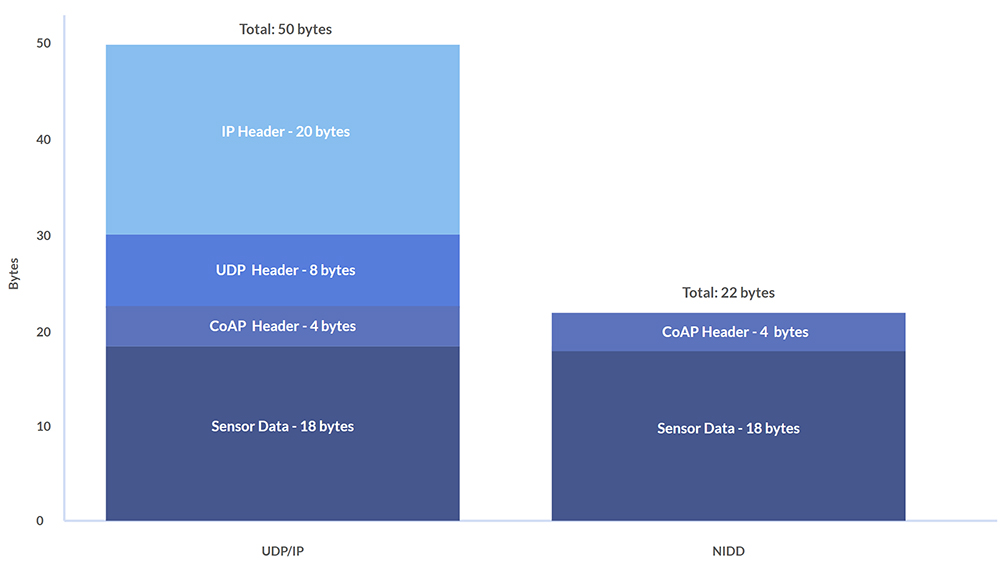
So, the case for using NIDD for NTN NB-IoT is that it reduces the size of data packets to be sent to the satellite, and therefore reduces satellite byte costs, while drawing less power. However, the key benefit of UDP/IP is that the same IP address can be used when moving between cellular and satellite, which is useful for applications which cover devices moving in and out of cellular range, such as maritime vessels or pipeline monitoring.
Comparing UDP/IP and NIDD Benefits
Depending on their agreement with the SNO, some NTN NB-IoT service providers will be offering UDP/IP and/or NIDD solutions, and there are benefits and drawbacks to both. Here is a comparison table to highlight the key differences between each method of data transfer.
| UDP/IP over NTN NB-IoT | NIDD (Non-IP) over NTN NB-IoT | |
|---|---|---|
| Protocol Overhead | IPv4+UDP adds 28 bytes header per packet. Some NTN offerings bill with a 50-byte minimum that includes this IP/UDP header. | No IP/UDP header; payload is carried on signaling (control-plane), avoiding the 28-byte IP/UDP overhead of UDP. |
| Power Consumption | Higher than NIDD for tiny, intermittent messages because you transmit extra header bytes and maintain an IP data session. | Lower for small, sporadic messages by eliminating IP overhead and using signaling paths designed for low power. |
| Integration | Easier for standard IP apps; minor firmware/backend changes may be needed. | Requires SCEF/I-API support and backend changes to map messages to your application. |
| Security | Runs over the Internet path; secure with DTLS/TLS and/or VPN. NAT/VPN commonly recommended for inbound traffic. | Data doesn’t traverse the public Internet; operator exposure functions provide an extra security boundary. |
| Roaming | Single IP address when moving terrestrial ↔ satellite. | Satellite‑only: no IP address for cellular roam; each uplink uses the NTN pathway. |
| Best For… | Applications that move in/out of cellular coverage (e.g., maritime, logistics). | Ultra‑low data, stationary sensors where minimizing airtime and power is paramount. |
Cost & Minimum Payload Considerations
The economics of NTN NB‑IoT hinge heavily on each provider’s minimum supported packet size. Today, Skylo enforces a 50 B floor (including headers) on every UDP/IP message, effectively eliminating NIDD’s payload‑size savings until true NIDD support arrives. Likewise, Sateliot offers standard 3GPP Rel‑17 NB‑IoT over satellite (UDP/IP only) and hasn’t published any reduced‑overhead or NIDD option, so ultra‑small packet users are forced into that same ~50 B envelope.
Until more satellite operators clarify their packet‑size limits or introduce truly NIDD‑capable services, many “tiny telemetry” applications will find themselves priced out of the savings NIDD could otherwise deliver.
The first full NIDD offerings won’t arrive until H1 2026, when Viasat NB-NTN launches its satellite‑only NB‑IoT SIM, complete with both UDP/IP and NIDD modes. Shortly after, Iridium NTN Direct – built on 3GPP Release 19 NTN enhancements – will also bring standardized NIDD support (devices expected in 2026).
In the meantime, proprietary satellite‑IoT networks such as Iridium SBD and Viasat IoT Nano bill in 10 B increments, making them the only current options for truly tiny, cost‑efficient uplinks – albeit at the price of custom hardware and vendor lock-in.
NTN NB‑IoT Service Timeline
Early 2024 – Summer 2025
- Skylo rolls out its Release 17-based service (UDP/IP only) via partner MNOs across the United States, Canada, Brazil, Australia, New Zealand and select European markets
- Sateliot operates a demo LEO fleet for Rel 17 NB‑IoT trials; today’s service is UDP/IP only, with no published NIDD option.
H2 2025 (Pilot & Dev Kits)
- Viasat NB-NTN appears in partner POCs and developer previews (e.g., Ground Control’s Cloudloop integration), with two way NB‑IoT over L‑band. UDP/IP today, NIDD to follow.
H1 2026 (Projected Commercial Launch)
- Viasat NB-NTN full release: satellite‑only NB‑IoT SIM supporting both UDP/IP and NIDD payloads
- Iridium NTN Direct enters commercial service built on 3GPP Release 19 NTN enhancements (including standardized NIDD support).
Will NTN NB‑IoT Open New Markets for Satellite IoT?
NTN NB‑IoT holds clear potential to bring truly global, low‑power IoT to industries unable to leverage terrestrial networks; think widespread environmental sensing, remote infrastructure monitoring and asset tracking in the world’s most isolated regions. However, two pivotal commercial variables will determine how far it can go:
- Cost per Byte & Minimum Packet Size: Until services offer sub‑30 B NIDD payloads at competitive rates (versus today’s 50 B UDP/IP floors or proprietary 10 B options), many micropacket use cases will remain marginal.
- Network Capacity & Congestion Management: Supporting massive fleets of devices over narrow satellite channels requires robust scheduling, interference mitigation and priority handling – features still under development in Rel 17/18 NTN specs and vendor implementations.
Importantly, NTN NB‑IoT does not replace today’s proven proprietary services; it adds to the IoT toolbox. Solutions like Iridium SBD/IMT and Viasat IoT Nano will continue to serve critical, higher throughput or low latency applications, where SLAs, two‑way command/control and strong QoS are non‑negotiable. And, as discussed, the advent of scale manufacturers taking over the production of proprietary modules is set to bring down the cost of these services. NTN NB‑IoT, by contrast, unlocks a new class of latency-tolerant, very small data deployments of homogenous hardware across areas with a mix of cellular and satellite coverage.
Once Viasat NB-NTN and Iridium NTN Direct deliver standardized NIDD in 2026, expect a step‑change: low power, low cost satellite IoT scaling from niche pilots into planet‑wide solutions, while incumbent proprietary networks remain the go‑to for mission‑critical workloads.
Talk to Us About NTN NB-IoT
We’re experts in satellite IoT and asset tracking, and are actively working on new NTN NB-IoT enabled hardware and service integrations with our IoT platform, Cloudloop.
If you have questions about how NTN NB-IoT could enable your IoT projects, please email hello@groundcontrol.com or complete the form to tell us about your requirements, and we’ll reply within one working day.
Cutting Through the Hype: What Direct-to-Device (D2D) IoT Really Means
Direct-to-Direct (D2D) satellite connectivity is one of the most talked about innovations in IoT right now. It promises seamless global coverage, allowing connected devices, from smartphones to smart sensors, to communicate with satellites without the need for additional hardware such as a specialized antenna.
At first glance, D2D sounds like the ultimate solution for remote IoT applications. But there’s a problem: the term is being used too broadly and too optimistically. Many assume that D2D is synonymous with standards-based satellite IoT, like NTN NB-IoT or LTE Cat-1 over satellite. In reality, these are adjacent but distinct technologies, each with very different capabilities, timelines, and trade-offs.
In this post we’ll cut through the noise to discover what’s actually available today, and what will be available in six months, one year, and beyond. We’ll look at the benefits and limitations of D2D, and explore whether you would be better off focusing on standards-based satellite IoT as you consider what’s best for your IoT deployment.
What Direct-to-Device (D2D) Actually Means
Direct-to-Device (D2D) connectivity means that a device – typically a smartphone – can communicate directly with a satellite (part of a non-terrestrial network, or NTN) without requiring additional external hardware like a specialized antenna / dongle.
D2D is a capability, not a standard. It means a device can talk directly to a satellite, but that doesn’t necessarily mean it uses NB-IoT or LTE.
The most well-known example is Apple’s agreement with Globalstar. Newer iPhones embed chipsets that allow them to access the Globalstar satellite constellation where available. This is a proprietary technology, meaning iPhones cannot connect to other satellite networks.
While still relevant, the Globalstar/Apple partnership is an outlier. Today, D2D is often referenced in the context of standards-based connectivity – but that’s where definitions start to blur.
D2D and Standards-Based Connectivity: Not the Same Thing!
Standards-based NTN connectivity refers to satellite networks that adhere to existing cellular standards, e.g. NB-IoT and LTE Cat 1.
A key benefit of this is that you don’t have to modify your data to send it through a proprietary satellite protocol. Standards-based connectivity also opens the door to switching networks for broader coverage or better pricing – a flexibility not available with proprietary solutions.
But here’s the key distinction:
D2D
Standards-Based NTN
D2D is about the physical capability for a device (e.g., smartphone or sensor) to connect to a satellite without extra hardware.
Standards-based is about ensuring that the satellite connection adheres to existing cellular protocols like NB-IoT and LTE Cat 1.
The connection can be proprietary or standards-based.
Compatible devices may still require separate hardware to connect, especially today.
Pure D2D for IoT is limited today and requires ideal antenna positioning and sky visibility.
You can access standards-based NTN today, usually via an external transceiver / dongle.
What’s Available Now (Early 2025)?
There are two cellular standards being adopted by satellite network operators: NB-IoT and LTE Cat 1.
- NB-IoT uses very little bandwidth and is being rolled out by providers like Iridium and Viasat to complement their proprietary solutions.
- LTE Cat 1 requires more bandwidth and is being pursued by newer entrants like Starlink and AST SpaceMobile, who partner with mobile network operators (MNOs) to access spectrum.
The standard closer to delivery is NTN NB-IoT. Skylo is not a satellite network operator, but has done a lot of work to make NB-IoT work over existing satellite networks. They have partnered with multiple satellite networks, including Viasat and Ligado Networks, to bring a solution to market in the USA, Canada, Australia, New Zealand and Brazil.
Some satellite network operators are already offering this service in a limited capacity – Sateliot were among the first to market with a proposition. However, they’re in the process of scaling their satellite IoT services; initial store-and-forward services are available, but fully operational coverage will be c. 2028.
At the moment, the hardware being built for IoT tends to take the form of a unit that can be attached to a sensor or gateway to facilitate NTN connectivity.
Why is Separate Hardware Still Needed for IoT?
- Many sensors or gateways don’t yet support NTN NB-IoT or LTE Cat 1 and will need to pass data through a connected device which can re-format the data to work with the appropriate standard.
- Satellite connectivity requires a clear view of the sky. Devices embedded in machinery or under panels (like an OBDII port or solar-powered sensor) are unlikely to maintain a reliable satellite link.
What Will Be Available In Six Months (Mid-Late 2025)?
In terms of NB-IoT, Viasat’s “NB-NTN” is currently in beta mode, before a full release in the second half of 2025. This will deliver global NB-IoT capabilities for connected devices, and we’re particularly excited about this development.
We also expect the first LTE Cat 1 service for IoT from Starlink to be available before the end of 2025. Starlink’s “D2C” model depends on cooperation from mobile network operators, and rollout will begin in countries with large land masses and low population density, where unused spectrum is more available.
Current rollout countries are the USA, Canada, Australia, New Zealand, Chile, Peru, Ukraine, Switzerland, and Japan.
What Will Be Available in One Year?
We should see more integrated, true D2D devices that can connect to both cellular and satellite networks using standard protocols, without needing separate antennas. But these are unlikely to be materially lower cost than the current, proprietary options available. This is because it is both economies of scale and competition that drives prices down, and that will take a little longer to come to fruition.
Starlink will likely have its first competitor in the LTE space (no pun intended) with the commercial launch of AST SpaceMobile anticipated in early 2026. However, AST SpaceMobile is focused squarely on the cellphone market rather than IoT devices; it will probably be another 12 months (early 2027) before IoT devices can connect to the AST SpaceMobile network. It’s also worth mentioning that AST SpaceMobile also needs agreements with MNOs to deliver its service; it will not be global at launch.
The Future (2-5 Years)
The update that allowed cellular standards to be used over satellite is called 3GPP Release 17. While Rel-17 made it possible to use cellular standards in satellite communication, it didn’t make it easy, with companies like Skylo having to do a considerable amount of engineering to make NB-IoT transmissions over satellite a reality.
Iridium, currently the world’s only global satellite IoT network, was a little late to the party in developing a standards-based proposition, but now that it is, it’s working very closely with the 3GPP to extend the functionality of NTN NB-IoT. This collaboration means that 3GPP Release 19 (anticipated in late 2025) will remove many technical challenges and hasten the widespread availability of industry standard chipsets.
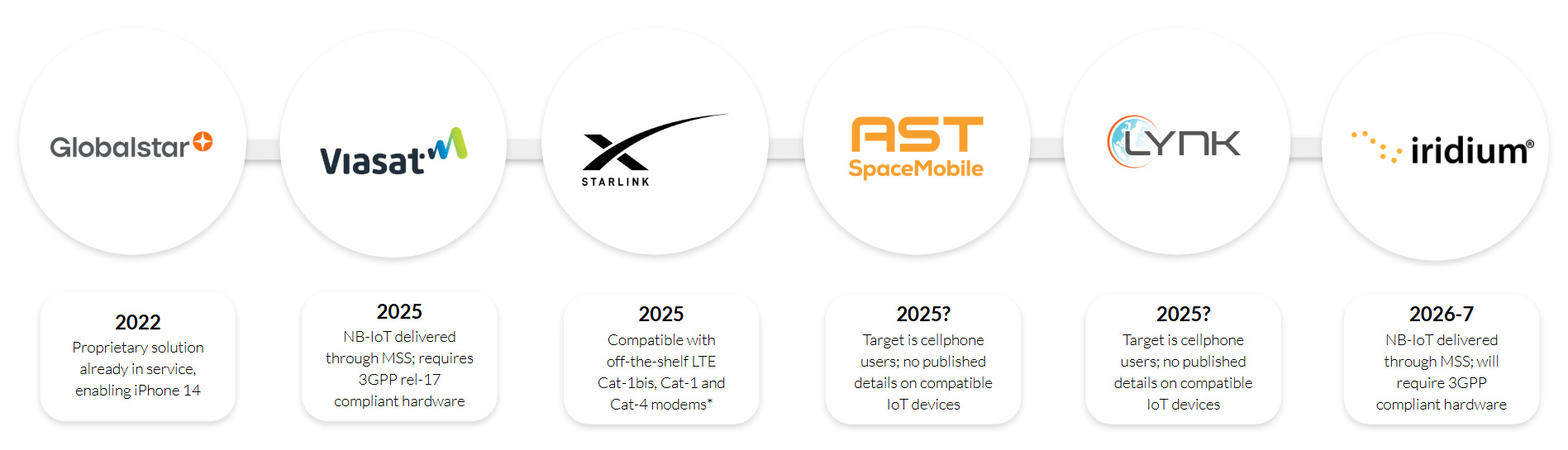
*3GPP compliant release 10 or newer, modem must support existing bands of operation in intended service countries
We also anticipate that we’ll see increased data throughput, greater power efficiency, and lower latency as these advanced protocols coupled with new satellite modems filter through, enabling smaller, lower cost and longer lasting IoT devices.
The reason this falls into the 2-5 years section is because the benefits take several years to reach end users. Firstly, network operators, device manufacturers and other industry stakeholders will need time to implement the new standards, which can involve significant hardware and software updates, plus extensive testing.
Deployment of the new technology across networks is often piecemeal, too, rolled out across regions and service providers at different times – meaning that it will take time to become widely available. And, of course, end users’ devices must be compatible with the new standards; this will include firmware changes to support the lower speeds and smaller message sizes available over NTN NB-IoT.
While NB-IoT remains the most popular choice for delivering NTN standards-based connectivity, by this time we’d anticipate also having IoT propositions from AST SpaceMobile and Lynk using the LTE Cat 1 standard. These new satellite network operators, along with Starlink, will undoubtedly create more commercial agreements with mobile network operators, extending the reach of NTN LTE Cat 1 services.
What Should IoT Businesses Do Now?
It depends on the criticality and data requirements of your application. While NTN NB-IoT services are reaching the market, the throughput is very small, and data transmission is infrequent, so it best serves applications where there are a high number of end points, but real-time information is not required (e.g., livestock tracking, environmental monitoring, agriculture, basic fleet management, and wearables).
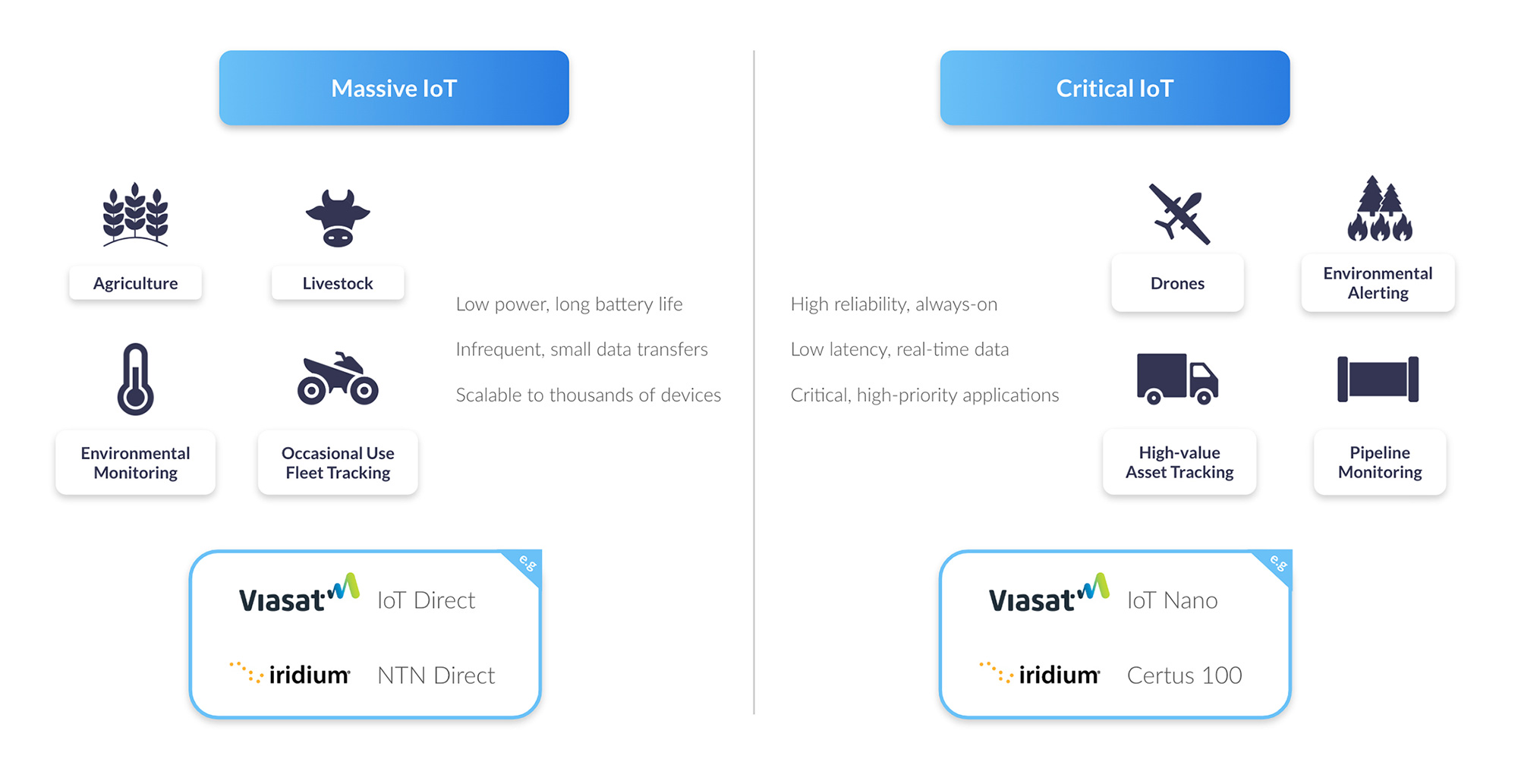
If this describes your application, get in touch with a service provider like Ground Control to get advice on the best network and hardware for your application. Note that this will almost certainly involve additional hardware, as the satellite industry is some way from solving the issues around device compatibility and antenna siting mentioned earlier.
If you need higher volumes of data and closer to real-time data, you will still be better served by a proprietary solution such as IMT / Certus 100 from Iridium, or IoT Nano from Viasat. These services are well established and globally available; they will co-exist alongside the standards-based solutions for the foreseeable future.
Finally, don’t get too preoccupied with D2D; it offers exciting possibilities, but it’s still a developing technology that won’t be widely available for some time, and will only be appropriate for certain use cases.
Ready to explore your options?
If you’re exploring how to keep your IoT devices connected beyond the reach of terrestrial networks, we’re here to help. At Ground Control, we work across both proprietary and standards-based satellite networks to recommend the best-fit solution for your use case – today, and in the future.
Whether you’re ready to deploy now or just starting to assess the landscape, we’d love to talk. Get in touch for practical, honest advice on devices, networks, and everything in between. Email hello@groundcontrol.com or complete the form, and we’ll be in touch within one working day.
Report: How Satellite IoT Connectivity Supports Data Security
Securing IoT Data: Why Satellite Connectivity Matters
As industries become more reliant on IoT technology to monitor and manage remote operations, the security of IoT data has never been more critical. From energy infrastructure to national utilities, Critical National Infrastructure (CNI) organizations handling sensitive data are prime targets for cyberattacks. While cellular and terrestrial networks have long been the backbone of connectivity, their vulnerabilities are increasingly being exposed.
This is where satellite connectivity stands apart. Satellite networks offer global coverage, operate independently of local terrestrial infrastructure, and provide enhanced security features to mitigate cyber threats. However, like any technology, they’re not without risk. Our latest report, How Satellite IoT Connectivity Supports Data Security Measures, delves into the specific security challenges and solutions that satellite connectivity offers for IoT applications.
Read Data Security Report
Key Insights from the Report
1. The Growing Cybersecurity Threat to IoT Networks
Critical national infrastructure sectors, including energy, utilities, and transportation, are facing an increasing number of cyber and physical threats. Attacks on property, plus DNS poisoning, DDoS attacks, and Man-in-the-Middle attacks are just a few of the risks that can disrupt operations or compromise data integrity. Organizations must adopt a proactive security strategy to safeguard their IoT deployments.
2. Why Satellite IoT Offers a More Secure Alternative
Unlike terrestrial networks, satellite connectivity does not rely on local ISPs or cellular towers, making it less susceptible to traditional cyberattacks. High encryption standards, private network options, and advanced threat detection make satellite communications a strong choice for securing IoT data.
3. How to Mitigate the Limitations of Satellite Data Security
While satellite networks provide strong security advantages, they are not immune to threats. The report explores best practices, such as end-to-end encryption, network segmentation, and failover protection, that organizations can implement to further strengthen their security posture.
4. Expert Insights from Leading Satellite Providers
The report includes expert perspectives from industry leaders, including Viasat, TSAT, and Iridium, highlighting the measures these providers take to enhance security for IoT applications. From private satellite networks to real-time monitoring and AI-powered threat detection, these insights help organizations make informed decisions about securing their satellite IoT deployments.
If your organization relies on IoT connectivity for critical operations, understanding the security implications of your network choice is essential. Our comprehensive report provides the insights and strategies you need to enhance your security posture and protect your data from emerging threats.
Download the full report now to learn how satellite can be a key component of your IoT security strategy.
- Discover the level of confidence the general public has in CNI organizations’ data security measures
- Learn from industry leaders about best practices for securing critical infrastructure
- See how past attacks have exploited vulnerabilities in terrestrial networks
- Compare security measures across different satellite networks
- Get the knowledge you need to make informed choices about secure connectivity.
Can we help level up data security for your organization?
We’ve delivered connectivity solutions for critical national infrastructure projects for over 20 years. Our expertise in satellite technology, combined with a deep understanding of mission-critical applications, allows us to tailor solutions to meet your specific needs.
By partnering with Ground Control, you gain access to a team that is not only well-versed in the latest satellite technologies but also dedicated to helping you secure your communications, mitigate risks, and ensure that your operations stay connected no matter the challenges.
Complete the form, or email hello@groundcontrol.com to be connected to one of our expert team.
How Satellite IoT Makes Predictive Maintenance Possible Anywhere
Manufacturing and Heavy Industry operations around the world rely on their machinery to get the job done, efficiently and effectively. The cost of equipment failure and the resulting unplanned downtime has serious consequences for the bottom line, with medium unplanned downtime costs approximately $125,000 per hour. When inflationary pressures, supply chain demands and raw material costs are factored in, unplanned downtime costs for Heavy Industry were calculated as $59 million per year in 2023.
Faced with the need to minimize the business impact of unplanned downtime for critical equipment, industries with heavy assets and significant downtime costs, such as oil & gas and mining, are leading the way in adopting Predictive Maintenance solutions.
By incorporating satellite connected IoT sensors, Heavy Industries operating in remote locations can reliably monitor machinery in real time and react quickly to avoid equipment failures and keep assets operational. The data from satellite-connected sensors on equipment forms a vital component of deploying Predictive Maintenance programs in industries with high asset costs.
What is Predictive Maintenance?
Predictive Maintenance (PdM) is a proactive, data-driven approach that uses advanced technologies – such as condition monitoring, machine learning (ML) and IoT devices – to anticipate equipment failures and schedule maintenance before disruptions occur. By analyzing real-time data from sensors installed on machinery, PdM identifies early signs of wear, faults, or deterioration, enabling timely intervention to prevent costly downtime.
Unlike time-based or reactive maintenance, PdM optimizes equipment performance by triggering maintenance tasks only when specific conditions indicate a need. This approach improves equipment reliability, reduces maintenance expenses, and extends the lifespan of assets. AI-powered analytics and IoT-enabled sensors track key metrics like temperature, pressure or vibration, providing continuous insights into machine performance. When thresholds are exceeded, PdM systems issue alerts or initiate maintenance work orders.
The goal of PdM is to enhance operational efficiency by minimizing unplanned downtime, lowering maintenance costs, and ensuring asset reliability. Industries such as manufacturing, energy, and transportation rely on PdM to align maintenance activities with actual equipment conditions, maximizing productivity and supporting cost-effective, sustainable operations.
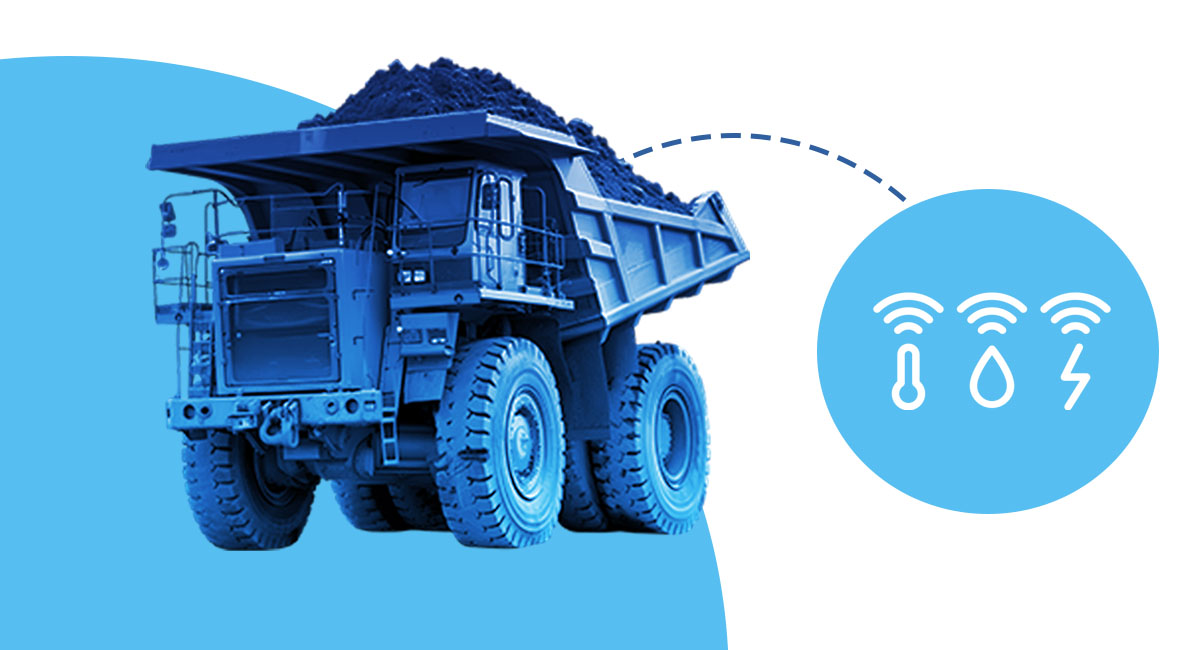
What is the Difference between Predictive and Preventive Maintenance?
Although often used interchangeably, Predictive Maintenance (PdM) and Preventive Maintenance (PM) are distinct approaches to equipment upkeep, each suited to different operational needs.
Preventive Maintenance follows a scheduled approach, performing maintenance at regular intervals based on time or measurable usage units, such as engine hours or production cycles. This method ensures equipment is inspected and maintained before issues arise, but it does not consider the actual condition of the asset.
For instance, a Mining operation may replace drill components every six months, regardless of whether those components show signs of wear. While this minimizes the chance of failure, it may result in premature replacements or unnecessary downtime.
Predictive Maintenance leverages real-time data from IoT sensors and advanced analytics to monitor the actual condition of assets. Maintenance is performed only when necessary, based on insights into potential failures or performance degradation.
For example, IoT sensors on a Combine Harvester may detect rising temperatures or irregular vibrations, indicating wear and tear. Predictive maintenance enables technicians to address the issue before a failure occurs, minimizing downtime and repair costs.
Comparing the Two Approaches
| Preventative Maintenance | Predictive Maintenance | |
|---|---|---|
| Basis for Maintenance | Time or Usage Intervals | Real Time Condition Monitoring and Analysis |
| Frequency | Regular, Fixed Schedule | As Needed, Based on Data Insights |
| Costs | Lower Initial Costs, Higher Cumulative Costs | Higher Initial Investment, Lower Long Term Costs |
| Downtime | May Require Equipment Stoppage | Often Avoids Downtime by Scheduling During Low Impact Periods |
| Efficiency | May Result in Unnecessary Maintenance | Targets Specific Issues, Optimizing Resources |
Types of Predictive Maintenance
There are three distinct types of Predictive Maintenance: Indirect Failure Prediction, Anomaly Detection, and Remaining Useful Life (RUL). Each approach differs in its desired objectives, the analytical methods used, and the type of information output provided.
Image adapted from the IoT Analytics Asset Performance & Predictive Maintenance Market Report 2023–2028
Indirect Failure Prediction
Estimates equipment health by calculating a ‘health score’ based on known maintenance requirements, operating conditions and historical performance data. When sufficient data is available, supervised machine learning can be applied to refine the predictions. This approach is scalable since it relies on manufacturer specifications, and it is cost-effective because it uses existing sensors.
Its dependence on large volumes of historical data may render it unsuitable for industries like heavy machinery, where high downtime costs necessitate more immediate and accurate insights.
Anomaly Detection
Identifies potential failures by detecting deviations from normal operating conditions in real time. Unlike methods that require historical data, it relies on current sensor data, making it particularly suited to organizations without extensive machinery usage records. This approach improves predictive accuracy by considering real-time environmental and operational factors rather than predefined maintenance parameters set by the manufacturers.
The risk of false positives can pose challenges, as unnecessary alerts may disrupt operations and complicate machine learning algorithm performance.
Remaining Useful Life (RUL)
Focuses on predicting the time left before equipment failure based on specific machine metrics such as operational hours, distance traveled, or activity cycles. By analyzing sensor data, this method identifies condition indicators that highlight whether the equipment is performing as expected or if faults have accelerated its degradation. RUL models are trained using system data collected under known conditions and applied to predict outcomes under new or variable circumstances.
While this method is highly robust and reliable, it requires detailed, high-quality data for accurate predictions, making it particularly effective for critical equipment in complex environments.
The Benefits of Predictive Maintenance
Predictive Maintenance brings many benefits to organizations through its advanced approach to equipment upkeep, using technology and data analysis to improve asset reliability and efficiency. By identifying potential issues before they lead to failures, PdM helps organizations reduce downtime, optimize resources, and maintain safer working environments.
Research, including findings from the US Department of Energy, highlights the tangible impact of Predictive Maintenance. Compared to preventive maintenance programs, it offers cost savings of 8% to 12%, and when compared to reactive maintenance, cost savings increase to 30% to 40%. These programs also enable a reduction in maintenance costs by 25% to 30% and minimize equipment breakdowns by 70% to 75%.
In addition to cost savings, PdM improves operational efficiency by reducing downtime by 35% to 45% and increasing production capacity by 20% to 25%.
How to Implement Predictive Maintenance
1. Establish Baselines and Data Collection
Baseline performance metrics are identified for the assets by monitoring its condition to set the normal performance benchmarks. Once the baseline is established, sensors are installed to capture real-time data, enabling continuous performance monitoring.
2. Install IoT Sensors on Equipment
IoT sensors are installed on critical equipment to monitor various parameters such as vibration, temperature, pressure, and noise. These sensors continuously collect data on the equipment’s condition and the data gathered is then transmitted to a centralized system for analysis.
3. Data Integration and System Setup
The data collected from the IoT sensors needs to be integrated with the PdM system. This involves connecting the sensors to a computerized maintenance management system (CMMS) or a remote dashboard which allows for real-time monitoring and data analysis.
4. Set Maintenance Thresholds and Automate Alerts
Organizations need to define thresholds for acceptable performance levels. When these thresholds are exceeded, the system automatically triggers maintenance alerts, enabling timely interventions before equipment failure occurs.
5. Select and Implement the Right Analytics Tools
An analytics platform is required to handle the large volumes of data, apply predictive models, and generate actionable insights. Machine learning and AI algorithms are crucial for analyzing sensor data and predicting future equipment failures based on historical data.
6. Develop Predictive Models and Train the System
Predictive models are developed using historical data, maintenance logs and sensor data to forecast future equipment behavior. These models are trained to identify patterns in the data that may signal the onset of failure.
7. Integration with Existing Maintenance Systems
The PdM system is integrated with existing workflows, maintenance management systems, and enterprise resource planning (ERP) systems. This enables seamless communication across platforms and allows for data-driven decision-making.
8. Monitor and Optimize the Program
After implementation, the PdM program should be monitored to evaluate its effectiveness. Continuous data collection and model refinement will help improve prediction accuracy over time.
Industrial Applications of Predictive Maintenance
Predictive Maintenance is becoming increasingly common practice in asset-intensive industries that depend on their large, complex machinery. For industries with assets in remote locations or critical communication requirements, satellite connected IoT devices can transmit real-time sensor data for PdM programs.

Energy and Utilities
The risk of equipment failure in energy production and utilities management can lead to significant financial losses and customer dissatisfaction. Power plants, wind farms, and utility grids employ PdM programs to ensure the continuous operation of critical assets like turbines, generators, and transformers. IoT sensors monitoring parameters such as vibration, temperature, and pressure are used to detect early signs of failure.
By analyzing these data points in real time with advanced predictive models, utility providers can prevent catastrophic failures, optimize energy production, and ensure compliance with regulatory standards. This is particularly important in industries where unexpected downtime can have widespread consequences on both financial performance and customer trust.

Railways and Transportation
PdM is crucial in the transportation industry for ensuring the safety and reliability of infrastructure such as railway tracks, trains, and airport ground equipment. IoT sensors on trains and other critical assets monitor parameters like pressure, temperature, and vibration to detect early signs of wear or failure.
For example, PdM can be used to monitor brake systems or detect track deformations, preventing accidents and service interruptions. By integrating sensors with automated maintenance management systems (CMMS), transportation companies can schedule repairs before a component fails, enhancing passenger safety and reducing operational disruptions.

Oil and Gas
In remote locations such as offshore platforms or desert pipelines, Oil and gas operations face unique challenges in maintaining equipment. PdM is highly beneficial in these situations, as it helps companies remotely monitor the condition of critical machinery like pumps, compressors, and valves.
Satellite-connected IoT sensors track parameters such as pressure, temperature, and vibration to detect signs of imminent failure. Real-time data is sent to cloud-based platforms for analysis, and predictive algorithms generate alerts to maintenance teams, allowing them to address issues before they result in costly downtime or safety hazards.

Mining
With Mining machinery operating in harsh conditions, the risk of unexpected breakdowns can lead to costly delays and safety hazards. Predictive maintenance helps to monitor heavy equipment such as crushers, drills, and loaders, which are critical to mining operations.
Satellite-enabled IoT sensors measure variables like temperature, pressure, and vibration, providing continuous health checks of the machinery. Predictive models analyze these data streams to identify wear patterns and predict when maintenance is required.
Sensor Technologies in Predictive Maintenance
Predictive Maintenance utilizes a range of sensor technologies to monitor the condition of equipment and to detect and address potential failures before they lead to unplanned downtime.
Infrared Thermography
Also known as thermal imaging, infrared cameras identify heat spots which can indicate issues such as friction, electrical resistance, or misalignment in mechanical systems. It is particularly valuable in identifying worn-out components or malfunctioning circuits that tend to overheat.
Infrared thermography allows for real-time monitoring without disrupting machine operation and is frequently used in industries like power generation to track turbine blade conditions and ensure equipment runs efficiently.
Acoustic Monitoring
Using specialized equipment, maintenance personnel can detect ultrasonic or sonic emissions from machinery, which may indicate leaks, electrical discharges, or mechanical wear. Sonic monitoring is typically applied to lower-speed equipment, while ultrasonic analysis is more accurate and applicable to both low- and high-speed machinery.
Ultrasonic analysis is widely used in industries like construction and heavy equipment operations, where hydraulic systems and machinery require constant monitoring to ensure seamless operation and prevent project delays.
Vibration Analysis
Sensors track vibration patterns that help technicians identify potential issues like misalignment, unbalanced components or bearing failures in high-speed rotating equipment, such as motors, drills and fans.
Each machine has a unique vibration signature, and deviations from this pattern can be a strong indicator of mechanical problems. The ability to monitor vibration in real-time allows for early intervention, preventing costly repairs and downtime.
Oil Analysis
By analyzing oil for contaminants, viscosity changes, and particle counts, technicians can pinpoint wear and tear in machine components. Chemical analysis of oil can also reveal overheating or chemical degradation, providing early warnings of issues that could lead to failure.
This technology is often used in heavy industries, such as energy production or oil drilling, where machinery components are subject to extreme operating conditions.
Current and Voltage Sensors
These sensors track electrical characteristics like overloads, short circuits, and failing components. In industries such as mining or energy, where electrical systems are critical, monitoring these parameters ensures safety and minimizes downtime caused by electrical failures.
For example, real time analysis of electrical data in mining operations can help identify potential issues in equipment like excavators or conveyors, allowing operators to address problems before they cause equipment failure and disrupt production.
Predictive Maintenance and Satellite IoT
For remote operations, such as those found in mining or offshore environments, Satellite IoT becomes a crucial part of the Predictive Maintenance Program. When assets are located in areas with unreliable or no cellular connectivity, traditional IoT solutions relying on cellular networks may fail to transmit vital data. Satellite IoT solutions overcome this challenge by enabling real-time data transmission via satellite, ensuring that assets can be monitored regardless of their location or environment.
Beyond just sensor data collection, Satellite IoT can enable remote control of assets. If an asset is detected to be operating in an unsafe condition, it can be remotely shut down to prevent catastrophic damage or safety incidents. This combination of real-time monitoring and remote intervention significantly enhances worker safety and helps avert equipment breakdowns before they escalate into more serious issues.
Get in Touch
At Ground Control, we design and build Satellite IoT devices leveraging the Iridium global network, providing reliable real-time data transfer from anywhere on Earth. Our feature-rich IoT platform, Cloudloop, can monitor and analyse sensor data and offers a simplified and well-documented API to connect to your existing Predictive Maintenance and Asset Performance Management (APM) toolkits.
With over 20 years of experience, we can help you make the best choices based on your requirements.
How to Choose the Right Satellite IoT Network for Your Application
As the world of satellite IoT connectivity rapidly evolves, selecting the right network for your remote application has never been more important — or more complex. Whether you’re deploying environmental monitoring devices, controlling unmanned systems, or tracking remote assets, understanding your options can save you significant time, money, and operational effort.
That’s why we created a comprehensive guide to help you navigate this dynamic landscape and make informed choices. The highlights are in this blog post; read the eBook to digest the in-depth version.
Read Free eBook
The Expanding Satellite IoT Landscape
In recent years, satellite networks have undergone a transformation. Established players have diversified their services, offering greater flexibility and more competitive pricing. At the same time, new satellite constellations are launching at a faster rate than ever, introducing innovative services and standards that promise even more possibilities for IoT applications.
This abundance of options is great news, but it also presents a challenge: with so many variables at play, how do you select the best network for your specific needs? That’s where our expertise comes in. Ground Control has spent over 20 years testing and integrating satellite networks to ensure optimal connectivity for our customers. We’ve distilled our knowledge into an easy-to-follow eBook that covers everything you need to consider.
Key Considerations for Choosing a Satellite Network
When evaluating satellite IoT networks, there are several critical questions to ask:
- How data-intensive is your application? Understanding your data volume needs is crucial. For instance, message-based services like Iridium Messaging Transport (IMT) are ideal for low-volume, energy-efficient data transmission. On the other hand, IP-based services such as Iridium Certus 100 are better suited for high-data applications like real-time control or video streaming.
- Where are your sensors located? Coverage matters. While some networks like Iridium offer truly global coverage, others may not reach polar regions or other remote areas. Additionally, factors like terrain and obstructions can affect the choice between Low Earth Orbit (LEO) and Geostationary (GEO) satellites.
- Is your application stationary or mobile? Mobile applications often require LEO networks, as they don’t rely on precise antenna alignment. Conversely, stationary deployments with a clear line of sight to a GEO satellite may benefit from the stability and cost-effectiveness of GEO-based solutions.
- How time-critical is your data? Applications requiring real-time data transmission will need well-established LEO networks with IP-based connections. For less time-sensitive use cases, store-and-forward technologies used by some newer LEO networks might be a cost-effective alternative.
Standards-Based vs. Proprietary Networks
One of the most exciting developments in satellite IoT is the emergence of standards-based technologies like LTE Cat 1 and NB-IoT over satellite. These allow a single modem to connect to both cellular and satellite networks, promising cost savings and supplier flexibility. However, these technologies are still in their infancy and come with trade-offs, such as higher power consumption or limited data volumes.
Where you have a combination of relatively high data volumes plus no mains power, proprietary networks offer optimized performance tailored to their specific satellite systems. For instance, message-based protocols like Iridium’s Short Burst Data (SBD) deliver efficient, low-power communication for small data packets, making them ideal for battery-powered IoT devices.
What You’ll Learn in the eBook
Our eBook, How to Choose the Right Satellite IoT Network, dives deeper into these topics and provides actionable insights, including:
- A detailed comparison of leading satellite networks like Iridium, Viasat, Starlink, and Globalstar.
- Real-world examples of how different networks excel in specific use cases.
- A practical framework for evaluating networks based on coverage, latency, power efficiency, and mobility.
- Insights into emerging technologies and how they may impact your future connectivity strategy.
By the end of this guide, you’ll have the tools you need to select a satellite IoT network that aligns with your technical and operational requirements.
Read Free eBook
Can we help with your remote IoT application?
We have decades of experience designing and building satellite IoT connectivity solutions, and work with multiple satellite networks to ensure our customers get the right service for their needs.
If you would like expert, impartial advice on your remote IoT application, please get in touch! Complete the form or email hello@groundcontrol.com. We will reply within one working day.
What’s the Best Satellite Network for Your IoT Application?
Recently, the Swarm satellite constellation notified customers that, as of the end of 2024, they would no longer be able to utilize their service to communicate with their remote IoT sensors.
Swarm, purchased by Space X in 2021, is being sunsetted in favor of their new Direct to Cell (D2C) technology that Starlink – Space X’s satellite service provider brand – aims to bring to market in 2025.
But Starlink’s D2C technology isn’t a like-for-like replacement of the Swarm service. Swarm is/was (depending on when you read this!) a proprietary message-based service; you could send 192 bytes of data per message. It was designed for remote IoT deployments with power constraints – Swarm modems could be powered by a small battery or solar.
It also lent itself to applications where real-time communication was not required; as this blog post from 2022 illustrates, the average ‘round trip’ time for Swarm data delivery was 39 minutes and 44 seconds. Plus, Swarm utilized unlicensed terrestrial spectrum; this made it very low cost, but with the potential to have lower reliability in high-traffic areas.
Starlink’s D2C technology is an entirely different proposition. Firstly, it uses the LTE Cat-4, Cat-1, and Cat-1bis standards rather than proprietary technology. This delivers higher data rates and lower latency (the ‘round trip’ time) but has a greater power draw – not really suited to battery or solar-powered applications.
So, while Starlink are recommending to Swarm’s customers that they move to their D2C service once available – and this may well be a good choice – we thought it presented an opportunity to present additional options that may be a better fit for your application.
This is usually quite a nuanced conversation, and due to the blog post format, by necessity we’re making some simplifications. It’s always worth giving our team a call to get individualized, expert advice.
There are four key considerations: location, data rates, latency, and power.
1. Location
Starlink’s D2C service will initially be available in the USA, Canada, Australia, New Zealand, Japan, Switzerland, Chile and Peru (source). So, if your IoT application is not in one of these countries, you’ll need to look elsewhere.
For 100% global coverage, including the polar regions, have a look at Iridium which has the only truly global IoT network in operation. If your project is not in the far North or South of the globe, Viasat (pictured) is a great choice. Globalstar has great coverage over North and South America, China and most of Africa and Europe.

2. Data Rates
Here we’re not just considering how much data you need to send, but how you need to send it. The most efficient way to communicate with satellites is to use a message-based service, which is what Swarm offered. It’s cost-effective and uses very little power. However, it does generally require some engineering work on your part to manipulate your sensor data into this format.
If you have the ability to do this, check out the following services:
- Iridium Messaging Transport (IMT), which allows you to send and receive 100,000 byte messages
- Iridium Short Burst Data (SBD), which allows you to send a modest 340 bytes, and receive 270 bytes; constrained, but competitively priced
- Viasat’s IoT Nano (previously called IsatData Pro), which allows you to send 6,400 byte messages, and receive 10,000 byte messages.
If you have a chatty application, and need to use IP data delivery, Starlink D2C is worth investigating (if/when available in your country / area of operation). Iridium Certus 100 is IP-based (22/88 Kbps), as is Viasat’s IoT Pro (formerly BGAN M2M). Because using IP data delivery is less efficient, it is often more expensive and power-hungry, so also explore whether your satellite IoT device supports edge computing, as this can help throttle back on airtime costs.
3. Latency
Latency refers to the length of time it takes for the data to leave the satellite IoT device, reach the satellite, come back down to the ground station, and be delivered to your server. One of the factors influencing this is the satellite orbit height; satellites in Low Earth Orbit (LEO) have a lower latency than satellites in Geostationary Orbit (GEO).
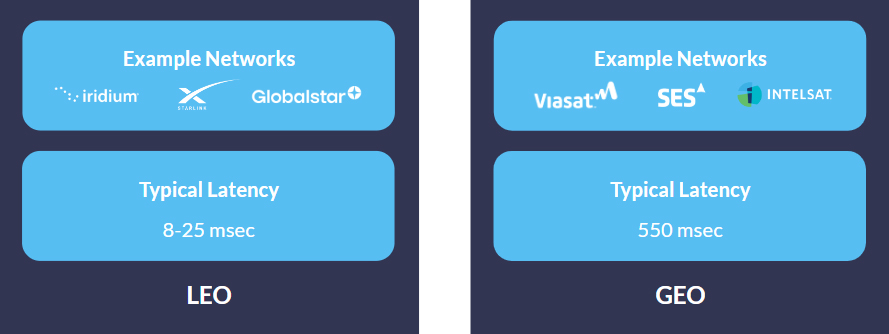
That said, just because a satellite network is in LEO does not mean it will be quick to send and receive data, because the other factor is how frequently a satellite passes overhead. If your satellite network only has a handful of satellites in operation, it may be several hours, even a day, before your data is successfully transmitted. Swarm, despite having approximately 175 satellites in operation before it was disbanded, had big coverage gaps, which led to it having an average message delivery time of 39 minutes and 44 seconds.
This may not matter for your application. If you can manage taking receipt of your data a few times a day rather than in close to real-time, there are several new satellite networks that are worth investigating – among them Sateliot and OQ Technologies.
If you have a latency-sensitive application, an established satellite network in LEO is likely your best bet; Iridium or Starlink’s D2C service, for example. You could also experiment with changing timeout values on network requests to allow for higher latencies, caching more data, or using overlapping network requests and responses where possible. SD-WAN solutions can also be deployed to create hierarchical classes of service, and for TCP optimization (if TCP/IP is the preferred means of data delivery). This could unlock the GEO networks, such as Viasat, which are often more cost-effective than their LEO counterparts.
4. Power
Satellite connectivity is generally only the primary means of communication if there’s no cellular infrastructure in place – .e.g. oceans, deserts, mountains, forests and farmlands. Sensors deployed in these locations often also lack mains power, and are not easy to access.
For example: data buoys; hydrology stations; environmental monitoring; livestock monitoring; wind and solar farms and oil and gas pipelines.

In these instances, you need to look for solutions optimized for low power. Right now, that most likely means a message-based service using Iridium (IMT or SBD), Viasat (IoT Nano) or Globalstar’s satellite networks. In the next few years, Viasat and Iridium will start to offer standards-based solutions which will likely be lower cost, while still requiring very little power to operate. The great news is that proprietary technologies have started to come down in price in response to the advent of standards, so there’s no need to put your project on hold!
If your application has a power source – trucks, trains and heavy machinery, for example, or a remote outpost that has multiple solar panels – then you should take a look at Starlink’s D2C service, as it is expected to be competitively priced while moving (by IoT standards!) high volumes of data.
How to Choose
Choosing the best satellite network for your IoT application requires careful consideration of factors like location, data rates, latency, and power requirements. While Starlink’s D2C technology offers impressive data speeds and low latency, it may not be the ideal solution for all IoT deployments, especially those constrained by power or located outside the initial coverage areas.
Alternatives like Iridium, Viasat, and Globalstar provide various options, from message-based services ideal for low-power environments to IP-based solutions for higher data throughput. Ultimately, the right choice depends on your specific needs, and consulting with an expert can help ensure you pick the best network for your application.
Speak to an Expert
At Ground Control we’ve been solving remote connectivity challenges for over 20 years. We design and build our own hardware, and work with multiple satellite network operators and standards to ensure our customers get the right solution for their specific needs.
If you have an IoT or tracking application that’ll travel beyond cellular coverage, we’re happy to provide objective, expert advice. Email hello@groundcontrol.com or complete the form, and we’ll be in touch within one working day.
Viasat Unveils New Product Portfolio
Viasat has officially launched a redefined and expanded product portfolio following its recent acquisition of Inmarsat. The new lineup is designed to simplify their satellite IoT and asset tracking solutions, combining the technical expertise and global reach of both companies. With the consolidation of services, Viasat aims to deliver a more integrated, customer-centric suite of solutions for businesses in industries ranging from logistics to energy, all while streamlining its product range.
What’s New in Viasat’s Product Portfolio?
With the reimagined suite of services, Viasat has focused on making it easier for companies to navigate their satellite communication needs. The new portfolio has been carefully organized around key industry applications, including satellite IoT, asset tracking, remote surveillance, and mission-critical communications.
By simplifying its offerings, Viasat allows businesses to quickly identify the right solution, whether it’s for fleet management, environmental monitoring, or operations in remote, hard-to-reach areas. While the shift may feel like a departure from Inmarsat’s familiar product names, the rebrand is geared toward enhancing the user experience with more clarity and convenience.

Key Changes to Viasat’s Product Series
Viasat’s rebranded product suite is built with a focus on usability and modern industry demands. Here’s a look at the most significant changes:
IsatData Pro (IDP) → IoT Nano
Connection Type: Message-based
Transmit: 6400 bytes, Receive: 10,000 bytes
Previously a flagship service under Inmarsat, IsatData Pro has been rebranded as IoT Nano. This solution offers low-power, long-life monitoring for remote assets, particularly useful in industrial IoT, fleet tracking, and environmental monitoring sectors. IoT Nano is optimized for minimal data transmission and is ideal for applications that require reliable connectivity in areas with limited infrastructure.
BGAN M2M → IoT Pro
Connection Type: IP-based
Transmit: 448Kbps Receive: 464 Kbps
BGAN M2M, known for delivering high-reliability machine-to-machine (M2M) or direct-to-device (D2D) communications via satellite, is now known as IoT Pro. This rebranded service provides businesses in industries such as oil and gas, utilities, and transportation with uninterrupted connectivity, even in the most extreme conditions. IoT Pro is perfect for enabling critical data flows between remote devices and centralized systems.

BGAN → Go-anywhere Pro
Connection Type: IP-based
Transmit: 492Kbps up and down (Standard), 800Kbps for video
The Broadband Global Area Network (BGAN), a trusted service for providing high-speed broadband from virtually any location on Earth, is now renamed Go-anywhere Pro. This solution is tailored for mobile teams, emergency response units, and industries requiring reliable internet connectivity in areas lacking terrestrial networks. Whether you’re in a disaster zone, on an offshore platform, or in remote wilderness, Go-anywhere Pro ensures you’re always connected.

What Does This Mean for Existing Customers?
These changes reflect Viasat’s commitment to delivering a more intuitive and cohesive satellite communication experience. By integrating Inmarsat’s renowned services with Viasat’s cutting-edge technologies, the company provides more powerful, streamlined solutions to meet the needs of various industries.
For businesses currently using Inmarsat services, the transition will be smooth and seamless. Existing services will automatically migrate to the new Viasat-branded solutions without service interruptions, ensuring that all operations remain unaffected.
Ground Control: Your Trusted Partner in Satellite Communications
As an Inmarsat/Viasat Elevate Partner with over 20 years of experience, Ground Control is uniquely positioned to offer customers the best in satellite communication solutions. We provide unmatched flexibility and access to the most competitive rates for airtime and service plans.

Get in touch
Whether you’re managing a fleet, monitoring assets in remote locations, or supporting a critical communications mission, Ground Control can help you find the right package of airtime to suit your unique requirements.
Get in touch to discuss how we can support your satellite communication needs and find the right airtime package for your project.