Topic: IoT & M2M
How Iridium Messaging Transport (IMT) opens up new IoT possibilities
Iridium Messaging Transport (IMT) was launched on 21st December 2022, and in Iridium’s own words, it’s “a two-way cloud-native networked data service optimized for use over Iridium Certus and designed to make it easier to add satellite connections to existing or new IoT solutions. IMT provides an IP data transport service unique to the Iridium network, designed for small-to-moderate-sized messages supporting satellite IoT applications.”
So what does this mean for the often overlooked, but nonetheless critical world of small-to-moderate-sized IoT messages?
For those of you wanting to reliably send/receive small amounts of data from anywhere on the planet, the only truly tried and tested solution is Iridium Short Burst Data (SBD) that enables you to send/receive messages up to around 300 bytes (yes, bytes)!
In general, describing anything as being small-to-moderately sized is not something to shout about. But in the world of IoT and M2M it’s not how big your payload is, it’s what you do with it…
Constraint breeds innovation — if you’ve only got 300 bytes to play with, you start to think creatively and use all sorts of tricks and techniques to cram as much information in as you can! There’s countless companies using SBD to do incredibly cool things (hello, ybtracking.com).
However there’s a limit — no matter how much you try, you cannot squeeze a photograph into an SBD message; nor can you squish in a whole weather GRIB file (trust me, I’ve spent the last 10 years trying)!
We’re gonna need a bigger boat…. enter stage left: Iridium Certus.
The Iridium Certus 100 service is the next-size-up for people looking to send/receive larger volumes of data via satellite. There are differences beyond speed and data limitations: Certus 100 provides a full-blown IP-connection and SBD is Message-based; not to mention the larger form-factor and antenna requirements, and cost etc.
What’s a satellite IP connection anyway? Simply put, it’s a full-on (albeit very slow) Internet connection, just like the one you’re using right now. Except instead of being a super-fast, fibre-optic, giga-bit connection, it’s a measly 88 Kbps — yes, there’s our old friend bytes again.
(Faster Iridium Certus service classes are available, up to a heady 700 Kbps using Certus 700 — but the entry-level Certus 100 service is best suited for IoT applications).
And Message-based? To save on words, it’s essentially an SMS text message you’d send from your mobile phone. You want to send “Hello World” and that’s all you send — there’s no superfluous headers, handshakes or protocol bloat (I’m looking at you, Mr IP Connection).
Analogy: Message-based communications is like calling up a friend and leaving a message on their answerphone; once they’ve listened to your message; to reply they call you back and leave you an answerphone message.
While this could be considered a crude form of two-way communication; it lacks the dynamism, flexibility and spontaneity of a telephone call — where both parties can freely communicate, interrupt without delay (i.e. IP Connection-based).
So to recap: Iridium Certus is faster and capable of sending loads more data (compared to the minuscule 300 bytes that SBD offers) — the kicker however is you have to contend with talking proper big-boy TCP/IP; this means latency, two-way handshakes, retries and failed transmissions.
One thing that you can be certain of: if you’re sending data from the middle-of-nowhere, up into space, to a satellite, back down to earth and then onto the Internet; and back again — there’s going to be latency and packet-loss. This is true of the Internet connection you’re using now, but this all happens in the background and you never notice anything — however, when you’re on a very slow connection (and you’re paying for every byte you send and how long you’re connected) — you’ll soon notice!
So the solution? Use a Message-based service, where you just pay for the actual payload that you send and only when it’s successfully transmitted. Er, what, like SBD? Yes exactly.
Enter stage right: Iridium Certus Message Transport (IMT).
IMT is the best of both worlds — Message-based service utilizing Iridium Certus 100 to facilitate, drum-roll please… sending/receiving messages up to:
One-hundred-thousand-bytes (yes, 100,000 bytes)!
(Finally, something about which those with a small-to-moderate-sized payload can rejoice)!
This is a massive increase in message size, finally making it feasible to send larger amounts of data from anywhere on the planet. You’re not going to be able to browse the Internet or stream Netflix — but your remotely deployed IoT application, monitoring some hypothetical oil and gas pipeline will now be able to send more data. Which in turn might facilitate additional sensor readings, greater data resolution or even low-res photographs if it detects suspicious activity — the sky’s the limit!
IMT is pretty cost-effective, you’re only charged for the data you send: price plans start from 25 USD/month, and typical data usage costs 10 USD/MB.
From SBD to IMT
The pathway to IMT for existing SBD applications (that use something like Ground Control’s RockBLOCK) is pretty straightforward.
As mentioned earlier, SBD and Certus 100 are not like-for-like comparable — Certus 100 is bigger, more expensive, requires more power and a bulkier antenna compared to its short-burst brethren (although both are still considered microscopic compared something like VSAT).
So if you’re building an autonomous-flying plane for delivering medicine across Africa (hello, Zipline) — you’ll probably want to stick with SBD. However, if your remote IoT application is not as constrained, IMT might just be the thing you’ve always longed for.
Engineers integrate with SBD by sending simple AT commands via a serial interface — however, in contrast, IMT is not directly exposed by default on Certus 100 terminals. It’s up to the individual terminal manufacturers to decide if/how they want to expose it.
At time of writing, only two manufacturers had IMT solutions ready for their terminals. And Ground Control is one of them: both the original RockREMOTE and the new RockREMOTE Rugged are IMT-ready.
RockREMOTE, utilizing our IoT Gateway, exposes IMT messaging through the lingua-franca of the IoT industry – MQTT. The proposition is simple: talk MQTT in the field (e.g. from your microprocessor, PLC, Arduino or RPi) to the RockREMOTE and your message will be magically whisked off (via space) and arrive at their Cloud MQTT broker ready to be consumed by your application/ dashboard — effectively end-to-end MQTT.
So from an integration perspective, while it’s not quite a drop-in for SBD — it’s not far from it. By using an industry standard MQTT interface, it’s possible to send/receive messages with just a few lines of code.
Let’s just replace all existing IP connections with IMT – simple, right?!
Alas, it’s not necessarily that straightforward.
Imagine you’re coming at IMT from an existing IP connection-based solution; maybe you’re already using Viasat IoT Pro or maybe you’re moving to Satellite IoT from the world of Cellular IoT.
The good news is, if you’re already using MQTT, the move is likely to be a piece-of-cake with a device like the RockREMOTE. All you’ll need to do is update the destination of your MQTT broker to point to the RockREMOTE.
If you’re using something like HTTP GET/POST or FTP — it’s pretty simple to take the data you would have sent via these means and package it up to send via MQTT instead. One of the great things about MQTT is that there’s no prescribed message format — send Text, Binary, JSON or Protobufs etc.
Finally, what about if you’re doing something more complex, for example using another application or protocol that expects an interactive two-way IP connection (e.g. SSH, SFTP, TCP/IP sockets, Web browsing etc)?
In short, IMT isn’t going to work for you. Message-based communication is perfect for asynchronous communication – fire-and-forget — it isn’t suitable for scenarios that require synchronous communication — (see again the answerphone analogy).
Unfortunately, if you have to use this type of synchronous communication; your only option will be to continue to use an IP Connection.
But there’s a glimmer of hope. Some devices, like the RockREMOTE, are able to support both message-based communication (using IMT) as well as IP connection — so you have the flexibility to use either methods (or indeed, both), depending on the type of communication you want to undertake.
Would you like to know more?
Whether you’re an engineer and want to talk to Dan (or someone like him!), or you’re interested in learning more about IMT, the IoT Gateway, or the RockREMOTE, please call or email us, or complete the form, and we’ll make sure you’re connected.
Introducing Iridium Messaging Transport (IMT)
Taking full advantage of IMT, the latest Iridium network service evolution, Ground Control is proud to announce the development of a new Satellite IoT delivery network. This ultra-efficient solution is designed to meet the needs of IoT applications that require transmission of larger data payloads from very remote locations.
What is Iridium Messaging Transport (IMT)?
The new IMT service from Iridium is designed for IoT / M2M applications, and joins several other satellite airtime services in this space. So what makes IMT different?
| Iridium SBD | Viasat IoT Nano (IDP) | IMT | Iridium Certus 100 | |
|---|---|---|---|---|
| Connection Type | Message Based | Message Based | Message Based | IP Based |
| Data Volume / Speed | 270 / 340 bytes per Message | 10 KB per Message | 100 KB per Message | 22 / 88 Kbps |
| Satellite Orbit | Low Earth Orbit (LEO) | Geostationery (GEO) | Low Earth Orbit (LEO) | Low Earth Orbit (LEO) |
| Latency | Very Low | Low | Very Low | Very Low |
| Cost at 1,000 Bytes Per Month | $10.50 | $8.75 | $17.50 | $25.00 |
| Cost at 10 KB Per Month | $21.00 | $23.75 | $21.00 | $25.20 |
| Cost at 25 KB Per Month | $36.80 | $36.25 | $21.00 | $25.50 |
| Cost at 100 KB Per Month | $89.30 | $90.00 | $30.00 | $26.90 |
| Power Usage During Transmit | 0.8 W | 750 mW | 400 mW | 3.5 W |
This table compares these satellite services to each other, not to the broader ecosystem of connectivity options.
Message Based vs IP Based
The simplest distinction between these two means of communication is that message-based services send discrete data packets at intervals determined by the owner / operator; IP-based services can send and receive data continuously. An advantage of IP-based connections is that many, particularly legacy, applications, use TCP/IP protocols, and so data can pass seamlessly between different systems. The major benefit of utilising message-based connections is that they are far lower cost, because you’re only billed for the data payload and not for any communication overhead (e.g. TCP).
Connection Speeds
Iridium already has a message-based airtime service called Short Burst Data, or SBD; Inmarsat has a similar service called IDP (IsatData Pro) – now known as Viasat IoT Nano. Both are designed for very small amounts of data: environmental monitoring and asset tracking for example.
Iridium introduced Certus 100 which offers the ability to send more data, more frequently, and is ideal for legacy installations and telemetry streaming applications.
IMT sits in between these two services; with the ability to send 100 KB per message, far more data can be transmitted than via the SBD or IDP services, but because it’s message-based, it remains a lower cost solution than Certus 100. If you’re sending over 10KB of data per month, it’s also lower cost than SBD or IDP.
Cost
In our assessment, SBD or IDP is lower cost if you’re sending less than 7-10 KB of data per month. IMT via the 9704 module is best if you’re sending up to 55-60 KB of data per month, and IMT via the 9770 module is most economical if you’re sending over 60 KB of data per month.
This is a little over-simplified, and doesn’t take into account commitment, pools, hardware cost, power consumption, physical size, antennas etc., but serves as a guide.
Power Usage
A device leveraging the IMT service will generally use less power than a device using Certus 100, because the data is sent and received on demand, and data packets can be optimized. However, there are two modules that can access IMT, and they have very different power requirements. The 9770 module leverages both Certus 100 and IMT, whereas the new 9704 module only accesses IMT. This has enabled Iridium’s engineers to optimize the 9704 for extremely low power use, better even than IDP and SBD.
Which Devices Utilize IMT?
Ground Control’s RockREMOTE devices are based around the 9770 module, making them extremely versatile; they can access IMT and Certus 100 (and in some cases, also cellular). Users configure the device to use the airtime that is most economical for their particular use case; Ground Control will consult and assist with this exercise if needed.
Devices Using the Iridium 9704 Module
The RockBLOCK 9704, RockBLOCK Pro and Pro OEM devices are based around the 9704 module; for data volumes between 10-50 KB per month, they’re extremely cost effective and ideal for very low power applications.
When Would You Use IMT?
| Iridium SBD | Viasat IoT Nano (IDP) | IMT | Iridium Certus 100 | Viasat IoT Pro (BGAN M2M) | |
|---|---|---|---|---|---|
| Great For | Very small amounts of data from individual sensors | Very small amounts of data from individual sensors | IoT applications with larger data transmission requirements | Fixed or mobile IoT applications which require IP connection | Fixed IoT applications with larger amounts of data to transfer via an IP connection |
| Examples | Small amounts of telemetry data | Small amounts of telemetry data | Larger amounts of telemetry data; compressed images | Connected M2M protocols e.g. Modbus RTU, WITS DPN3 | Connected M2M protocols e.g. Modbus RTU, WITS DPN3 |
| Use Cases | SCADA, Agritech, Basic asset tracking | SCADA, Agritech, Basic asset tracking | Remote camera traps preventing poaching / trespassing; Remote surveillance capabilities for on-the-move assets | Visibility and control of assets spread over a wide area; Extending the reach of telemetry applications | Visibility and control of assets spread over a wide area; Extending the reach of telemetry applications |
How Does Ground Control’s Satellite IoT Delivery Network Work?
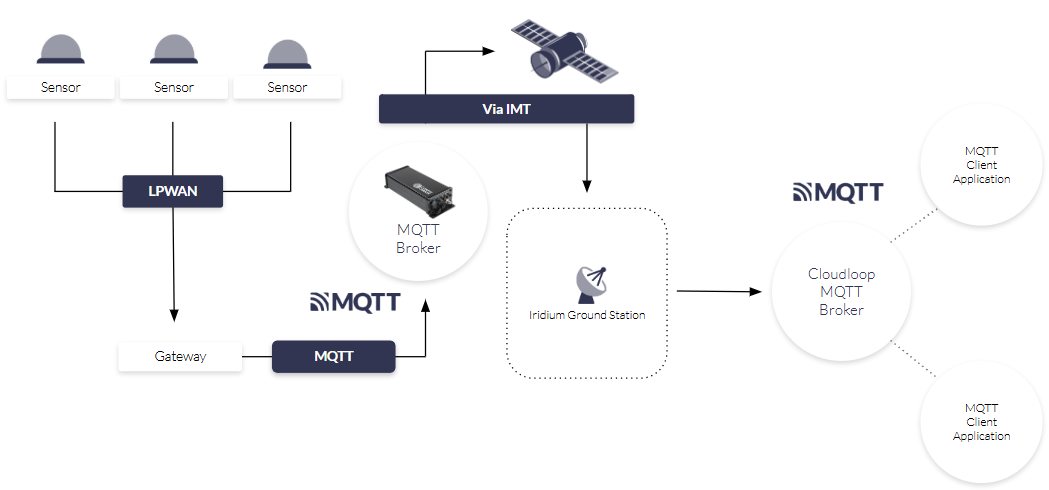
The IoT delivery network is designed to deliver large message payloads for a wide range of IoT applications in a highly cost effective way. It leverages the new IMT satellite service, the RockREMOTE or RockREMOTE Rugged terminals, and the MQTT messaging transport.
It provides an end-to-end solution comprised of:
- An MQTT application deployed on the RockREMOTE or RockREMOTE Rugged terminal; this provides the interface for your remote application to submit and receive data payloads
- The Iridium IMT satellite service
- An MQTT server application, delivered via Ground Control’s Cloudloop platform, which enables your IoT service application to submit and receive data payloads.
A 2021 research paper found that 75% of businesses experienced connectivity challenges when trialing IoT projects, ranging from coverage to interoperability to cost. Ground Control’s IoT Gateway is designed to address each of these challenges, providing global coverage, industry standard interfaces, and cost efficiency.
What is MQTT?
MQTT is a messaging protocol – a structured way for applications to exchange payloads of data between applications – designed for IoT. TCP / IP is another messaging (or communication) protocol, used to connect network devices on the internet, and in private computer networks.
MQTT was designed specifically for IoT, where the data transmission requirements are usually small, and the microcontrollers that host the code are also very small (physically and in terms of the amount of instructions they can support). So MQTT is very lightweight and efficient.
Another advantage of MQTT is that it has small message headers; this is the initial portion of a data packet, and contains control information such as addressing and version. In IP messaging protocols this is (relatively speaking) quite a large amount of information which makes sending data via IP more resource intensive. MQTT’s small message headers ensure that the network bandwidth is optimised.
It has become the industry standard for newer IoT projects because of its many advantages, including reliable message delivery, security, and scalability.
For more information on MQTT, visit https://mqtt.org/.
Talk to us about IMT
If you have an IoT connectivity challenge which satellite can solve, and you’d like expert, impartial advice on the best airtime and delivery network for your requirements, email or call us, or complete the form.
We’ve been delivering satellite and cellular connectivity services for over 20 years, and our partnerships with leading satellite operators means we can offer great pricing and a robust, reliable service, in addition to our commitment to delivering innovative, customer-driven data and device management solutions.
How RockBLOCKs Can Transform IoT Projects With Global Connectivity
The Internet of Things (IoT) has been transforming global industry and driving digitalisation for some years now. Simply, IoT describes connecting any device to other connected devices and the internet, or other communications networks. This allows all devices to collect and share data about their environment and how they are used; and it is this data that can deliver true insight.
But this value is wholly reliant on reliable connectivity. After all, for data to enable proactive, smarter decisions, that data first needs to be delivered, for example, from sensor to HQ. In addition, fragmented data and gaps can give a wildly inaccurate picture and cellular connectivity only covers 15% of the globe. This is where Ground Control’s RockBLOCK suite can help.
Introducing the RockBLOCK
RockBLOCKs are transceivers that you can use to send and receive short serial messages, through the Iridium satellite network and back to Earth. They deliver plug-and-play satellite communication, meaning if you have a clear view of the sky, your solution / project stays connected.
How do RockBLOCKs work?
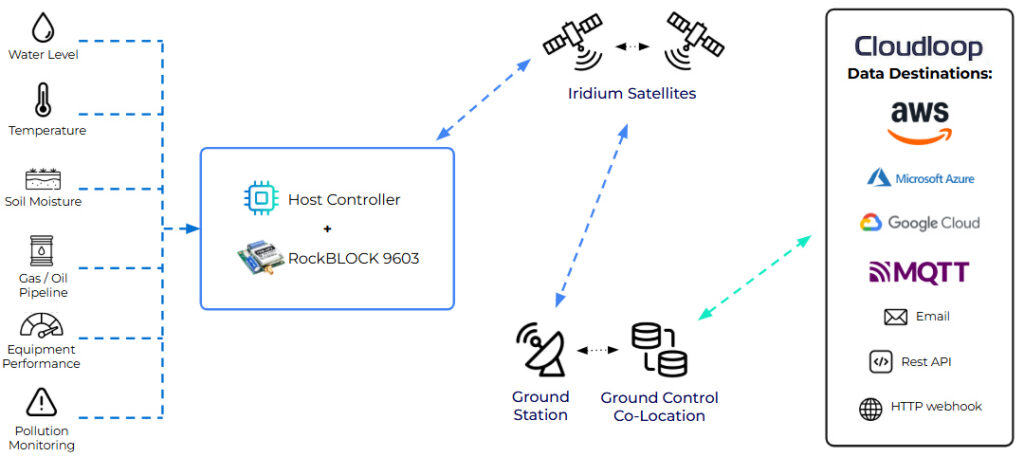
Leveraging the Iridium Satellite network – specifically, ‘short burst data’ (SBD) – RockBLOCKs are connected to a sensor and send this data to 1 of 66 satellites within the Iridium constellation. The satellite then relays this data through the constellation until it’s within transmission distance of Iridium’s ground stations (this takes fractions of a second!). Finally this data can be viewed either in our web portal, or set up to automatically relay this information to email, several email addresses or direct to a web service.
Although SBD only equates to message sizes around 340 bytes up and 270 bytes down, it’s ideal for many IoT applications, including weather balloons, data buoys, UAVs and more. It’s also relatively low cost, and can be purchased on a pay-as-you-go basis, or contracted, which delivers flexibility for developers and educators while testing.
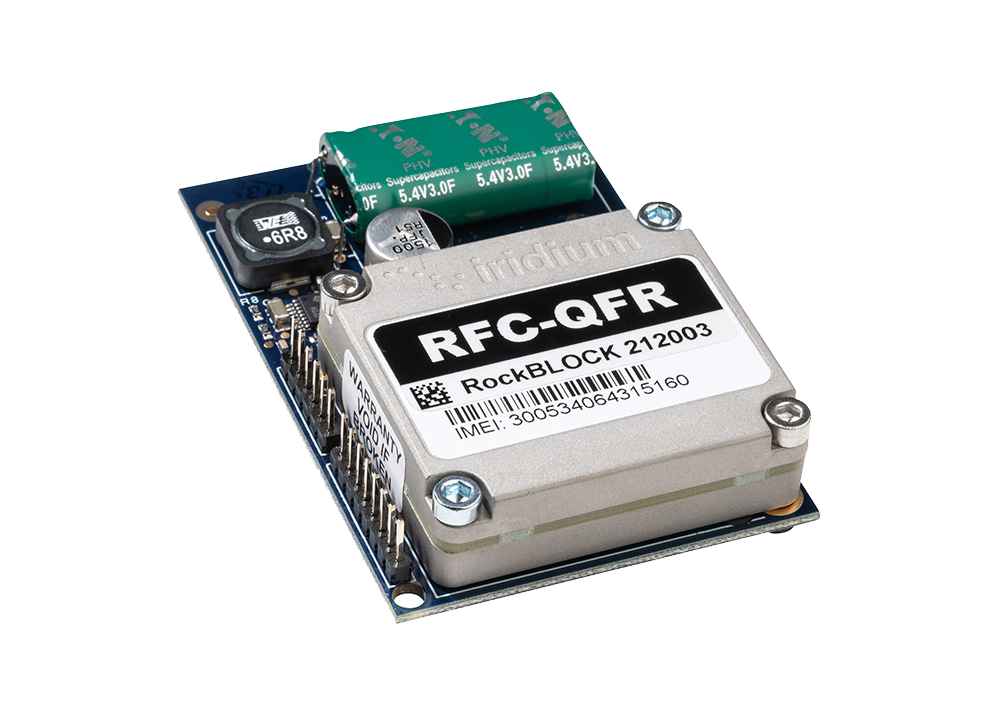
RockBLOCK 9602
RockBLOCK is essentially a development board for the Iridium satellite modem. In the case of the 9602, it hosts the 9602 modem, provides it with an antenna, its power supply requirements and exposes the modem’s serial interface via a breakout connector.
Often used by hobbyists and scientists, it can support many applications, from meteorological sensing, through to preventing fires in remote locations. All you need to get up and running is 5 volts DC, a controller that speaks serial and a clear view of the sky.
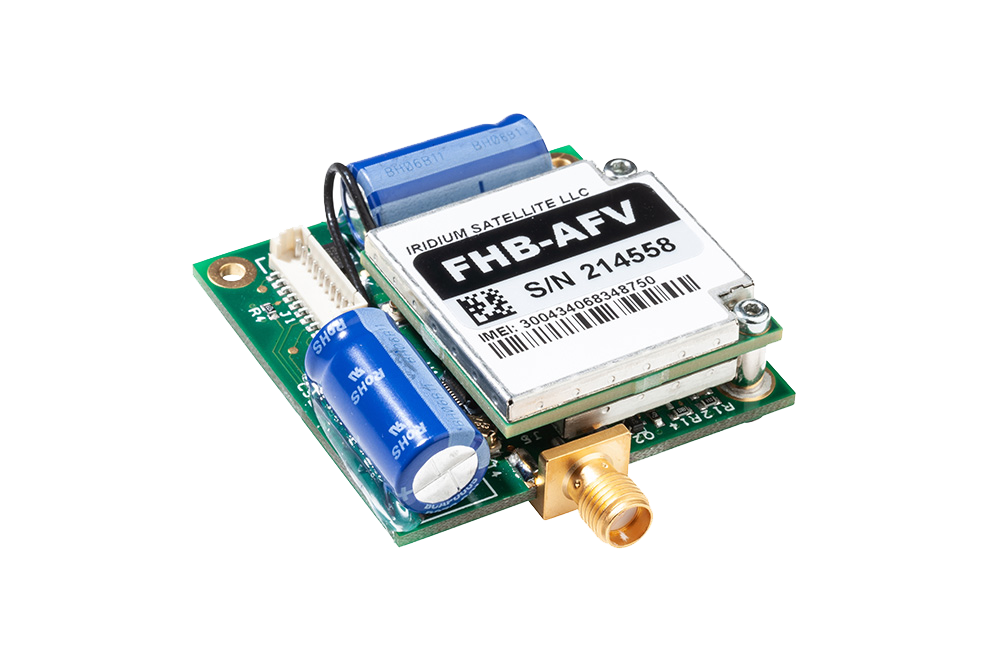
RockBLOCK 9603
RockBLOCK 9603 is almost half the size of its predecessor and was designed especially for product developers and system integrators used to using smaller equipment for small enclosures.
It hosts a 9603 Iridium satellite modem, has a small form factor Molex connector to link the serial, power, and signalling lines to your controller. This may be slightly harder for developers than the 0.1″ dot pitch header used on the standard RockBLOCK, but we do also have USB serial cables which include the mating molex connector on the other side.
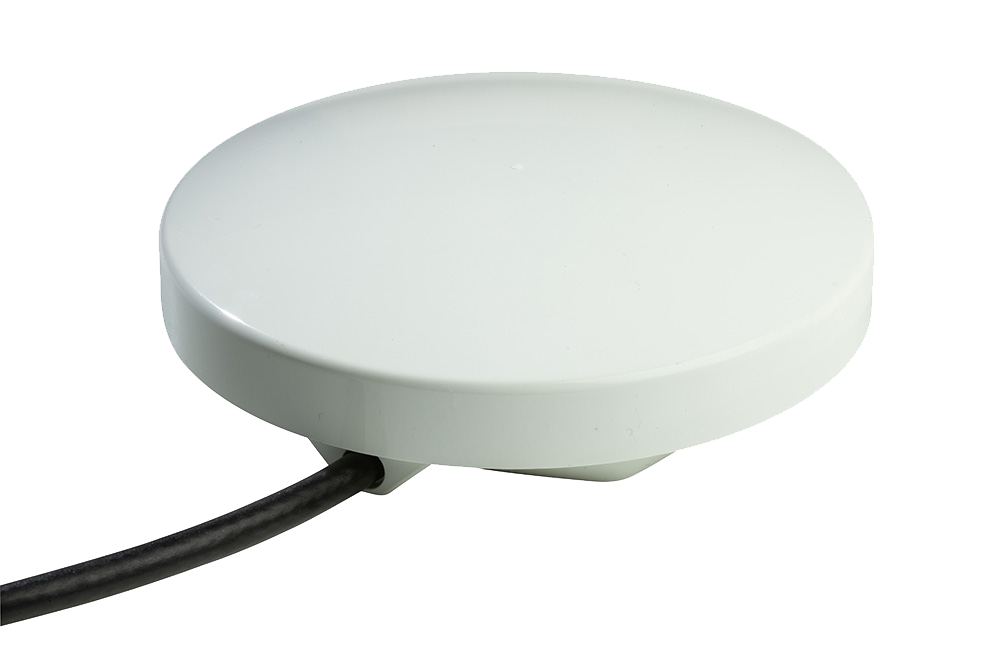
RockBLOCK Plus
RockBLOCK Plus is a waterproof and ruggedized version of the RockBLOCK 9602, with 9-30v power input and RS-232 data link.
It’s designed to transmit sensor data from IoT applications, and is being used in forestry, preventing illegal deforestation and creating alerts for extreme temperature changes; in environmental applications, monitoring earth movement and water levels to provide early warning of landslides and flood risks. It’s also deployed as part of Thailand’s tsunami detection system, with the potential to save many, many lives.
Antenna options – Patch vs SMA
Our RockBLOCK devices include a patch antenna which is suitable for applications where the RockBLOCK can ‘see’ the sky; for example, under plastic but close to the top of the enclosure. However, for applications where the RockBLOCK needs to be situated deep within an enclosure or have a metal barrier between it and the sky, both the 9602 and 9603 have an SMA connector allows the attachment of an external antenna.
Common RockBLOCK projects
Because the RockBLOCK is a small, low cost, low power transceiver, the applications are vast. We work with many partners to bring truly innovative, end-to-end solutions to life. We often partner with those responsible for building the sensors the RockBLOCKs then connect to. To give you an idea and possibly inspire your next project, we’ve collated below some of the most common use cases supported by our RockBLOCK products today.
Tsunami early warning system
When it comes to early warning systems and critical communications networks, organisations need to utilise satellite connectivity, both for the coverage requirements and network reliability. Currently the RockBLOCK Plus is installed across Thailand, empowering their Tsunami early warning system, with ubiquitous, reliable connectivity. The system continually monitors for Tsunami warning indicators, and upon detection – as the RockBLOCK supports two-way communication – it triggers an audible alarm.
Automated landslide monitoring
To reduce the impact of hazardous landslides, enabling proactive, preventative measures to be taken, near real-time monitoring is essential. The RockBLOCK assists regular monitoring of landslide activity with always on connectivity, sending data of high spatiotemporal resolution and centimetre-level accuracy for long-term deployments. Measuring in this way aids in early warning information and limits the use of invasive and expensive drilling, the more traditional landslide monitoring technique.
Environmental monitoring and reporting
Blocked, overflowing systems can cause flooding, erosion, turbidity, storm and sanitary sewer system overflow, and infrastructure damage. Combining data sent via RockBLOCKs within Powered Telemetry Modules (PTM), companies are able to monitor and forecast these events. Utilising a mixture of time lapse cameras, water level gauges, rain gauges, and weather gauges, companies are able to predict where issues may occur and which areas are most at risk, and implement proactive, preventative measures.
Drifting data buoys
Generally, the main purpose of drifting buoys is to measure ocean currents and sea temperatures, the data of which is then transmitted back to research labs on the mainland for analysis. We work with MakerBuoy, who create drifter buoys for individuals and hobbyists to throw into the ocean and retrieve oceanic data; for example, air and water temperature, wind speeds etc. The data retrieved provides vital intelligence for weather and climate models and ultimately aids better understanding of ocean behaviour and intensity forecasting. As the RockBLOCK benefits from pole-to-pole coverage via the Iridium satellite network, buoys carrying a RockBLOCK can transmit this data back to hobbyists, researchers and meteorological organisations for analysis, from anywhere on earth.
Drone connectivity
The applications for drone usage continue to grow: medicine delivery, crop spraying, seed drops, surveillance, meteorology, goods transportation – the list goes on. As many of these tasks take drones into areas with limited or no cellular coverage, satellite connectivity is essential to ensure that, when the drone is Beyond Visual Line of Sight (BVLOS), the drone can still receive commands from the operator.
Ground Control supports UAV and Drone operators with critical Beyond Visual Line of Sight (BVLOS) communications to allow constant connectivity with minimal latency to airborne drones. We use Iridium Short Burst Data (SBD) to allow small strings of data to be sent from a base of operations to the field, providing flight programs, course alterations and other instructions in real time.
Most recently, we’re proud to have had our RockBLOCKs play an important role in the delivery of critical medical care via drone through our partnership with Skylift.
Preventing illegal deforestation
Illegal extraction activities are a significant threat to rainforests and natural resources more generally. With the RockBLOCK, monitoring systems within a rainforest can act as watchdogs. Once certain markers are detected, an alert can be sent and the data analysed by NGOs and governments. If they feel there is an imminent threat, the appropriate authorities can then be notified.
Wildlife tracking
Africa is home to some of the world’s best-known and most iconic wildlife. However, the African Wildlife Foundation (AWF) reports that due to illegal poaching, 43% of the lion population has been lost in the last 20 years.
One of our partners is responsible for creating tracking collars for lions, most notably, in Namibia. Each collar houses a RockBLOCK device, ensuring rangers are able to reliably and effectively track pride movements and ultimately, more effectively protect them.
Off-grid fire prevention system
Regular home fire safety equipment (alarms and extinguishers) rely on a fire to have already entered the premises or someone to be home to raise the alarm. Off-grid fire prevention systems can protect properties and communities, using the data collated to predict and detect wildfires. RockBLOCKs can ensure data is sent from sensors in near real-time and as the RockBLOCK supports two-way communications, once certain thresholds are met, for example significant increase in temperature, a command can be sent back to the system to trigger high-pressure sprinkler systems.
Interest piqued?
Our RockBLOCK product suite is endlessly being used to create really clever, inspiring projects we’d not even thought of and a huge part of this is due to our partners.
If you are interested in learning more about any of the RockBLOCK suite, or partnering with Ground Control on an end-to-end solution, simply fill in the contact form below.
“0 to 1 in Sixty Seconds” – Data’s Journey in Shaping Digital Transformation in Utilities
First coined around 2011, digital transformation according to Salesforce is the – “process of using digital technologies to create new — or modify existing — business processes, culture, and customer experiences to meet changing business and market requirements.”
With global spending on digital transformation set to double to $2.8 trillion by 2025, digital evolution and smart technology continue to gain significant traction, especially within Utilities and Renewables. Described as at the center of a massive global shift, the Utilities sector is under considerable pressure. With global energy demand expected to increase by 37% by 2040 and surges in demand for renewable energy resources and sustainability; more Utility companies are turning to digital strategies to become more agile, competitive and resilient.
The challenges and opportunities of digital transformation in Utilities are very well documented. However, having served Utilities for over 20 years, we know the role data has played in shaping this transformation. We’ve created a paper covering how far Utilities companies have come in terms of collecting and analysing data to streamline their operations, and how data is likely to shape digitalisation in the future.
Electrical grids and gas distribution systems are critical infrastructure. Outages and supply interruptions result in huge financial burden and penalties for the supplier, and severe (often prolonged) disruption for consumers. With increasing pressure for renewable energy and from customers seeking to generate their own power, digital transformation could be the catalyst Utilities need to boost consumer interest.
The UK Department of Energy and Climate Change has invested heavily into its smart grid vision and route map – building a smart grid across the UK. Smart meters and sensors along grid lines transmit usage data to providers, enabling them to match supply with demand. Likewise, smart appliances can alter the times of electricity usage, avoiding peak times when pressure on the grid is high, resulting in lower costs and reduced risk of outages.
It is these detailed insights into customer habits that does and will allow Utilities to achieve maximum efficiency and customer satisfaction. And at a time of expensive grid updates, usage trends could prove invaluable to planning and prioritising engineering work, and the most efficient means of distributing utility supply.
Big data, machine-to-machine technology, and dependable connectivity provide the means to understand consumer trends and predict future utility usage. Companies failing to incorporate a robust data strategy into their business plan are likely to find themselves at a major competitive disadvantage, if not already, in the very near future.
The future of connectivity
Although not covered in the paper directly, data retrieval is dependent on connectivity. Inmarsat reports that 58% of electrical Utility providers are unable to implement IoT projects due to availability of reliable connectivity in required areas. Data gaps and delays can lead to inaccurate pictures of infrastructure and supply. With Mobile Network Operators (MNOs) sunsetting their 2G and 3G networks, and PTSN set to be switched off in 2025, it is becoming even more difficult for Utility providers to secure reliable, consistent connectivity throughout their supply chain.
Cellular connectivity continues to advance and a recent survey by Deloitte highlighted that 26% of respondents within Utilities had included 5G within their strategy, with a further 36% stating they planned to. However, while cellular connectivity provides a viable alternative, some sites are so remote that there is no cellular coverage. 8% of the UK’s landmass remains uncovered by mobile networks. What’s more, it will be many years before fibre finds its way to these remote locations – if indeed it ever does – and it’s cost-prohibitive for most companies to fund this privately. Satellite is already used by a third of Utility companies and given the challenges ahead, satellite could prove pivotal to creating a more resilient grid.
Data security
Data security continues to be top of mind for Utility providers, with cybersecurity breaches on the rise. IBM reported a 10% increase, from $3.86 million to $4.24 million per incident, in data breach costs between 2020 and 2021. And the energy industry ranked fifth in data breach costs, surpassed only by Healthcare, Financial, Pharmaceutical and technology verticals.
Arguably, security is also becoming more of a focus for consumers. According to our survey of utility users, hackers bringing down internal systems (as was done in the Colonial pipeline attack), was identified as a potential risk to utility supply by 46.9% of recipients. Given that almost half (46.7%) of March’s survey respondents stated there was a slightly higher cybersecurity risk to Utility supply due to the war in Ukraine, and 20.3%, a substantially increased risk, this is clearly a growing concern.
Is satellite connectivity secure?
Satellite communications are as secure as any IP connection. Cybersecurity can be enhanced by securing data paths with encryption, and where appropriate, creating systems completely redundant from public networks and infrastructure. What’s more, any security protocols already in place will operate over a satellite network.
When working with companies within the Utilities and Renewables industry, one of the first questions we’ll ask is which communications they are most concerned about from a security point of view. And often, we’ll advise TSAT. TSAT provides a private satellite network operating a direct communication channel between a process control center and remote locations, specifically designed to meet the demanding requirements of the SCADA and utility industries. TSAT complies with AES-256 encryption and authentication. Furthermore, it’s completely isolated from the Internet or any other network, riding over a dedicated space segment of one or more satellites for redundant fail-over reliability, in multiple topologies.
Cyber security features include: VLAN (Virtual LAN) support, file system encryption, secure Linux login to avoid unauthorised access, and SW/FW upgrade over-satellite authentication.
For more information regarding security and connectivity more generally, take a look at our recent eBook.
Secure data transmission: the key to unlocking Utilities’ operational success?
The key to operational success in Utilities is to collect accurate, real-time data throughout the supply chain. But data collection is increasingly fraught with risk as cyber-criminals target infrastructure. Our eBook explores three main challenges facing Utility providers: security, ageing infrastructure and climate change, and explores the role of connectivity in overcoming these.
Get in touch
We are proud to have provided one of our utility customers 27 years uninterrupted service, making satellite that company’s most reliable system.
To learn more about our solutions and how these can help you consistently provide better for your customers, contact hello@groundcontrol.com.
How to Improve Satellite IoT Network Security
The IoT M2M Council recently reported a potential threat to “millions of routers and IoT devices”; malware named BotenaGo, identified by Alien Labs. This comes after a Zscaler report that IoT malware attacks rose 700% during the pandemic, 59% of which came from devices in manufacturing and retail.
Fortunately, there’s plenty of great advice to help mitigate the threat of IoT malware, and we’ve adapted this specifically for relevance to satellite IoT.
1. Monitor network traffic and unreasonable bandwidth usage
Can you review and analyze the amount of data each device in your network is using? Can you set alerts to ensure any unauthorized or unexpected data surges are shut down quickly? There are solutions available today that make this easy, such as Cloudloop; investing in one of these won’t prevent attacks but they will help you limit the damage.
2. Ensure minimal exposure to the internet / isolate IoT networks
Most satellite IoT users, whether you’re using satellites in low earth orbit (LEO) or geostationary, retrieve your data from your satellite service provider’s ground station using the internet at some point – and you have choices over how secure you make that connection. For example, this diagram shows a very simplified networking diagram for the RockREMOTE, a satellite IoT connectivity device.
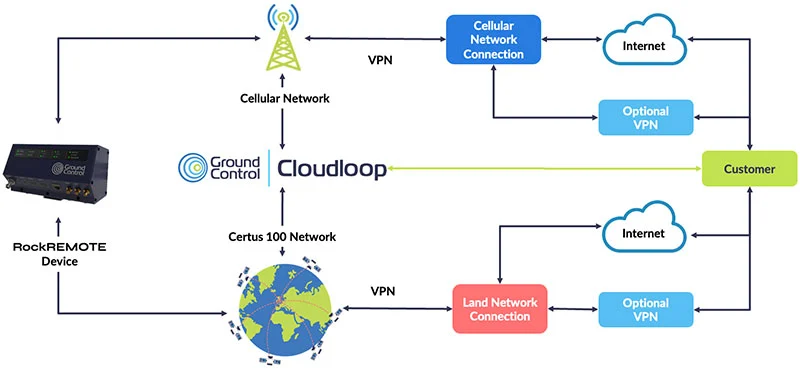
After the data from either the satellite or cellular network is sent to the land network connection, users choose between delivering that data via the internet, or using a VPN; the latter minimizes your exposure to the internet and is recommended for critical applications.

There is a further option for companies concerned with critical national infrastructure, such as Oil & Gas and Utilities, and that is to operate an entirely private networking solution. This service, from TSAT, is designed specifically for SCADA / telemetry networks, and essentially places a ground station at your premises; it does not use any public infrastructure connectivity such as the internet.
Further, the TSAT system has many features to prevent unauthorized access to traffic communicated via the satellite link, regardless of the traffic type (TCP/IP or serial), including the option of AES-256 encryption. In our view, it’s certainly worth exploring. The hardware is more expensive than your average satellite connectivity device, but once you’ve taken into account the simplified networking and lower data transmission costs, it can deliver, and has delivered, lower operating costs.
3. Use a properly configured firewall
An effective firewall will protect against:
- Network threats: DDoS (Distributed Denial of Service) and application-layer attacks which may disrupt the integrity and availability of the Service Provider’s network.
- Device threats: preventing devices from connecting to unknown services. This reduces the chances of devices being compromised.
- Service abuse: preventing IoT devices from being used unexpectedly, which can result in revenue leakage for the Service Provider or the application owner.
4. Update your passwords
Clearly not specific to satellite IoT but this is such an important point, we couldn’t leave it out. Remember, the infamous Colonial Pipeline hack in April 2021 was made possible because of a single compromised password which allowed the hackers to gain entry through an (unused but still viable) VPN account.
If you could use some objective advice on improving the security within your satellite IoT network, please get in touch with the Ground Control team. We have customers providing critical national infrastructure services globally, and have delivered secure, reliable connectivity in multiple applications.
Get in touch
We’ve implemented satellite IoT infrastructure for decades, and there’s very rarely been an obstruction issue we couldn’t overcome with a bit of knowledge and ingenuity.
We’d be happy to talk to you about your project and offer impartial advice on the best antenna and satellite service for your particular requirements. Call or email us, or complete the form.
IoT and M2M: What is the difference?
Two of the technologies that you’ll often hear about in the context of device networking are M2M (machine-to-machine) and IoT (Internet of Things). But what are they and how do they differ?
What is M2M and IoT?
In simple terms, M2M is where machines connect to each other using a network to share data, such as machines, sensors or appliances. An M2M connection is a direct, point-to-point connection between two networked devices using wired or wireless communication channels – such as ethernet and cellular networks.
M2M technology is present in our homes, offices and cars. Controlling electrical appliances like smart bulbs and connecting Bluetooth from your smartphone in your car are just two examples of M2M applications at home. Here, the smart bulbs and your smartphone are the two machines interacting with each other; likewise, your smartphone with your car.
IoT is essentially the next step. It’s an evolution of M2M that increases the things that device connectivity can achieve. It’s a network of devices – not a point-to-point connection like M2M – that exchange data over a network or “cloud” of networked devices. The technologies used by IoT devices allow users to create fast, flexible, secure networks that connect a wide variety of devices. The data can also be monitored and controlled using a platform too, allowing businesses to closely monitor their ‘things’.
“IoT is itself a subset of M2M technology. IoT involves communication between machines without any human input, making it by definition a form of M2M communication. However, IoT expands the power and potential of M2M technology in new ways.”
The biggest difference between M2M and IoT is that an M2M system uses point-to-point communication. An IoT system, meanwhile, typically places its devices within a cloud network that allows larger-scale integration and more sophisticated applications. However, there are also further distinct differences:
| M2M | IoT | |
|---|---|---|
| Communication Method | Direct communication between machines or systems | Connected devices exchange data through a wider network or platform |
| Network Structure | Often point-to-point or based around a defined group of machines | Typically connects many devices, systems and applications |
| Internet Dependency | Does not necessarily require an internet connection | Usually relies on internet-connected platforms or cloud services |
| System Architecture | Commonly centred on dedicated hardware and connectivity | Combines devices, connectivity, software, platforms and applications |
| Scalability | Often designed for a specific, contained application | Designed to support larger numbers of devices and multiple use cases |
| Device Access | Systems commonly communicate with a limited number of predefined endpoints | Users and applications can monitor or manage multiple devices centrally |
| Data Integration | Data is typically delivered to a specific machine, server or control system | Data can be shared across cloud platforms, applications and business systems |
| Typical Purpose | Remote monitoring, control or automated communication between machines | Broader data collection, analysis, automation and integration across connected assets |
(Source: Parker Engineering)
*There is nuance here. For example, a yacht race organizer tracking multiple participants’ location via satellite is a good example of IoT in action, however, location data from the yachts to the cloud service does not need to be delivered via IP. The internet is only required for data delivery once the data has landed from space.
In summary…
Both IoT and M2M technologies enable machines to exchange data autonomously and perform tasks with limited human intervention. Yet, IoT and M2M have a number of distinct differences that we’ve highlighted here, depending on connection type, application and scalability.
The two are different solutions and provide different levels of data exchange and collection. Both, however, are geared toward creating a more connected and “smart” world.
Get in touch
We’re here to help. With highly experienced staff based in the UK and USA, we’re here to talk through your most challenging remote connectivity requirements.
Complete the form, or if you prefer to speak to someone directly, call us on +44 (0) 1452 751940 (Europe, Asia, Africa) or +1.805.783.4600 (North and South America).
Can Satellite be an Effective PSTN Replacement?
In this webinar, recorded in September 2021, we explore the challenge presented by the PSTN switch off, particularly the impact upon utilities companies.
As you might anticipate, we’ll propose satellite connectivity as a solution to these challenges, but this offers you a broad spectrum of possibilities, so we explore the best options for this application.
Finally, we address some of the frequently asked questions about this service.
Why are British Utilities Companies Affected by the PSTN Switch Off?
Utilities companies are particularly exposed by BT OpenReach’s decision to switch off the PSTN network, as they operate many thousands of sites currently connected using this technology. And it’s worked really well – PSTN’s astonishing availability (99.992%) is something that even FTTP may struggle to match. Security is another concern: as many utilities companies are requesting more and more data to facilitate the “smart grid”, if that data can be intercepted, that could lead to costly and reputation damaging outages.
Cellular connectivity will be the solution for most utilities sites – but not all. Remote sites may have no cellular coverage because they’re in a valley, for example, and you can’t simply move the site into 3G or 4G range. Or you may have some cellular coverage, but it’s unreliable – and so a backup, or failover, system is needed to ensure that the data can always get out.
Why is Satellite a Viable Solution?
Satellite connectivity has long been the failover for really remote utilities sites where not even the PSTN network reaches. You need very limited infrastructure – a clear view of the sky, and an antenna plus transceiver that can connect with the satellite network. These devices are not weather or location dependant; they have a 10-15 year life span, and have been built with your existing infrastructure in mind. The key here is resilience: when the cellular network is unavailable or unreliable, satellite provides an excellent primary or failover system.
Not all Satellite Connectivity is Created Equal
Satellite connectivity ranges from very small daily data volumes which are transmitted hourly, to high throughput live video streaming-capable solutions. For the PSTN switch off, you are looking at something towards the smaller end of that scale, with kilobytes of daily data, and transmission frequency measured in minutes. We would recommend either the RockREMOTE or the Cobham Explorer 540. The video explains the differences between the two services, but if you’ve any questions, please get in touch.
Get in touch
We’ve implemented satellite IoT infrastructure for decades, and there’s very rarely been an obstruction issue we couldn’t overcome with a bit of knowledge and ingenuity.
We’d be happy to talk to you about your project and offer impartial advice on the best antenna and satellite service for your particular requirements.
Calling UK Utility Providers…Get Switched on About the Big Switch Off
Many UK businesses still heavily depend on copper wire-based services to collect data and communicate with remote sites. These hardwired connections have offered reliability and resilience for decades. However, the cost of operating and maintaining outdated copper wire-based analogue services is high, and the limited bandwidth and speeds no longer meet customer expectations. BT Openreach, who own and manage these lines, have therefore called an end to analogue based services. The PSTN network will be switched off in December 2025.
The decision to switch off PSTN creates a necessity for organizational change and large-scale investment. The switch off provides an ideal opportunity for digital transformation, and the removal of existing legacy systems. Businesses are also changing. Organizations are merging Operational Technology (OT) with IT services, drawing the worlds of physical infrastructure and data management closer together. Further, expansion into process control and automation, and data sharing across an organization, creates efficiencies through optimization and greater visibility.
Fibre optic cable as a PSTN solution
Openreach is focused on fibre optic cable as the solution for replacing PSTN. It’s cheaper and more resilient as a product and it offers faster speeds and greater bandwidth to carry more data. The area around an exchange and its network infrastructure which can use fibre, is known as a ‘fibre footprint’. The size of the footprint may be due to economics or physics, but the real communication challenge for PSTN switch off lies outside the footprint.
Utilities providers can pay for a fibre connection to be added to remote sites, and this is a good choice if applications will benefit from 20 times more bandwidth and higher speeds of up to a gigabit per second. However, millions of active PSTN lines at remote sites won’t benefit, and increased sophistication of cyber threats and the prohibitive economic cost of digging fibre to remote locations means a different approach is required.
Satellite communication as a PSTN solution
Several satellite communication services offer secure solutions with varying bandwidth and speeds at viable pricing. What’s more, satellite services go one step further and provide more than an like for like replacement for remote sites with no coverage. Satellite also offers cyber security and resilience at critical locations, even where there is cellular coverage. Implementing built in satellite and cellular communication paths reduces the risks posed by the switch off PSTN lines.
BT Openreach findings
The number and variability in locations, applications and data requirements, means the PSTN replacement will be a mix of solutions. With 16 million lines and channels to manage, most replacements will be simple, straightforward swaps to cellular or fibre. The distance from the exchange and the data volumes are key questions. Certain lines will be better served by fibre connections and some will be more easily replaced by a cellular solution. This leaves an estimated 10% of sites too far from the exchange to be serviced by fibre or broadband over copper, with many of these also requiring more resilience than cellular coverage offers.
RockREMOTE as a satellite-based solution
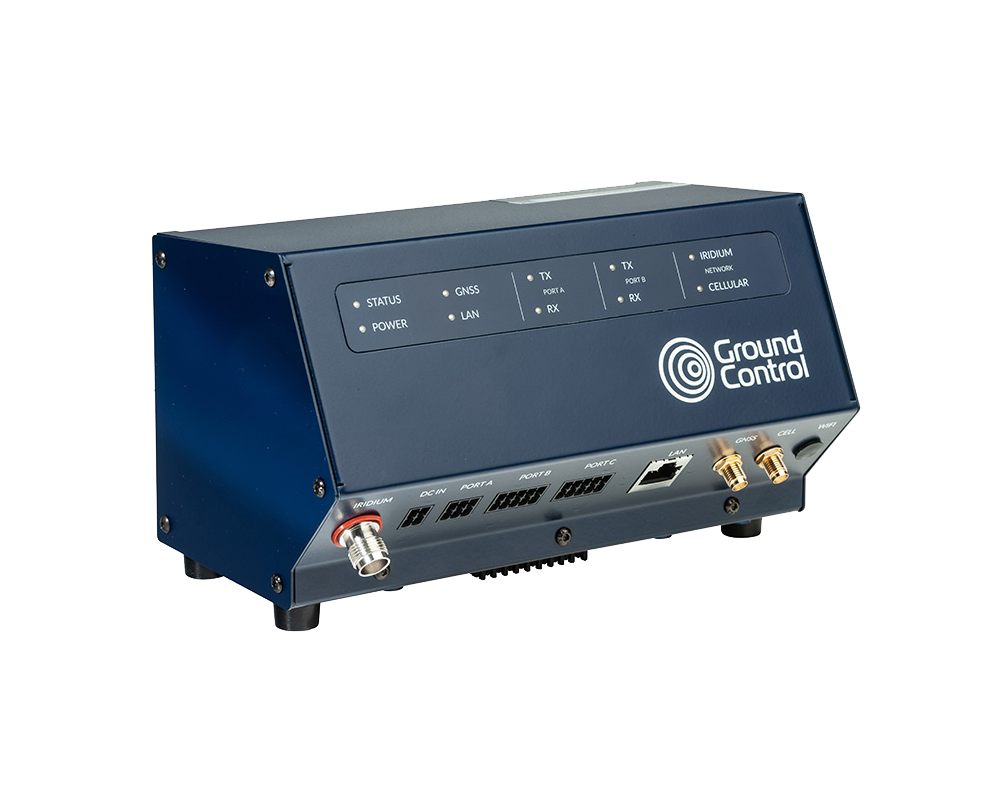
The potential loss of connection and data transfer from assets can carry heavy penalties, both monetary and reputation damage. The challenge of converting traditional lines into digital communications without such loss can be resolved effectively by adopting the new RockREMOTE technology. The unit, with its hybrid LTE / Iridium Certus connectivity, facilitates data transfer from and to anywhere – only solar power is required to run the RockREMOTE continuously and without loss of connectivity.
With RS232 and RS485 built in, supporting serial to IP migration for telemetry devices, RockREMOTE has a full Linux OS, and even has storage allowing users to move closer to the benefits of edge computing-based processing.
Key Features:
- RockREMOTE reaches where other solutions can’t – cellular doesn’t always provide reliable connectivity in remote areas and there is a lack of capacity in rural locations. Also, this will likely get worse with the sunsetting of 2G/3G over the next few years
- Provides backup comms – some sites are connectivity-critical and require backup comms when all else (namely cellular or fibre) fails
- More cost-effective than fibre – fibre solutions remain costly and difficult to implement, especially if channelling to and installing in remote locations
- Requires only solar – it is not uncommon for sites to be powered entirely by renewable energies. RockREMOTE can run purely through solar and does not require a generator or other power source, making it both energy- and cost-efficient.
Final Thoughts…
Understanding the practical business requirements for data transmission from remote sites and then designing a matrix of viable options is undoubtedly a major project. For non-essential applications in areas of good coverage, cellular will always, and appropriately, be considered the easy win.
Utility companies who count PSTN lines in their thousands need to make a start swapping to robust and secure digital IP-based communication technologies. Technologies that allow organizations to securely extend IT infrastructure to every remote corner of their operations, create complete visibility of assets, and allow process control. Satellite technologies also offer proven cyber-secure scalable communications. RockREMOTE is therefore ideal for industrial use cases where sites are remote and satellite communication is the only sensible PSTN switch off solution.
Video guide
This webinar has also been put together as a handy guide for using satellite communication as your PSTN replacement:
Get in touch
We’ve implemented satellite IoT infrastructure for decades, and there’s very rarely been an obstruction issue we couldn’t overcome with a bit of knowledge and ingenuity.
We’d be happy to talk to you about your project and offer impartial advice on the best antenna and satellite service for your particular requirements. Call or email us, or complete the form.
Welcoming New Reseller, Adafruit
Ground Control is delighted to announce that the world famous IoT specialist Adafruit has become a US reseller of a RockBLOCK bundle. The bundle, which consists of the RockBLOCK 9603 unit with FTDI cable, is now available through the Adafruit website.
Adafruit
Founded in 2005 by MIT hacker and engineer, Limor ‘Ladyada’ Fried, the 100% female-owned Adafruit is an open-source hardware designer, manufacturer, reseller, and online store for tools, equipment, and electronics. They also record and distribute weekly show-and-tell programs for product launches, as well as their long-running Ask an Engineer videos.
With a wealth of brains and passion behind them, Adafruit has become #11 in the top 20 USA manufacturing companies. It’s also noted as one of the fastest-growing private companies in NYC by Inc. 5000, with over 100 employees and a 50,000+ sq ft. factory.
Alongside over 5,000 products, the RockBLOCK 9603 is now taking pride of place on the Adafruit shelves.
RockBLOCK 9603
The RockBLOCK 9603 is the compact little sibling of our RockBLOCK 9602 Mk2. With a clear view of the sky, the board allows users to transmit their project data from machine to machine, anywhere in the world. The RockBLOCK has been used for countless projects, from small-scale experiments to university geological research, like Slide Sentinel, through to offshore telemetry for issues such as renewable energy (see our work with Ocean Scientific International Ltd).
The RockBLOCK is now available from the Adafruit website. Adafruit Industries Founder and CEO, Limor Fried, introduced their latest product offerings herself, including the RockBLOCK, on Adafruit’s YouTube channel. Subscribers showed their excitement at the RockBLOCK with comments including:
“Omg the satellite texting blows my mind right now :)” ~ PewDiepie
“The satellite modem is very interesting, I need to investigate this further” ~ Christopher Guy
And simply “Very interesting” ~ David Adams.
In the video, Fried said: “You can send messages anywhere in the world, which is amazing. The price per message is not that expensive as long as you’re putting your data together in the right way. I love it, it’s really small. A great way for any developer, scientist, student, or engineer to start using satellite communication.”
To help customers get started with the RockBLOCK bundle, Adafruit also kindly put together a RockBLOCK 9603 with USB Cable – Iridium Satellite Modem Bundle + Accessory Cable.
Ground Control Solutions Architect, Elonda Wallace, said: “Adafruit are a big player in the IoT reseller market. As part of Ground Control’s new sales and marketing strategy, we’re looking to expand our reseller presence across the world so Adafruit was an obvious choice. We’re delighted that they are now selling RockBLOCKS.”
OSIL use RockBLOCK to Assist Data Collection for Tidal Energy Opportunities
Working with Bangor University (Wales) on the SEACAMS2 project, Ocean Scientific International Ltd (OSIL) has provided a network of three telemetered data buoys which are each equipped with a RockBLOCK. The buoys collect and measure oceanographic, meteorological, and water quality data parameters around the coast of North Wales, using the RockBLOCK to transmit that data from remote locations.
The SEACAMS2 project is a collaboration between Bangor University and Swansea University. Funded by the European Regional Development Fund, the aim of the project is to support research and applications for renewable energy, climate change resilience, and resource efficiency.
In a continued effort to find sustainable, renewable energy opportunities, the purpose of the buoys in the SEACAMS2 project is to measure the possibility of using the ‘dramatic, tempestuous, and extremely complex environments’ the area is synonymous with for energy purposes, while ensuring it’s done safely and efficiently.
Each buoy has a dual telemetry system to relay their absorbed data from its data logger to control for analysis. If the buoy is in GSM range then the GPRS modem is used, whilst the RockBLOCK Iridium modem is triggered for short burst data (SBD) transmissions when out of GSM range.
Rock Seven (now trading as Ground Control) CEO, Nick Farrell said: “We’re pleased OSIL has chosen to use the RockBLOCK as the satellite communications element for its SEACAMS2 project buoys, ensuring continuity and reliability of its data transmission. The SEACAMS2 project is of great importance in the pursuit of clean energy and making sure the data is complete is invaluable. The RockBLOCK is a versatile and dependable way of sending and receiving data from remote locations, and can be used in conjunction with GPRS or in isolation. Because it uses the Iridium satellite network, it guarantees truly global coverage, even at the Poles.”
OSIL Project Manager, Rob Luthwaite said: “We enjoy working with Ground Control as they offer great, sensibly priced, products with excellent after-sales support and an easy-to-use online shopfront.”
View the monitoring real-time hydrodynamic changes from coastal platforms article on the OSIL website for further information on this story.
Get in touch
We have over 20 years’ experience delivering satellite-enabled asset tracking solutions to aviators worldwide.
We’re proud to design and build our own hardware, and we work with other leading manufacturers and airtime providers to ensure that all of our customers get the best solution for their needs.
Just complete the form and we’ll respond with impartial, expert advice.
Ground Control Delivers SBD Data to AWS Platforms
Whatever the function, Iridium short burst data (SBD) is a tried, tested, and cost-effective method of getting IoT data back to you via satellite from anywhere on Earth. Rock Seven (now trading as Ground Control) and Amazon Web Services (AWS) have now taken this one step further by allowing the data to be transported directly into Amazon Simple Queue Service (SQS) queues. This is done via a CloudFormation stack which creates the customer’s queues and takes care of cross-account permissions.
This new offering saves developers time in dealing with TCP sockets, byte-arrays, and proprietary protocols. While there may be a degree of background work, Ground Control can help, with minimal strains on resource times. It also helps people already using AWS to easily integrate with Ground Control devices.
Ground Control CTO, Ric Searle, said: “We’re already expert at leveraging AWS to build and scale our own IoT applications. Broadening this offering to help our customers get data into their own applications just makes perfect sense, and really speeds up application development. Our customers can focus on their business logic, rather than wasting effort re-engineering the data ingestion layer.”
Ground Control customers are already adopting this new offering. A recent example is an established Agritech organisation working with farmers in remote areas. They are using Iridium Edge and RockBLOCK products supplied by us to report on critical crop data from remote locations. To add to this, the needs of this customer were urgent as they were constrained by seasonal requirements.
Ground Control helped to integrate the global reach of Iridium, robust equipment such as the RockBLOCK and Iridium Edge, and the cutting-edge processing inside AWS – and gave the customer the solution they needed in record time.
In summary, this collaboration shows that:
- SBD is ideal for M2M/IoT applications
- Ground Control can help get your IoT data into the Cloud
- SBD equipment typically has small form factor and low power requirements
- Ground Control are Iridium SBD and AWS specialists
- Iridium SBD provides truly global coverage for IoT requirements.
Is Iridium SBD right for your project?
We are SBD experts; we’ve been designing and manufacturing devices that work on this network since 2005, and we’re very well placed to help you find the right product and airtime for your requirements.
Complete the form, or if you prefer to speak to someone directly, call us on +44 (0) 1452 751940 (Europe, Asia, Africa) or +1.805.783.4600 (North and South America). Whether you’d like a quote or just friendly and impartial advice, we’re here to help.
Global Satellite Communication for Qwiic Projects from SparkFun
The SparkFun Qwiic Iridium 9603N has been developed in order to provide a method for Short Burst Data (SBD) global communication for Qwiic projects via the Iridium Satellite Network. If a customer is prototyping with I2C and is looking to transmit short messages outside of GSM or WiFi networks or when said networks may not always work, this could be the answer.
SparkFun’s Qwiic Connect System uses 4-pin JST connectors to quickly interface development boards with sensors, LCDs, relays and more. The Qwiic Iridium 9603N module hosts a 9603N modem and also provides an antenna and power supply requirements. The modem’s serial interface is translated into I2C commands by the ATtiny841 microcontroller.
With a clear view of the sky, SparkFun boasts: “Sending and receiving messages to the Iridium network is as easy as sending I2C commands from your RedBoard over a Qwiic connector. The Arduino library walks you through sending messages to the Iridium network using your Qwiic Iridium 9603. Ground Control’s online portal, Cloudloop, and APIs allow you to send messages from the Iridium satellite network to your modem.”
Ground Control CTO, Ric Searle said: “It’s great to see Ground Control services being used in SparkFun’s experimental products to further development in IoT and SBD – SparkFun is a key partner and US reseller of our RockBLOCK products. The Qwiic board is a great little piece of kit and we look forward to assisting in the further development of the Qwiic Iridium 9603N and its certification”.
Currently the Qwiic Iridium 9603N is being sold under the SparkX banner. SparkX hosts products that have been rapidly produced so that customers have access to the most cutting-edge technologies. However, because they have yet to be “polished” to completion, SparkFun manage a peer-to-peer forum for like-minded individuals to gain support and share knowledge.
SparkFun was founded on the ethos of making electronics more accessible to everyone. Products and resources have been designed with this premise at its heart. Its portfolio of over 2,000 source components and widgets is impressive and is complemented by curriculum, training, and online tutorials to ‘demystify the wonderful world of embedded electronics’.
Get in touch
Having partnered with satellite network providers such as Iridium and Inmarsat for well over a decade, we have access to competitively priced tariffs, and can also be very flexible in terms of bundled data.
So if you are working on an IoT project and would like some no pressure, objective advice, simply fill in the form and one of our expert team will get back to you.