
When OEM teams discuss satellite connectivity for UAVs, the conversation often defaults to IP. It feels familiar, maps neatly to ‘internet-like’ thinking, and enables genuinely interactive workflows. And if your primary link is cellular, you’re usually already living in an IP world, so using an IP-based satellite service can look like the cleanest way to add failover comms without changing the application stack.
There’s also a second, equally valid pattern that many UAV architectures underuse: message-based transport. Used intentionally, it gives you a delivery oriented path for critical data, well suited to situations where connectivity can be variable and you want the system to behave calmly through brief fades. Further, if you’re tight on payload and battery, messaging can be the better fit in practice because the terminals are typically smaller, lighter, and lower power.
In real operations, links do get imperfect; often briefly, sometimes repeatedly. The question isn’t whether IP or messaging is better. The question is: what should your system do when connectivity becomes intermittent?
Intermittency is Normal in UAV Satcom
Irrespective of your choice of satellite network, satellite connectivity is shaped by installation choices and the operational environment. You may see brief fades or dropouts caused by antenna placement and orientation (vehicle attitude, manoeuvring, installation constraints), airframe shadowing (the drone itself blocking sky view), and terrain or obstructions (especially at lower altitudes). These aren’t exotic edge cases; they’re part of the everyday reality of airborne links.
Designing for that reality is less about chasing a perfect connection, and more about choosing link behaviors that match the data you need to move.
|
IP (interactive session) |
Messaging (queued delivery) |
|
|
Best for |
Operator driven workflows and interactive payload control |
Delivery oriented updates and 'must get through' messages |
|
Typical pattern |
Continuous back and forth |
Discrete messages sent in packets |
|
When the link fades briefly |
Sessions may need reconnection / state re-establishment before resuming |
Messages can be queued and retried according to your policy / service behavior |
|
How to think about it |
“Stay connected” |
“Deliver this information” |
IP is Ideal for Interactive Sessions
An IP connection excels when you genuinely need an interactive session: operator driven workflows, higher touch payload control, and applications that depend on continuous back and forth.
Many IP applications also maintain session state and use keep-alives. When connectivity becomes intermittent, those session oriented behaviors may require reconnection and state re-establishment before the application resumes normal operation. That’s not a problem with IP; it’s simply how many interactive applications are designed.
In UAV satcom, where brief fades can be normal, it can be helpful to complement interactive IP workflows with a delivery oriented path for data that should still make progress even when the link isn’t perfectly continuous.
Messaging is Designed for Queued Delivery
Message-based transport starts from a different premise: you’re not trying to stay in an ongoing conversation. You’re trying to deliver discrete information, and you want the system to behave sensibly if conditions aren’t perfect at the moment you try to send.
In a well designed message-based workflow, you can queue data for delivery and apply an explicit retry policy, so brief fades don’t necessarily translate into a broken live session experience. Messaging doesn’t need to hold a session together to succeed; it just needs a window good enough to move the message, with delivery behavior determined by the service and by how you design your application logic.
Messaging is often a good fit for data types where you care about delivery and can tolerate brief delays, such as safety and control intents, periodic telemetry snapshots, mission state updates and compliance events, and ‘must get through’ alerts.
A useful practical point for OEMs: messaging aligns with how many UAV systems already work internally. Most aircraft already buffer, queue, and batch. Messaging extends that same logic across the link.
Treat Connectivity as Multiple Lanes, Not One Pipe
A helpful mental model is to stop choosing “IP vs messaging” as a single binary decision for the whole aircraft. Instead, choose by data type, and build lanes that match how that data behaves and what it’s worth.
Hardware reality (SWaP): These lanes often map to different terminal classes. Messaging modules can be palm sized and tens of grams, while IP terminals are commonly larger, heavier and higher peak power because they’re built to sustain a live session.
Lane 1: Tiny, decisive commands (SBD / RockBLOCK 9603)
Some messages are small because they should be small. When the message is ‘deliver the intent’, payload is not the point.
This is where Iridium Short Burst Data (SBD), delivered via RockBLOCK 9603, fits well: very small messages that can carry command and control intents such as stop, start, return to base, or critical state flags.
It’s an architecture move as much as a connectivity move: you’re creating a path for decisive actions that don’t require an ongoing live session to be valuable.
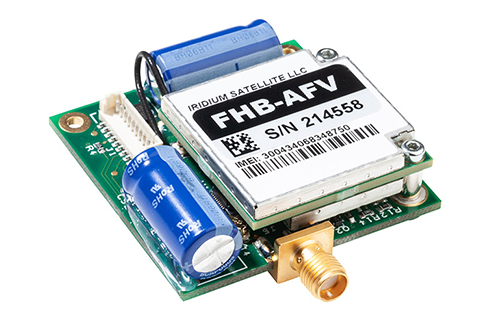
SWaP snapshot: RockBLOCK 9603 is 45 × 45 × 15 mm, 39 g (incl. antenna), max 450 mA; a good fit when you want deliver the intent with minimal payload and battery impact.
Lane 2: Larger discrete packets (IMT / RockBLOCK 9704)
Messaging becomes even more interesting when it isn’t constrained to tiny pings. With Iridium Messaging Transport (IMT), delivered via RockBLOCK 9704, you can work with larger messages (up to 100 KB). That’s enough to move more than bare minimum telemetry.
For many OEM designs, it opens the door to a straightforward pattern: collect richer data onboard (as you already do), then transmit it as structured packets – telemetry snapshots, compressed logs, payload summaries, detection events – according to a schedule and policy that fits the mission. Instead of ‘keep the pipe open’, the goal becomes ‘move the next packet when conditions allow’, with clear application logic around queueing, acknowledgement, and retry.
This approach can be a good match for how operators actually use data: many decisions don’t require millisecond streaming; they require timely, trustworthy updates that arrive consistently.
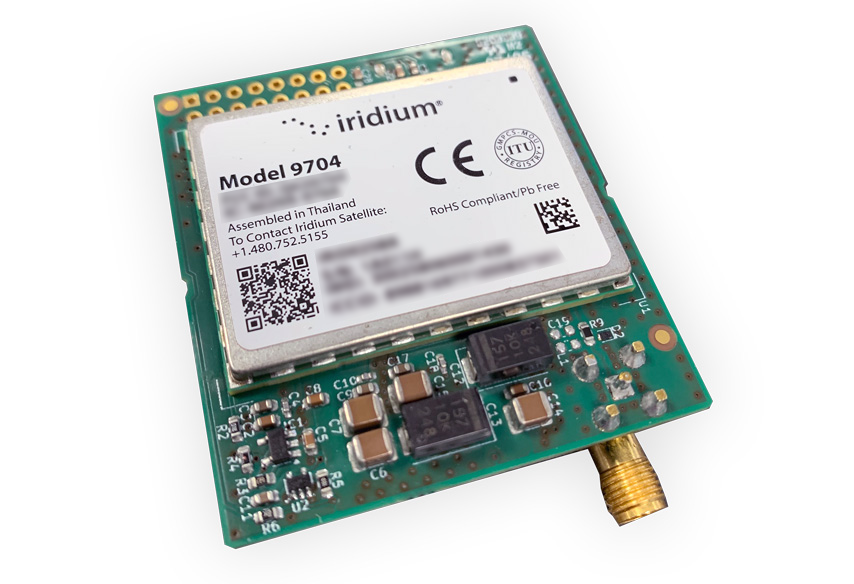
SWaP snapshot: RockBLOCK 9704 (SMA) is 48 × 52 × 16 mm, <35 g (excl. antenna), max 1.4 W; still firmly in the small and light messaging class.
Lane 3: Interactive workflows (Certus 100 / RockREMOTE UAV OEM)
When you truly need a live interactive link, IP is absolutely the right tool.
That’s where Iridium Certus 100, delivered via RockREMOTE UAV OEM, comes in. For OEMs, the appeal is flexibility at the system level: you can support an IP-based connection for interactive workflows, while also designing message-based IMT workflows for data types that benefit from queued, delivery oriented transport, without forcing every workload through a single paradigm.
The result is a more intentional architecture: interactive applications use IP when they need to, and delivery oriented data uses messaging patterns when that better matches the operational reality.
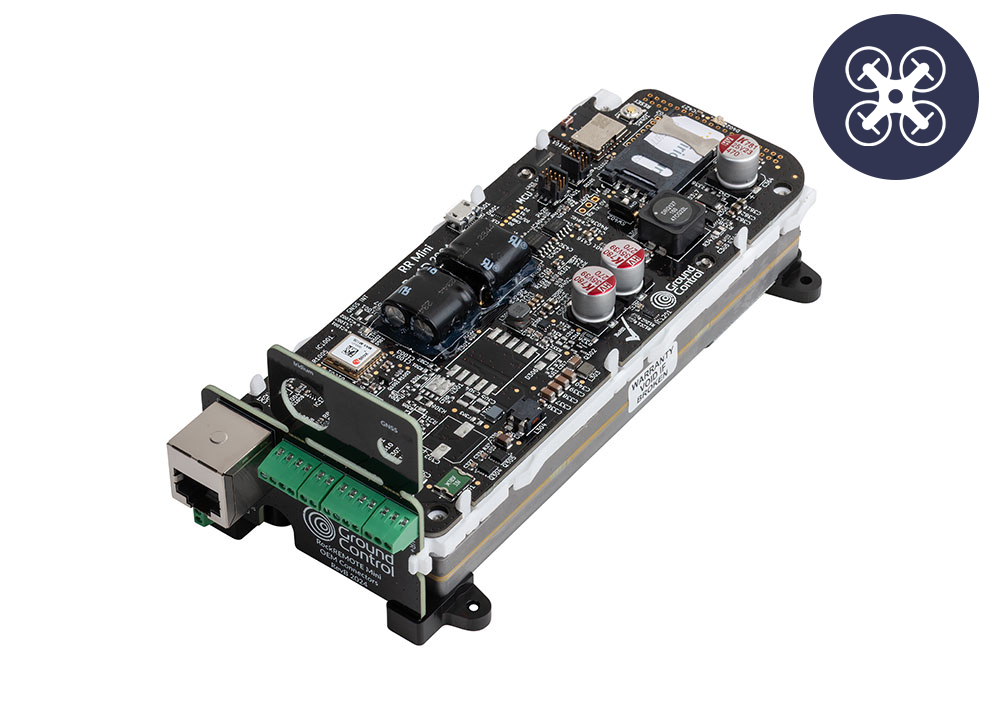
Trade-off (SWaP): RockREMOTE UAV OEM is 175 × 60 × 37 mm, 287 g, peak <1.66 A @ 12 V or <833 mA @ 24 V (≈ 20 W peak); worth it when you truly need an interactive link, but a meaningful step up in size / weight / power versus messaging modules.
The OEM Decision: What Happens During a 30 Second Fade?
Here’s a simple test that clarifies architecture decisions fast. Picture a brief period where conditions degrade: antenna orientation changes during a manoeuvre, the airframe masks sky view, or the aircraft drops behind terrain. It’s not a total outage, but the link becomes unreliable.
Now ask: what should your system do? If the data is interactive, it’s reasonable for the experience to be interrupted. The operator understands that continuous live control isn’t guaranteed in all conditions.
If the data is delivery-oriented, especially safety, health, compliance, or mission state, then the system should behave calmly: queue, send when it can, and retry according to your service behaviour and your application’s retry policy.
That’s the core difference in mindset: designing for interactivity versus designing for delivery.


Messaging

IP

Combined
The strongest OEM architectures rarely treat connectivity as one monolithic pipe. They treat it as a set of behaviors, each aligned to what the data is for.
Bottom Line: Choose by Data Type, and Design for Real Operations
IP is excellent when you need live interactivity. Messaging is well suited to delivery oriented updates when conditions are variable and you want a queued approach with an explicit retry policy. Hybrid designs let you use each where it fits best: IP for interactive moments, messaging patterns for critical updates and structured packets.
If you’re designing for real operations, and not just ideal lab conditions, message-based transport deserves consideration early in the architecture, alongside IP, rather than as an afterthought.
Disclaimer: real world performance depends on system design, antenna integration, operational environment, and service configuration; the right approach is mission- and data-dependent.

Talk through your satcom architecture with us
Email us at hello@groundcontrol.com, or complete the form, with your details and a couple of lines about your platform (airframe class, typical mission profile, and what data you need to move).
We’ll follow up with practical guidance on where SBD (RockBLOCK 9603), IMT (RockBLOCK 9704), and Certus 100 (RockREMOTE UAV OEM) fit in your architecture, and how to combine them for an operator-friendly design.