
In 2024, a nationwide AT&T outage disrupted emergency communications, and affected access to 911 services in the US. More than 25,000 attempts to reach 911 were blocked, and service was disrupted for more than 125 million devices. At the same time, multi-state 911 outages continue to occur. Increasingly, for emergency response, the issue is not just whether networks are available, but how they perform when conditions change.
For the teams responding to calls or disaster events, working with real time video, data, and mobile command environments as part of day to day operations brings a different kind of pressure. Coverage alone is no longer enough; what matters is whether the connectivity remains usable under pressure, across networks, locations, and conditions.
Operating across multiple networks such as FirstNet or commercial LTE, traditional satellite, and increasingly LEO services such as Starlink introduces new complexity and inefficiency. Those issues now need to be addressed if emergency teams are to stay reliably connected.
Why Performance Matters as Much as Coverage
You can have a strong signal and still struggle to get the performance you need. During major incidents, networks rarely fail completely; congestion builds, latency increases, packets drop, and throughput becomes inconsistent. Even with signal present, performance becomes unpredictable. The FCC has highlighted how disasters expose these types of resilience gaps.
At the same time, operational demands are increasing. With the transition to Next Generation 911 (NG911), video, images, and real time data are becoming part of standard workflows. If communication links drop, the result is video feeds that struggle to stay stable; slower or unreliable access to CAD and GIS systems; and inconsistent performance between vehicles, command posts, and field teams.
Multiple networks: LTE, 5G, LEO satellite, and legacy GEO systems, are often all in play, whether by design or through gradual adoption. And this reflects a broader shift. Managing multiple technologies and networks is now part of the operational reality. So the challenge isn’t whether there is enough connectivity. It’s how well those networks work together when it matters.
Why Failover Based Connectivity Can Fall Short
Many setups still rely on failover. One network is primary, and others act as backup. It works when a network drops completely. It doesn’t work as well when performance degrades. In most incidents, what you actually see is:
- Increasing latency
- Packet loss
- Reduced throughput
- Unstable performance.
But failover only responds once a threshold is crossed, and by then, performance has already dropped below what applications need. There’s a delay between degradation and recovery, and during that time, services like video, VoIP, and real time data are disrupted.
It also means you’re not making full use of the networks available to you. Failover reacts to failure. It doesn’t actively optimize performance, which is the key.
Adding Starlink or Multiple Networks Doesn’t Solve the Problem Alone
You may already have addressed coverage gaps by adding services like Starlink. That improves reach and bandwidth, especially in remote or hard to cover areas. But adding more networks introduces its own complexity: multiple providers and contracts, different data plans and cost models, networks with very different performance characteristics.
Without coordination, those networks sit alongside each other, rather than working together. This often leads to manual switching between connections; static rules that don’t reflect real time conditions; uneven data usage across devices, and limited visibility into what’s actually happening across the whole response setup. So while you have more connectivity available, it’s not always being used in the most effective way.
What Multi-Network Connectivity Should Look Like in Practice
The shift here is not about adding more. It’s about changing how you use existing services, managing continuous, multi-network connectivity. In practice, that means multiple connections active at the same time and traffic routed dynamically based on real time conditions.
Instead of waiting for a connection to fail, the system adapts continuously, using the most appropriate network path at any given moment, based on latency, packet loss, and bandwidth. This is the principle behind Dejero Smart Blending technology, which routes traffic across multiple connections in real time rather than switching between them.
The outcome is more consistent performance, with fewer connectivity interruptions and less need for manual intervention. Making reliability less about network uptime, and more about service usability. It supports the wider move toward IP-based emergency communications, where video, data, and voice increasingly need to work across different networks and locations. And supports what matters most: not the status of one link, which is still important, but whether the overall service remains usable and effective at all times, providing true resiliency.
How Ground Control Multipath Optimizes Connectivity
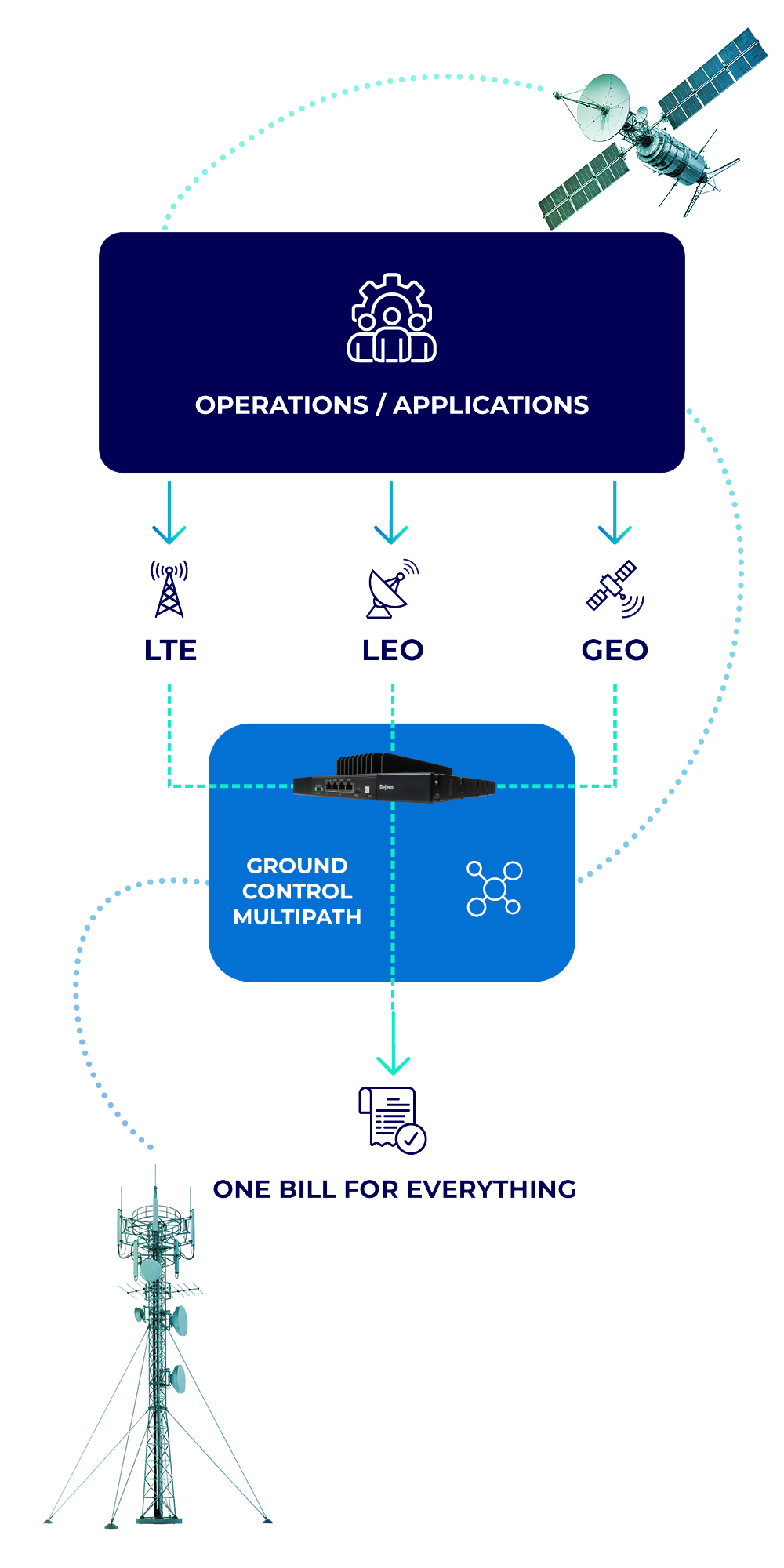
Ground Control Multipath is designed to help you bring all of your networks together into something that works as a whole. It builds on what you already have: your existing LTE and 5G connectivity, your current satellite services, including LEO and GEO, and additional capacity where it makes sense.
Those connections are then managed through a routing layer that continuously selects the most appropriate path based on real time conditions. From your perspective, that means less time managing networks individually, more consistent performance across devices and locations, shared data usage instead of isolated plans, and reduced reliance on manual failover. The goal is not to replace your existing setup; it’s to make it work more effectively as a system.
The Multipath and Dejero TITAN fit
Ground Control Multipath provides the overall solution. It’s designed around your operation, and brings your available networks together so they work more effectively as one. Dejero TITAN is the device that brings your connectivity together, helping to manage multiple live connections, ensuring a seamless switch between networks, or combining them where needed, making bandwidth usage efficient and reducing your costs. In other words, Multipath is the overall service approach; TITAN is the enabling technology that can deliver it.
What This Means for Your Operations
When your networks work together properly, you see more consistent performance across video and data services, even when individual networks degrade. You make better use of the connectivity you’re already paying for, with data shared and optimized across the deployment. And you gain confidence in how your systems will behave during an incident, not because networks don’t fail, but because your setup adapts when they do.
Most agencies now operate across multiple networks, whether intentionally or not. The next step is making those networks work together. So this is not about adding more connectivity, it is about improving how it’s used. Good coverage is no longer enough. What matters is consistent, usable performance when it matters most.

Review Your Current Connectivity Setup
If you want to make better use of the connectivity you already have, we can help. Our team offers a no cost review of your current setup to identify where performance can be improved and costs reduced. It’s a practical conversation based on how you operate today.
Complete the form or email us at hello@groundcontrol.com and we’ll get back to you within one working day.