Iridium have just announced that they’ll launch their latest satellite IoT transceiver, the Iridium 9604, in June 2026. We’re exploring how this differs from its immediate predecessor, the 9603, and its “big brother”, the Iridium Certus 9704 module.
What is the Iridium 9604 module?
Iridium 9604 is a satellite IoT transceiver that utilizes Iridium’s Short Burst Data (SBD) service to send small volumes of data from remote applications operating outside cellular coverage.
In addition to SBD the 9604 module can also transmit using LTE-M cellular connectivity, making it ideal for mobile applications that cross in and out of cellular coverage, or where cellular coverage is unreliable, so a satellite failover is beneficial. The device doesn’t force automatic switching; it’s up to application developers to enable either simple failover rules or more advanced routing logic.
The 9604 module also features integrated GNSS (multi-constellation: GPS/GLONASS/Galileo/BeiDou), making it well-suited for tracking as well as IoT applications.
What Applications are Suited to the 9604?
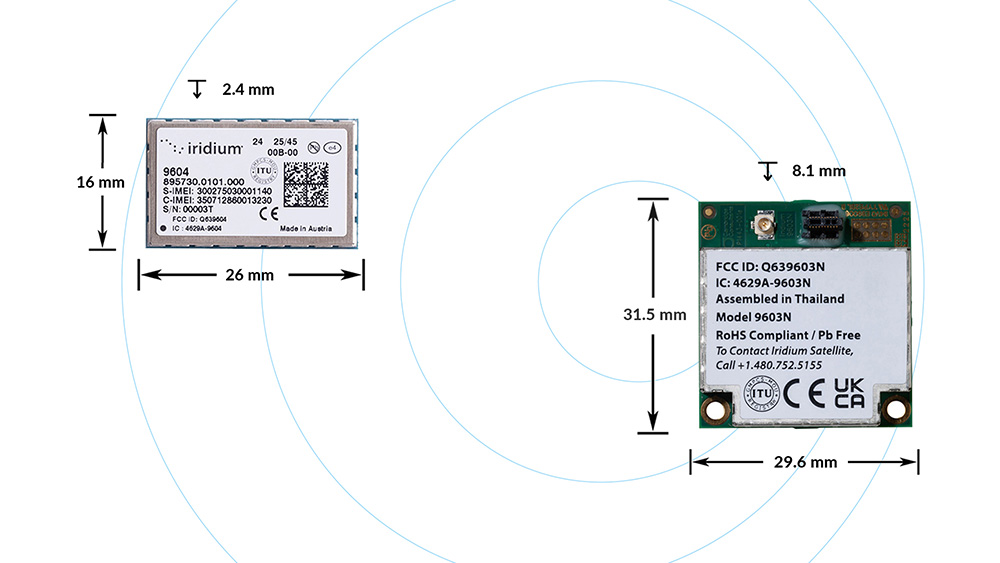
The new 9604 module is extremely small, measuring just 16 x 26 x 2.4 mm; the weight hasn’t yet been released but we can assume it will be similarly tiny. And while we don’t yet have detailed specifications,, Iridium have stated that it is designed for ultra low power applications.
Any mobile remote IoT application constrained by size, weight and power – e.g. drones/UAVs, animal tracking, data buoys, autonomous machinery – will benefit from the 9604’s form factor and dual-mode satellite/cellular capabilities.
How Does the 9604 Differ from the 9603 Transceiver?
- Connectivity: the 9603N uses Iridium SBD (340 bytes transmit; 270 bytes receive), as does the 9604, however the 9604 also adds LTE-M connectivity.
- Tracking: the 9603N needs to be paired with a separate GNSS receiver to transmit a location, whereas this capability is built into the 9604.
- Form factor: the 9603N measures 31.5 mm × 29.6 mm × 8.1 mm vs. the 9604’s 16 x 26 x 2.4 mm.
Will it be Easy to Upgrade from 9603 to 9604?
We anticipate a lot of teams will want to keep their familiar SBD workflow, but add cellular opportunism. We will be available to help make this migration process simple. And for teams outgrowing SBD message sizes, we can help make the jump from SBD to IMT.
How Does the 9604 Differ from the 9704 Transceiver?
Iridium relatively recently launched the Certus 9704 satellite IoT transceiver (December 2024), and the 9604 is not a direct competitor or successor to this device. 9604 is about hybrid connectivity for small messages, while 9704 is about bigger payloads.
The 9704 utilizes Iridium Messaging Transport (IMT), which will transmit up to 100 KB per message; up to the challenge of sending aggregated gateway data, audio, and compressed images. The 9604 uses Short Burst Data (SBD), which is intended for extremely small messages (340 bytes transmit / 270 bytes receive).
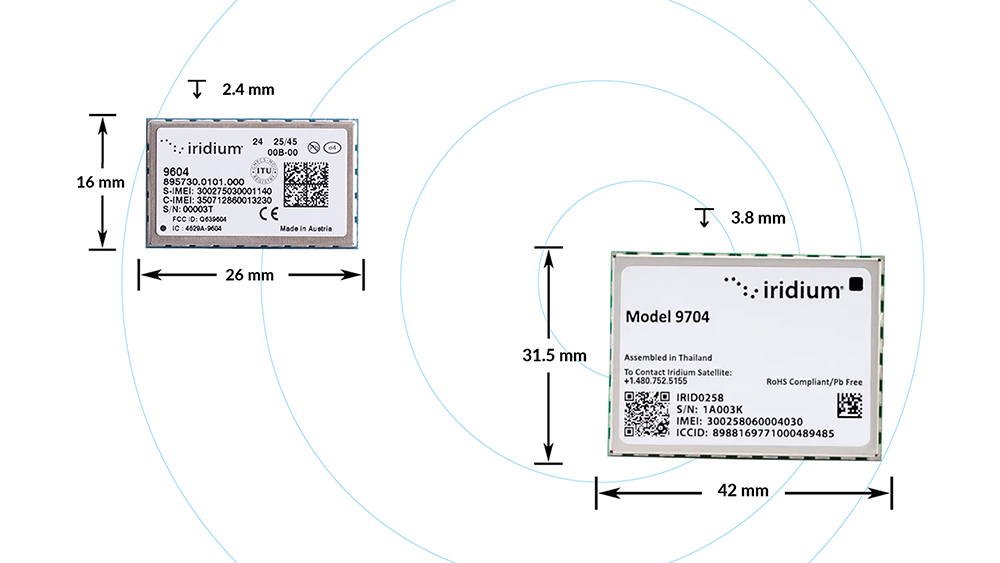
The 9704 module is larger – 31.5 mm × 42.0 mm × 3.8 mm – and does not have built-in GNSS or cellular capabilities; it is intended for fully remote deployments where you still need meaningful data volume.
Choose the 9604 if you’re sending small messages frequently; if you’ll benefit from its hybrid connectivity, and if your goal is optimized cost/performance in mixed coverage regions.
Which Devices Utilize the 9604 Transceiver?
We’re part of Iridium’s beta program, leveraging our decades of experience working with Iridium modules to build customer solutions that make it easy to benefit from the 9604’s extra capabilities – hybrid connectivity, low power consumption, and a tiny form factor.
Both the bare module and the Ground Control solutions will be integrated into Cloudloop, our cloud-based, API-first IoT platform which manages subscriptions, devices and data. Cloudloop Data is particularly useful for systems integrators, as it seamlessly routes uplinks and downlinks to your HTTPS or MQTT endpoint, and exposes a REST API and dashboard for device metadata, transmission status, and message history.

How to Get Started
We encourage you to contact us to discuss your application; we are Iridium experts, and will provide you with impartial advice on the best airtime, service and hardware to best meet your needs.
Fill in the form or email hello@groundcontrol.com, and we’ll reply within one working day.