
Given that 90% of international trade is carried by sea, maritime safety is fundamental. For most of the modern maritime era, the formula was relatively simple: assess the route, understand the threat environment, adapt operating procedures, and, when justified by risk, place experienced personnel on board to deter, respond, and protect. That approach still matters, but it is no longer sufficient.
Today, merchant shipping is delegating a far broader range of responsibilities to private maritime security companies (PMSCs). The remit is no longer limited to protection from physical threats; increasingly, it also includes support for the operational risks created by disruption to critical onboard systems. One of the clearest and fastest growing examples is navigation resilience.
For maritime security providers supporting secure fleet operations, advising owners and operators, and delivering risk-managed transit, this change is already taking shape in practice. Clients may not use the term “A-PNT” (Assured Position, Navigation, and Timing), and they may not explicitly ask for “navigation resilience”. But the expectation is there nonetheless: in the questions they raise, the incident reporting they request, and the operational standards they increasingly assume are in place. The reason is straightforward: when positioning fails at sea, it becomes a security issue whether anyone labels it that way or not.
Security Has Expanded Beyond the Physical
The biggest misconception in maritime security right now is thinking this is a niche technical issue, something for bridge teams, electronics specialists, or a ship’s IT provider, when in practice, it has become a frontline operational risk.
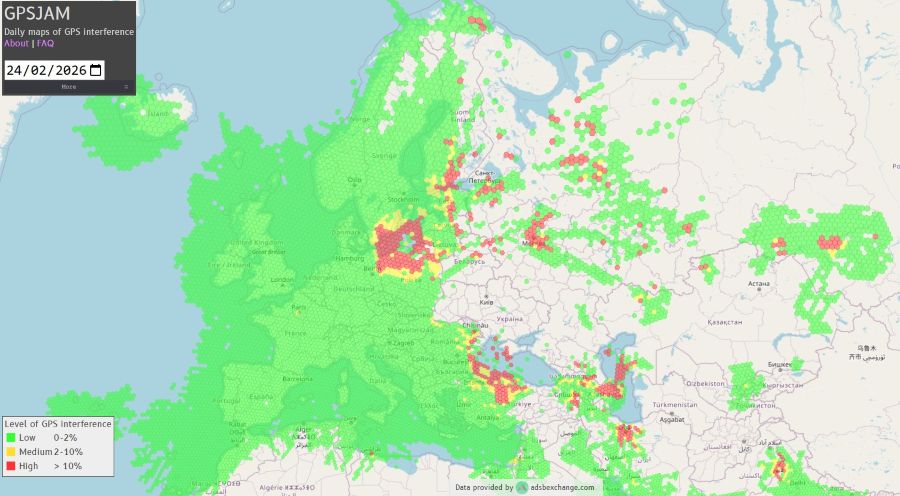
GNSS disruption, jamming, and spoofing are no longer rare anomalies confined to active conflict zones. Independent analysis by C4ADS has documented widespread maritime spoofing events affecting thousands of vessels, particularly in the Black Sea and the Middle East. Subsequent advisories from the U.S. Coast Guard Navigation Center (NAVCEN) and UK Maritime Trade Operations (UKMTO) have continued to warn of GPS interference affecting commercial traffic in multiple regions.
When a vessel loses trustworthy position and timing, the impact cascades fast. Routing decisions become uncertain, safety margins shrink, bridge teams hesitate, and in high consequence waters, uncertainty becomes vulnerability. That’s why navigation resilience is moving into the security deliverables category. Not because it’s a buzzword, but because the outcomes are security outcomes – the ability to maintain control, continuity, and confidence in the vessel’s movements. And, as shipping companies continue to lean on third party providers to manage risk, the responsibility is naturally shifting to the people who already own the security mission.
Merchant Shipping Is Outsourcing Resilience, Not Just Risk
The International Maritime Organization (IMO) has formally recognized navigation systems as part of a vessel’s cyber risk surface. U.S. Department of Transportation reporting on Complementary PNT strategies has likewise acknowledged the vulnerability of civil GPS and the need for resilient alternatives. At the same time, the operational picture has become harder to ignore. From spoofed coordinates linked to tanker incidents, to cargo vessels disappearing from satellite tracking under jamming conditions, interference with positioning and navigation is now a live operational issue.
That has direct implications for maritime security. It is no longer enough for PMSCs to track piracy patterns and regional instability. They now have to understand electronic disruption, degraded communications, cyber-enabled interference, and deliberate manipulation of navigation systems. The threat landscape is no longer confined to the physical domain; it now extends into the systems vessels rely on to operate safely.
For shipping companies, the response is familiar. When risk grows faster than internal capacity, they outsource. First that meant physical protection. Then it meant intelligence and route advisory. Now it increasingly means outsourcing resilience, especially where failure has immediate operational consequences. Navigation is one of the clearest examples.
The New Scope of PMSCs
PMSCs are increasingly being drawn into questions that would once have remained strictly on the bridge:
- What happens if GNSS becomes unreliable mid-transit?
- How quickly can we detect spoofing versus simple signal loss?
- How do we keep the bridge team confident in the vessel’s position when the primary reference is compromised?
- What proof can we provide after the fact – to the owner, to insurers, to regulators, and to internal stakeholders – that the vessel maintained safe navigation?
These are no longer theoretical or hypothetical concerns and possibilities; they’re operational questions and sit directly inside the modern security mission. Marine insurers and P&I clubs such as Allianz and Gard have already published guidance highlighting navigation system vulnerabilities as emerging operational risks. The Nautical Institute’s Mariners’ Alerting and Reporting Scheme (MARS) has also captured incident reports reflecting confusion and degraded situational awareness linked to navigation system anomalies. In many cases, the crew onboard is highly competent but not equipped with the tools or the time to manage GNSS integrity issues in a repeatable way. But it’s not a training failure – it’s an equipment and process gap.
Why A-PNT Is Becoming the Navigational Standard
The real challenge in modern navigation is not only loss of signal, but loss of trust. In a disrupted environment, the greatest risk is often not that positioning disappears, but that it appears reliable when it is in fact wrong. That is what spoofing does, and it turns navigation failure into an operational and security problem.
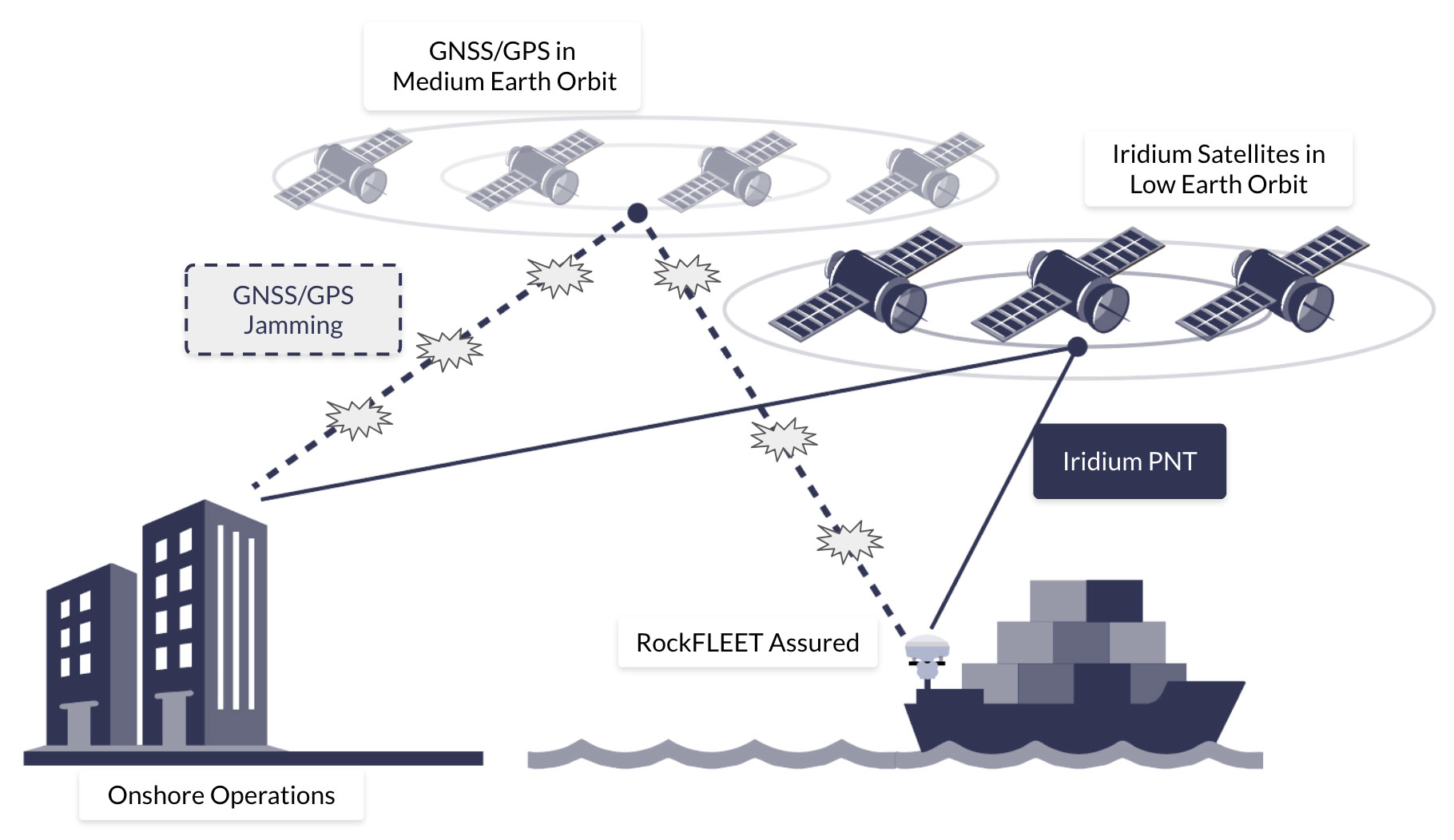
That’s why A-PNT is becoming increasingly important. It’s often not a single product or platform, but a broader resilience approach: ensuring that positioning, navigation, and timing remain dependable and verifiable when GNSS is degraded, denied, or manipulated.
Solutions such as Iridium PNT sit within that broader picture. They offer an additional means of maintaining trusted PNT in operating environments where traditional GNSS may be vulnerable to interference.
For maritime operators, that is the real shift. A-PNT is becoming less of a specialist capability and more of an operational standard, because resilience in navigation is increasingly inseparable from resilience in the voyage itself.
Where RockFLEET Assured Fits into Modern Maritime Security
RockFLEET Assured, powered by Iridium PNT, enters the market at a moment when PMSCs are increasingly expected to provide resilience as part of secure fleet operations, not just protection from physical threats.
Designed specifically for maritime deployment, the marine-grade smart antenna delivers cryptographically authenticated positioning and an assured navigation reference for vessels operating in environments where GNSS integrity cannot be guaranteed. In practice, that means an independent source of trusted position data when GPS or other GNSS signals are degraded, denied, or manipulated.
Its value is operational as much as technical. By comparing GNSS inputs with Iridium PNT outputs, RockFLEET Assured helps bridge teams and shore-based personnel identify anomalies more quickly, detect possible spoofing or jamming, and respond with greater confidence. Event data can be logged and transmitted ashore, creating a defensible record for incident review, compliance documentation, or insurer scrutiny.
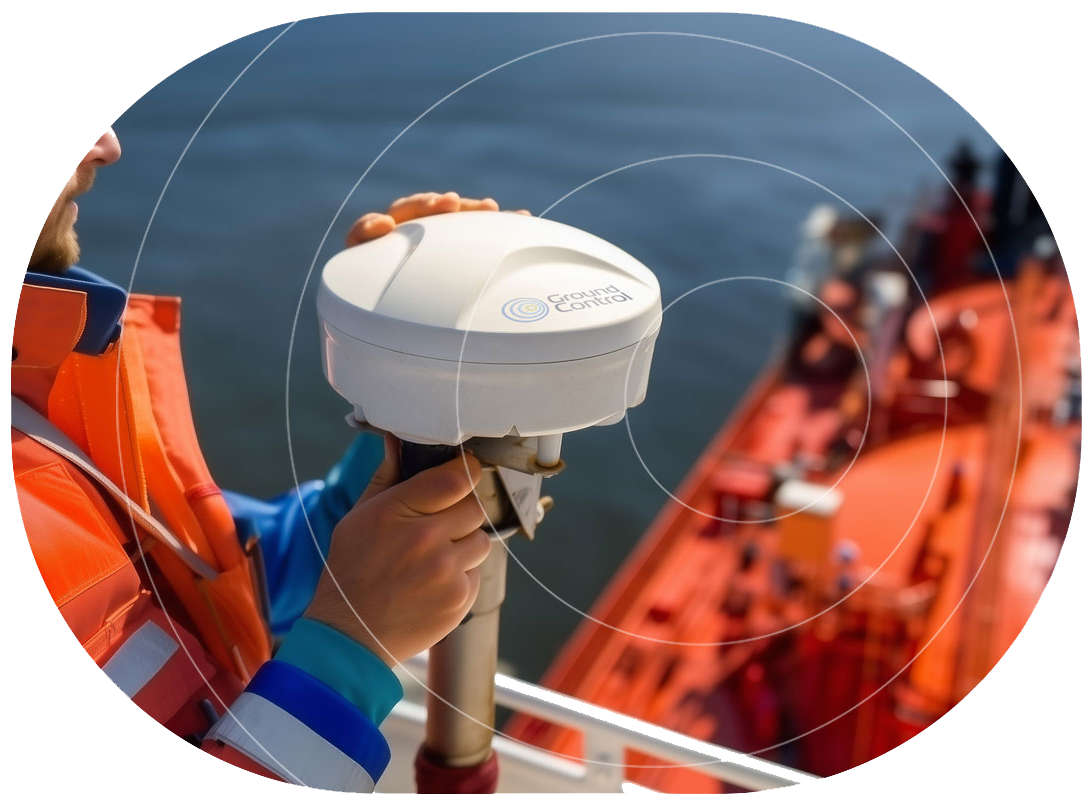
Just as importantly, it’s built for repeatable deployment at fleet level. The system is delivered as a single above-deck terminal, with mounting options to suit different vessel types and superstructure layouts, reducing the need for vessel-by-vessel customization. Its IP66-rated enclosure is designed for exposed marine conditions, and no below-deck electronics are required unless bridge view is selected.
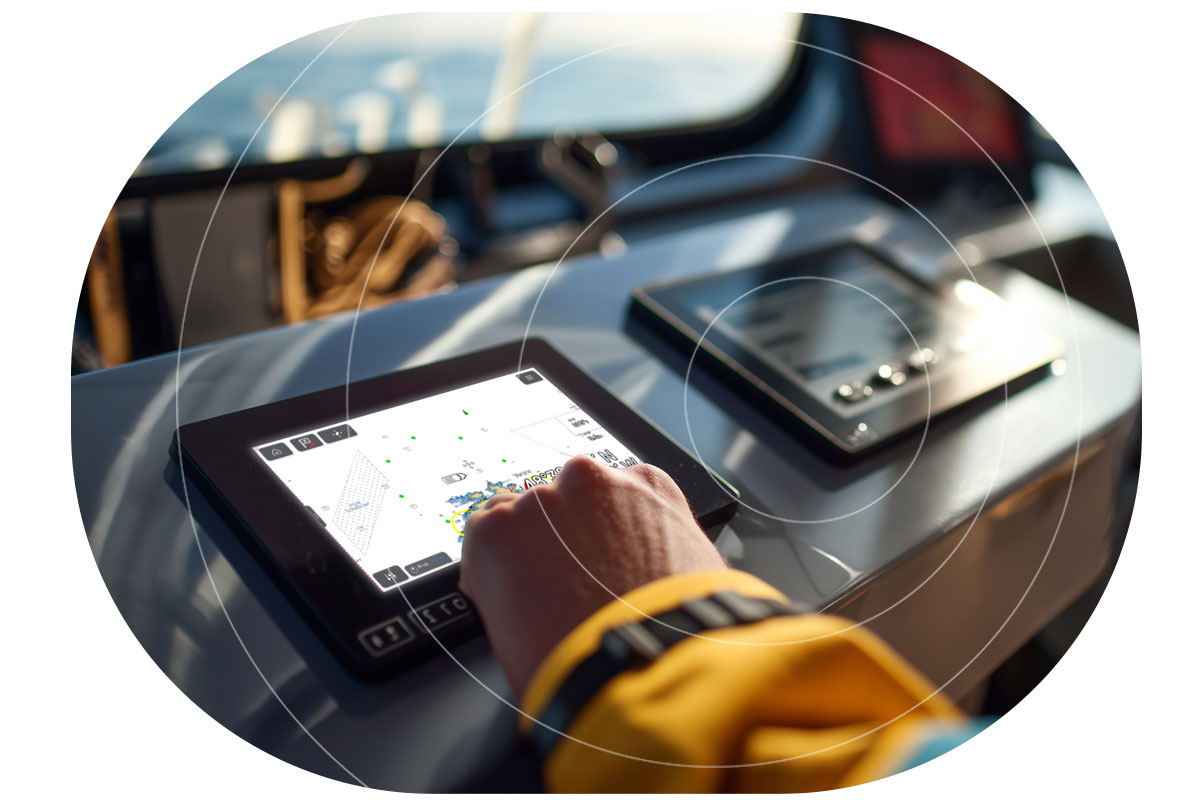
Reporting is equally flexible. Through Iridium Messaging Transport (IMT), RockFLEET Assured supports configurable position updates and secure two way messaging between ship and shore, with reporting intervals tailored to different operational requirements. Integration with Ground Control’s Cloudloop platform enables centralized fleet visibility, while API connectivity supports incorporation into existing monitoring and security systems.
Optional bridge view functionality adds another practical advantage, allowing assured positioning data to be displayed alongside standard GNSS outputs. For crews, that provides a clearer visual reference during interference events and helps reduce hesitation when rapid navigational decisions are required.
For PMSCs, that makes RockFLEET Assured a practical way to embed navigation resilience into a broader security offering. Rather than treating disruption as a vague technical failure, it helps turn it into something observable, reportable, and manageable.
What Changes Operationally for PMSCs
PMSCs often operate under heightened expectations for compliance, documentation, and professionalism. Clients – corporate security teams, fleet operators, insurers, charterers – expect measurable capability, not procedural reassurance. Without A-PNT, disruption remains ambiguous. With it, disruption becomes detectable, documentable, and defensible. That shift strengthens operational reporting, reduces decision latency on the bridge, and improves client confidence. It becomes a deliverable in a security modeland part of how PMSCs define secure fleet operations in 2026 and beyond.
The Future of Maritime Security
The maritime security industry is not abandoning its roots: physical threats still exist, high-risk areas still demand proven experience, and human expertise still matters. But the center of gravity is shifting as electronic disruption, contested signal environments, and hybrid risk become normalized features of global shipping lanes. International policy bodies, insurers, and national governments have all acknowledged this reality in recent years.
The most forward-looking maritime security providers are therefore evolving from personnel-based security offerings to layered security and resilience platforms. They are expanding into technical advisory, electronic threat awareness, and operational continuity support. They are positioning themselves as secure fleet partners, not just voyage contractors, and A-PNT is one of the cleanest, most valuable additions to that stack.
The next era of maritime security will be defined by who can keep ships operating safely and confidently when the environment becomes contested physically, electronically, and operationally. Navigation resilience is becoming a security standard because disruption is becoming the norm, so for PMSCs responsible for secure fleet operations, this is the moment to lead. The companies that adopt assured A-PNT now through solutions like RockFLEET Assured will be the ones positioned to define what security means at sea over the coming years or more.

Trusted A-PNT For Navigational Certainty at Sea
For over 20 years, we’ve delivered resilient satellite solutions for remote connectivity and secure communications. We’re proud to support commercial shipping, offshore operators, and maritime security providers with dependable satellite connectivity and assured positioning capabilities designed for the realities of the modern maritime domain.
If you want to offer A-PNT solutions as part of the security strategy for your maritime clients, complete the form, or email hello@groundcontrol.com and we’ll reply within one working day.